Electrical question?

Joined
Nov 5, 2007
Messages
11,826
City & State/Province
Dallas, TX
Ok, first, I’m not going to do this myself, I will hire an electrician. And I’m not in a hurry, I still haven’t bought a ladder or changed the lightbulbs in my 14’ ceiling.

My question:
We have a coffee maker and toaster oven on the same circuit in the kitchen. It’s a pretty nice toaster over, but if you turn the heat up above 340°, it will trip the circuit breaker. Or if it’s at 330° and you use the espresso machine, it will trip the circuit breaker.

I was just walking my dog, and saw a guy with a nice F350 diesel. Long bed, so huge truck. But he said he’s a local electrician in the neighborhood and gave me his card.

I explained the situation to him and he said he would have to run a new wire. He can’t just go from the 15amp breaker to a 20amp breaker.

Here’s my question….
Is he correct or trying to upsell me? He seemed like a decent guy and I’m thinking of calling him to fix this.

It’s been a year and I want my frozen pizza to cook faster!

No seriously, if he comes to fix this then I can have him change the lightbulbs at the same time.

I just don’t want to be taken advantage of. Which has happened almost every time I hire a contractor….almost.
 
You are drawing too much current running both at the same time.

You can't just swap the breaker the wires are also sized for the amount of current.

Do you have multiple circuits to your counter? If yes, can you move one appliance to that circuit?
No moving the appliances around won't go over very well. The rest of the countertop is on the island. It does have electricity, but I don't want the coffee maker there and I'm sure sweetie doesn't either.

In reality we don't use the toaster as an oven and coffee maker (espresso machine) at the same time. It's mostly when we use the toaster oven as an oven above 335° or 340°. You can make toast and coffee at the same time.

But thanks, this does confirm my understanding of how it works. I still might call the guy. Like I said I don’t want to pay more than necessary.
 
If you have 14 ga. wire for that circuit , it will have to be changed to 12 ga. for a 20 amp breaker to be safe. So the contractor is correct provided your house has the basic 14 ga. wire for a receptacle.
But I have to wonder if even a 20 amp breaker would hold both the coffee maker in it's brewing stage & toaster oven set on higher temps. Like Dan says, move on appliance to another circuit or wait for the coffee maker to stop brewing(the brew cycle draws the most juice, after it's done the hot plate alone draws way less.) before firing up the oven.
 
I would look at the label on the toaster oven. I'm guessing it draws more than 15A at full load. It's still an over current issue of some version, either single machine or the combo.

Anything that heats up draws a lot of current. A simple toaster, or hair dryer draw 12 or so amps.

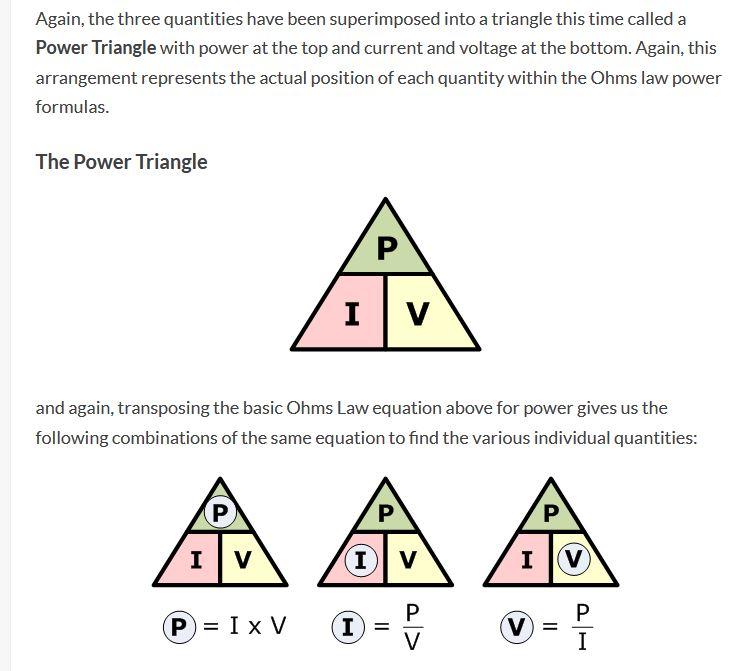
P=IV **** Power(W-Watts) = Current/Amps(I) X Volts (V) (I learned this as PIE)

from the above formula Amps = P/V

Amps = 1500/120

1500 watt appliance draws 12.5 Amps

***********


Clearer version of the formula (good for generator estimations too)

Put your finger over what you need to know. What's left is formula to figure it out.


Capturepie.JPG
 
Last edited:
As an Amazon Associate we earn from qualifying purchases. Product prices and availability are accurate as of the date/time indicated and are subject to change.
How old is your house / apartment? My place was built in the late 80's and most homes like mine back then had 20A breakers and 12ga wire but mine still trips the breaker if I use two appliances at the same time. Two 1500 watt devices are going to trip 20A.

Also a new 20A circuit needs 20A outlets added.
 
Thank you for all the feedback. It’s a house, and the kitchen was remodeled in the Fall of 2017. So brand new electrical everything as we moved a wall. Everything from outlet where you plug in the appliance to the new secondary electrical panel.

And for the life of me, I’ve looked everywhere for the sticker on the toaster oven. There isn’t one. We bought it for Christmas 2023. I’ve looked at the machine itself, the box before throwing out, and online.

When I get home I’ll post a picture of it.

The toaster oven before (still a very nice oven) could go to 400° no problem.
 
I am an electrician, haven't done residential in a long time but per NEC National Electrical Code. there are 2 required 20a small appliance circuits required for a kitchen counter. article 210.50(b) 2. sounds like your neighbor is correct.
 
To answer your question, I think he is above board and not screwing you. With that said he is really guessing until he looks. Probably a good guess but guessing none the less.

Like many have said amp draw depends on wire gauge mostly.

I bought an air compressor way back from Sears and it was 110 circuit unit (I didn't want to mess with 220). Plugged it in, turned it on, pop!
Check amps and the breaker etc and it should work. Tried again, pop.

Turned out the wire in the wall of the garage was only 14ga. Got lucky and found a drop of 10ga wire at Home Depot for cheap and ran a new outlet. Works every time.

The running amps and buy the chart in the manual seemed like it would run fine on a 15 amp circuit but the startup amps are what popped it.

Good luck.
If it was me I'd run two sets of wire and have two outlets so you can be sure to have plenty of power there. Maybe an upgrade in the future would be covered by it. Also todays labor is expensive but it won't be cheaper in the future.
 
Dan inMI and Gunzo have it right. If you want to put that much load on a single circuit you will need to run 12 gauge wire with a 20 amp breaker. You might ask the Electrician if there is any benefit to going with 10 gauge just to be safe? What do you guys think?
 
10 ga is not needed. the receptacle is only rated for 20 amps. so 12 ga wire and 20a breaker is code. i do agree with roylt as long as the electrician is there have him run 2 20a circuits sounds like the 15a in undersized for your use.
 
I am assuming the original problem outlet is 14ga on a 15a breaker which is legal but undersized for a kitchen counter
 
First thing to try is just swap breaker out. As breakers get old they some trip out before their rating. We Used Square D QO breakers everywhere. Chicken houses, shop, home, barn. They cost more but worth the extra money
Breakers do get weaker with age( sound familiar?) ,putting in a new one MIGHT help,no guarantee though..
 
I am assuming the original problem outlet is 14ga on a 15a breaker which is legal but undersized for a kitchen counter
This makes sense. The contractor we used to redo the kitchen tried their very best to cut as many corners as possible. It wasn't cheap and took about 6 months. They used sub contractors, and it was nothing short of a nightmare.

Don't even get me started how, and I was home when this happened. The City of Dallas sent an inspector over to sign off on the completed work. He was inside the house for a total of 37 seconds. I'm not making that up at all. So if the electrician used a cheaper, smaller gauge wire to save money, then that is what happened. I still complain to my wife about him.

This is why I'm sort of jaded against contractors. Except the guy who built our house down in Galveston. He was pretty great.

Again, thank you to everyone for all the help.
 
It's simply not possible to tell if you need new wire run without seeing what you currently have in the wall. If it's 14 gage, then yes you will. If it's 12 gage, you can simply replace the 15A breaker with a 20A.

I can't imagine someone would have wired a kitchen with 14A wire though. You could flip the breaker off and pull the outlet out to see what size the existing wire is.

Also, any outlet within about 6' of the sink should be a GFI outlet.
 
I don't get why it takes contractors 6 months to do a kitchen. If you have all of your needfuls on site It shouldn't take more than a week, week and a half. I honestly think they take so long to justify the rip off prices they charge.

The last time I did my kitchen I had all of the cabinets, flooring, wall board, etc. in my garage "before" I started demo. Granted I didn't make any major changes in plumbing, but did update all of the electrical. I had loaded the garage with my materials in order of use. It wasn't hard to make a plan and then stick to it. Folks, it's just taking stuff out and putting stuff back.
 
I think your question has been answered.... but the guy in the truck is probably right... he is assuming that you not only have a 15 amp breaker but the smaller wire for it. Once an electrician looks at what you have they can make sure of this... if you have 12 gage wire then you probably could get by with just upgrading to a 20 amp breaker but in reality you are better off with two circuits for what you are running... or the simple solution... just run one at a time....
 
Two circuits on the kitchen counters has been code for at least 15+ years. The microwave and refrigerator should have their own circuits too. The old way was to use the same circuit for the whole kitchen.

The simplest thing would be to add a dedicated circuit for the toaster oven.
It probably would be best to have two new circuits- one for each.

I do mostly commercial work and coffee makers use more amps than many people realize.
 
I’m surprised the toaster oven alone will trip the breaker, assuming it is a 15 amp breaker. I wonder if the original breaker isn't working properly. I’m not surprised using both at the same time on the same circuit trips it.
 
Kevin, I would buy a new toaster oven for starters..... it sounds to my uneducated mind that your toaster may be pulling too much current. My house is old (1968) ; with old electric service and 15 amp everything. All the kitchen is on one circuit... never a problem.
J.
 
If the toaster alone is tripping the breaker then I would suspect a bad breaker... easier and cheaper to replace than the toaster oven.

Oh and something interesting I learned recently from an electrician.... as we have discussed: in residential wiring.... 14gage wire uses a 15 amp breaker and 12 gage wire uses a 20 amp. for those not in the know 12 gage wire is thicker than 14 and can carry more current.... but here is the crux... in comercial applications you can use the thinner 14 gage on a 20 amp circuit. I'm wondering if this is because in commercial the wiring is in conduit ?
 
Last edited:
It's simply not possible to tell if you need new wire run without seeing what you currently have in the wall. If it's 14 gage, then yes you will. If it's 12 gage, you can simply replace the 15A breaker with a 20A.

I can't imagine someone would have wired a kitchen with 14A wire though. You could flip the breaker off and pull the outlet out to see what size the existing wire is.

Also, any outlet within about 6' of the sink should be a GFI outlet.
If it is a GFI they can wear out or they could be low cost or bargain basement ones. A new breaker and new GFI is a cheap way to trouble shoot before bringing in an electrician, The wire should be 12 ga according to code. Check that too.
 
Not enough information to answer. Need to know if the toaster oven load is in spec and need to know that gauge wire you have on that circuit. If it were my issue, I would buy and install a new breaker the same rating as what is there just to rule it out as faulty. They're cheap and easy to replace. Then I would determine the load the oven is supposed to create. If it's out of spec, I would try and get a warranty replacement if applicable. If it's in spec I would determine the gauge wiring. If too small for 20 amps, then I would hire someone.
 
Having been a licensed commercial/industrial electrician for 35 years I can think of no instance where you can use 14ga wire on a 20a breaker. The NEC is mostly the same rules residential or commercial when it comes to overload protection. most differences are on motor circuits.
 
Back
Top