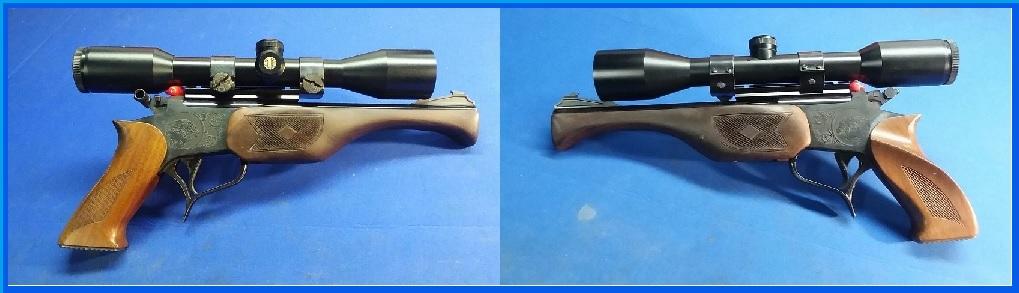
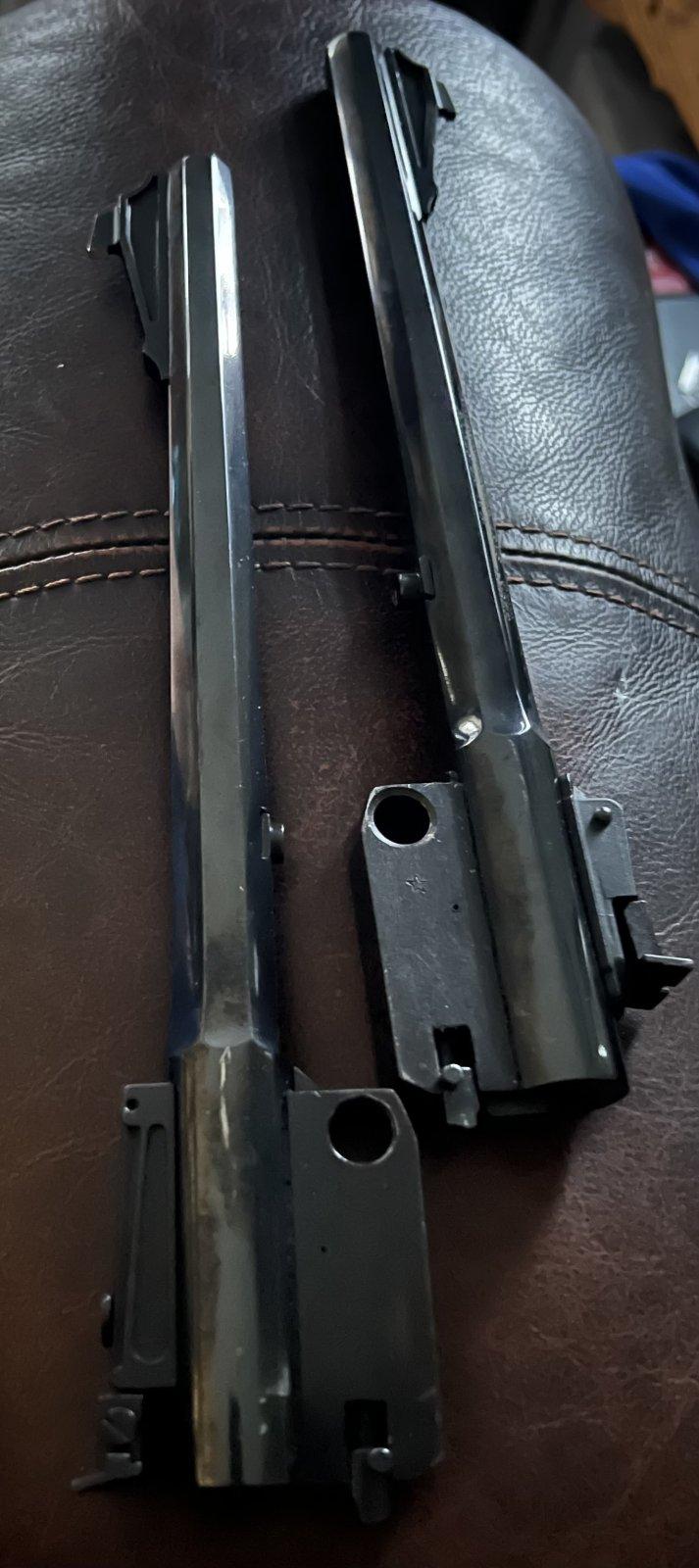
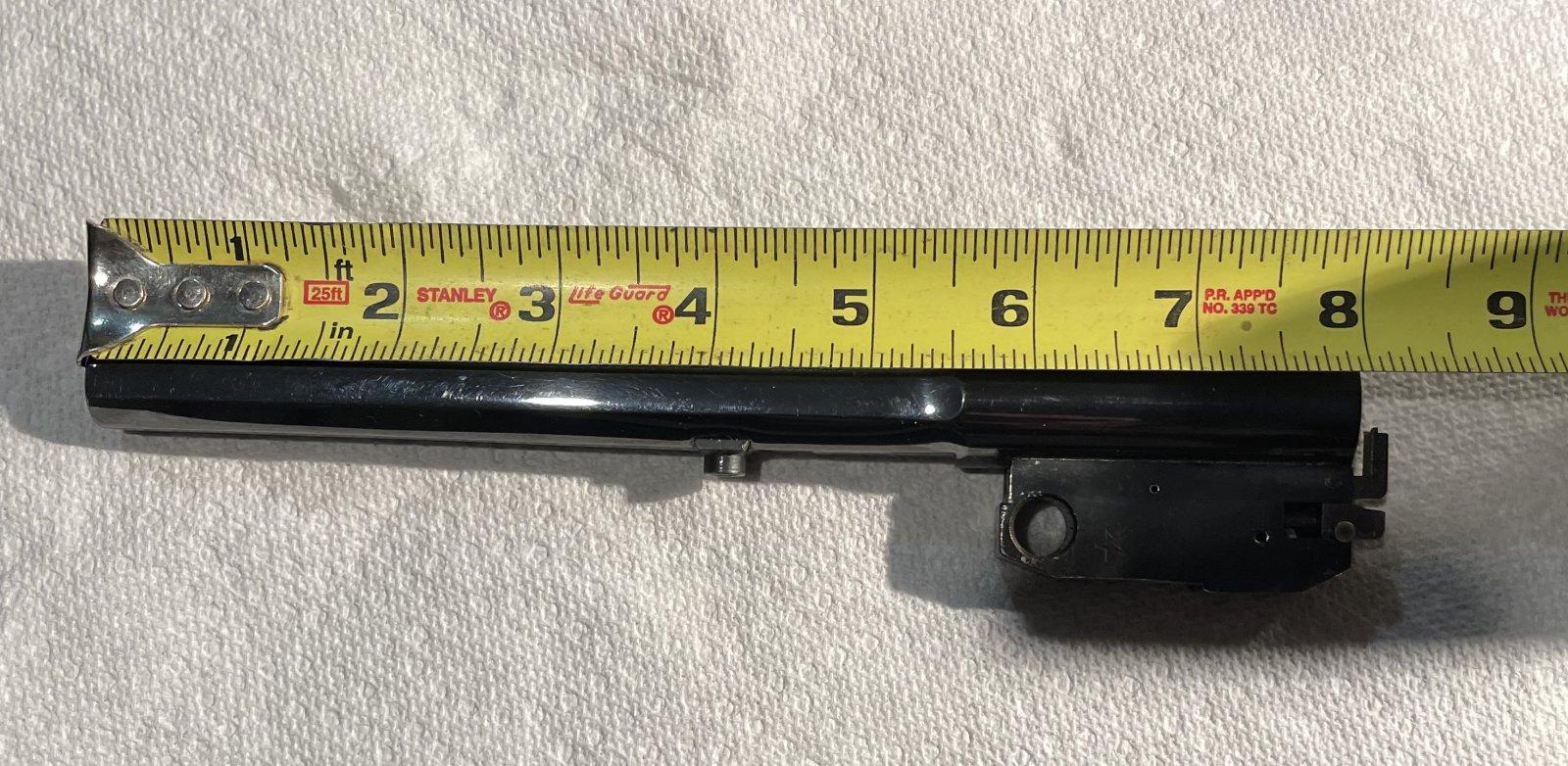
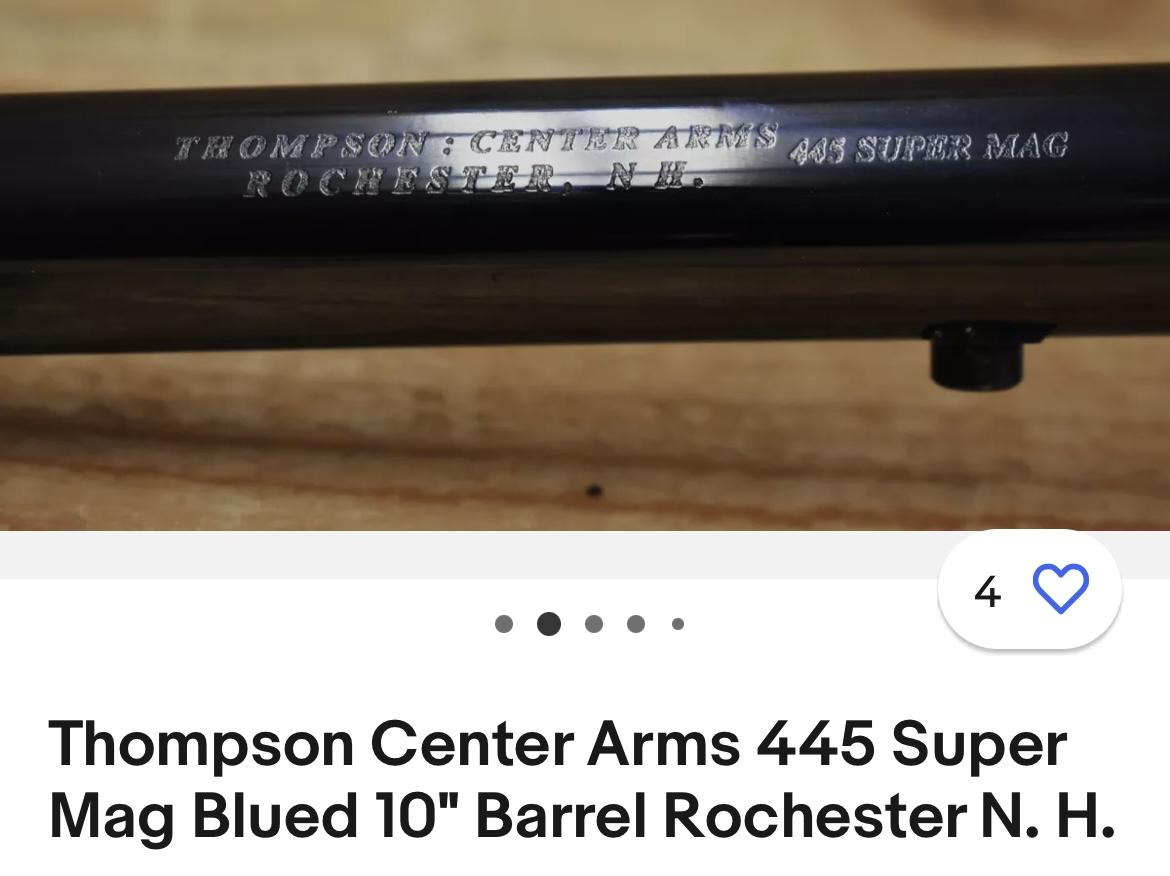
Contender Octagon Barrels

Another odd 12” octagon barrel
IMG_6058.jpeg
 
That makes sense @contender @bykerhd mentioned that too

Interesting what is/was available. Seems like the newer ones are mostly 12". @Dan in MI is probably correct.

I'll keep looking and posting what I find. Just to put them all in one place.

Thanks everyone.
 
Last edited:
Fox Ridge Outfitters was located next door to the plant I was told, although I never actually saw the T-C plant.
The building was used as an office by T-C after they closed the retail store.
No idea where the Fox Ridge stuffed Polar bear "greeter" ended up.
 
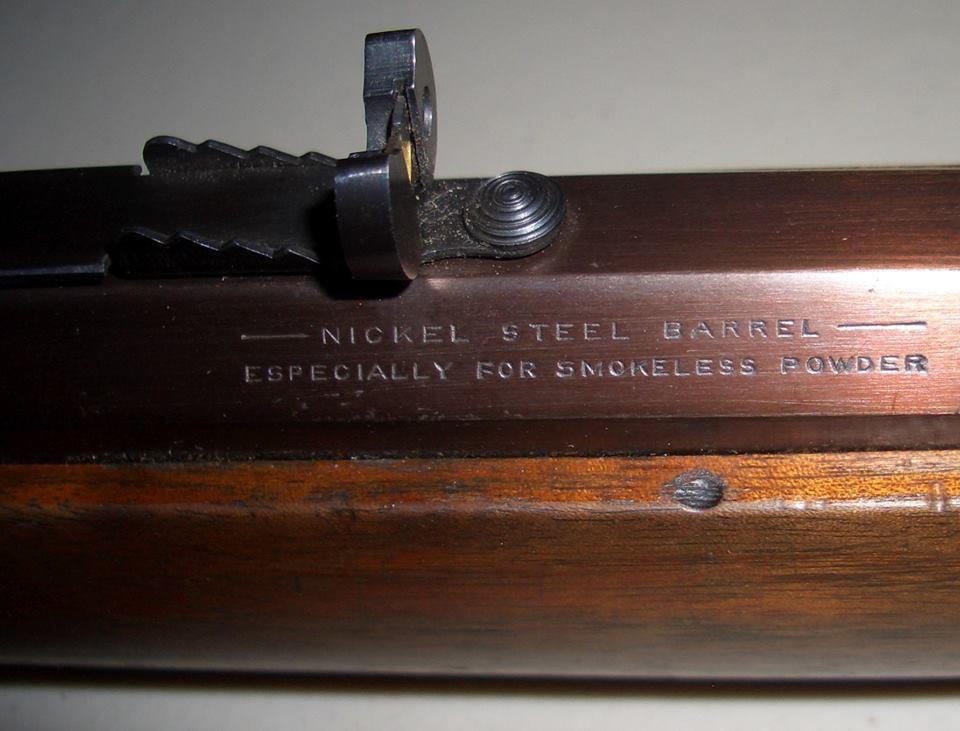
I read some time ago that originally, octagon barrels were easier to make. To make barrels lighter they started milling them to be round. Personally, I think octagon barrels look better/cooler/etc. than round barrels on rifles and revolvers. Here are my octagon barreled firearms. Henry .30-.30.
Octagon Barrel 002.JPG

Winchester 1894 mfg. in 1908 Nickel Steel Barrel
Nickel Steel Barrel.jpg
 
As an Amazon Associate we earn from qualifying purchases. Product prices and availability are accurate as of the date/time indicated and are subject to change.
Years ago on the ordering counter in the Fox Ridge store they had an octagon barrel on display.
The barrel flats were so highly polished that you could see your reflection in them.
Just a very fine example of the work they were capable of.

I ordered a heavy stainless, matt finish, 24" barrel in .223 from the Custom shop.
The new barrel was gorgeous, to me, I assembled it on an action and snapped it closed and then could not open it ?
I had to disassemble the action to remove it.
The extractor channel was chuck full of stainless steel chips !
It worked fine after cleaning out the chips but I was disappointed by the obvious goof by whoever assembled it and inspected ? the barrel.
 
@KIR I agree all octagon barrels are classy, and heavy. These Contender barrels are on another level, octagon and tapered and amazing bluing and somehow svelte. Just beautiful. They didn't have to be octagon, round and tapered would have been easier.

It makes sense that Octagon barrels became passe' after the lathe was invented. But a blacksmith could have used a round swedge block as easily as an octagonal one. I think they did it so the barrel could be put in a vise.

@bykerhd I went to the TC factory once to drop off my Renegade. Unfortunately I was only barely aware of Contenders and knew nothing about Fox Ridge. It broke my heart when I heard about the fire.

The original TC was such an awesome company. A lot like Ruger was. Owned by visionaries who did things they wanted to do even if it was outside the box and risky.
 
Last edited:
IMG_6146.png


This was listed as stainless steel. Its the first stainless octagon Contender barrel I’ve seen or heard of. It just doesn’t look right to me. Unless one of you disagrees, Im going to assume its ceracote or something similar and the seller is unaware.
 
Thompson use to offer a coating or plating ? called Armoloy ? quite a while back.
Possible that barrel was done with that ?
The Armoloy barrels could not be used on a non-Armoloy frame without modifications to the frame, as I recall.
As T-C is kaput finding someone to "fit" such a barrel might be problematic.
 
I got 2 new 10 inch octagon barrels in the mail today. .38 special and 9mm Luger. That completes my wish list. I updated the list in the first post to reflect my purchases and also ones noted later on in this thread.

I'll keep looking, but it seems this is a pretty complete list at this point. Thanks everyone.
IMG_6201.jpeg
 
This was listed as stainless steel. Its the first stainless octagon Contender barrel I've seen or heard of. It just doesn't look right to me. Unless one of you disagrees, Im going to assume its ceracote or something similar and the seller is unaware.

My dollar is on Ron Mahovsky's "Metalife" plating.

I've always wanted to plate a 10" Octagon .22LR that had been trimmed back to 8", taking the front sight with it.

Why? Because 1) I've spent too much time daydreaming about Contenders, 2) they never made that configuration in stainless (this'd be a "fabulous fake”), 3) why not?

Kind of a, “If you can dream it, we can build it!” type of thing… 😎

A person can get some strange fixations, when mulling over a subject for a long time… 🤪
 
Here is a little info I found on Contender barrels.


Type I
Term used to describe the very earliest of production Contender barrels (early 1967 to late 1967). These barrel are easily spotted by their "one line" company address and caliber designations. All Type I barrels are octagonal, have flat bottomed lugs, allen screw bolt retention and short style rear sights. To date, only six calibers are known to exist in this barrel type. They are 22LR, 22WRM, 22 Jet, 22 Hornet, 38 Special, and 357 Magnum. Type I barrels are known to exist in both 10 and 8 3/4 inch barrel lengths.

Type II
Designation given to the second style of octagonal Contender barrels (late 1967 to 1972). These barrels may be easily recognized by their two line address and caliber designations. Of further importance is the punctuation used between the "N" and the "H" used to abbreviate the words New Hampshire; both are followed by a period. (example - Rochester, N. H.). Type II barrels are also recognized by their flat bottomed lugs, allen screw bolt retention and short rear sights. Type II barrels exist in three lengths, 10 inch, 8 3/4 inch and 6 inch. These may also be found as "scope model" variations (w/o front sights). The largest selection of calibers exist within the Type II classification including all of the original 17 caliber offerings.

Type III
Third generation of octagon Contender barrels (1972-1973) possessing most of the same features as the Type II barrels, namely the flat bottomed lug, allen screw bolt retention and short rear sights, but differ ever so slightly having only one period following the abbreviation for New Hampshire (example N H.) Keep in mind, that due to the fact that rear sights are interchangeable, all barrel types may be found with incorrect styles of rear sights installed.

Type IV
The forth generation of octagon Contender barrels (1973 to 1977) look almost identical to Type III barrels. Address and caliber markings are identical, (N H. abbreviation) with both possessing the flat bottomed lug. Careful examination of the underside of the lug however will reveal the absence of the allen screw used to retain the bolt. All Type IV barrels utilize the new "roll pin" method of bolt retention. Long rear sights were used on all Type IV barrels.

Type V
Type V barrels represent pretty much the final stage in octagon barrel development (1977 to 1980's). The most readily noticeable change made to these barrels is the addition of material to the rear of the barrel lug just under the bolt which causes a step in the lug midway through length. Type V barrels will usually sport the second or third generation rear sights (long or improved style), but keep in mind that these sights are interchangeable and may not be original to the barrel. Writing styles may differ on Type V barrels as several different variations were used prior to the discontinuance of octagon barrels from the catalog. Later production Type V octagon barrels were perhaps some of the finest looking barrels ever made by Thompson / Center with their "super" high gloss blued finish and crisp barrel markings
 
Here is a little info I found on Contender barrels.


Type I
Term used to describe the very earliest of production Contender barrels (early 1967 to late 1967). These barrel are easily spotted by their "one line" company address and caliber designations. All Type I barrels are octagonal, have flat bottomed lugs, allen screw bolt retention and short style rear sights. To date, only six calibers are known to exist in this barrel type. They are 22LR, 22WRM, 22 Jet, 22 Hornet, 38 Special, and 357 Magnum. Type I barrels are known to exist in both 10 and 8 3/4 inch barrel lengths.

Type II
Designation given to the second style of octagonal Contender barrels (late 1967 to 1972). These barrels may be easily recognized by their two line address and caliber designations. Of further importance is the punctuation used between the "N" and the "H" used to abbreviate the words New Hampshire; both are followed by a period. (example - Rochester, N. H.). Type II barrels are also recognized by their flat bottomed lugs, allen screw bolt retention and short rear sights. Type II barrels exist in three lengths, 10 inch, 8 3/4 inch and 6 inch. These may also be found as "scope model" variations (w/o front sights). The largest selection of calibers exist within the Type II classification including all of the original 17 caliber offerings.

Type III
Third generation of octagon Contender barrels (1972-1973) possessing most of the same features as the Type II barrels, namely the flat bottomed lug, allen screw bolt retention and short rear sights, but differ ever so slightly having only one period following the abbreviation for New Hampshire (example N H.) Keep in mind, that due to the fact that rear sights are interchangeable, all barrel types may be found with incorrect styles of rear sights installed.

Type IV
The forth generation of octagon Contender barrels (1973 to 1977) look almost identical to Type III barrels. Address and caliber markings are identical, (N H. abbreviation) with both possessing the flat bottomed lug. Careful examination of the underside of the lug however will reveal the absence of the allen screw used to retain the bolt. All Type IV barrels utilize the new "roll pin" method of bolt retention. Long rear sights were used on all Type IV barrels.

Type V
Type V barrels represent pretty much the final stage in octagon barrel development (1977 to 1980's). The most readily noticeable change made to these barrels is the addition of material to the rear of the barrel lug just under the bolt which causes a step in the lug midway through length. Type V barrels will usually sport the second or third generation rear sights (long or improved style), but keep in mind that these sights are interchangeable and may not be original to the barrel. Writing styles may differ on Type V barrels as several different variations were used prior to the discontinuance of octagon barrels from the catalog. Later production Type V octagon barrels were perhaps some of the finest looking barrels ever made by Thompson / Center with their "super" high gloss blued finish and crisp barrel markings
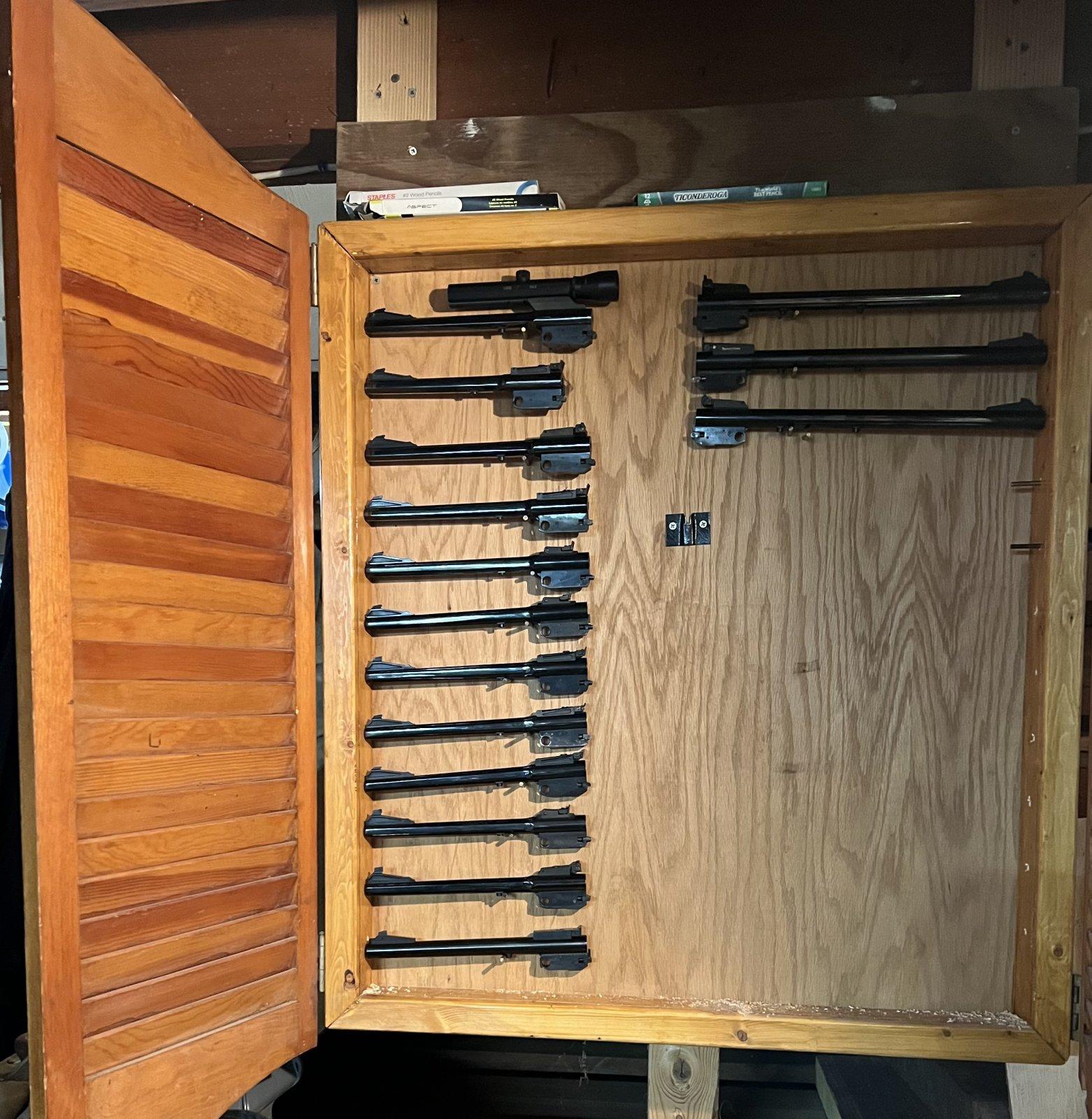
Buster, thanks for the excellent info on the Contender Octagon barrel progression and identification.
 
Excellent info on the Contender barrels. I have seen a similar breakdown in some of my older stuff at some point. I think I need to copy it this time & place it in my Contender catalog books.

Neat storage of the barrels.

I saw a Contender display set-up similar to that on another web site but passed on buying it because it wouldn't fit my safe,, and didn't have space for all my barrels.
 
SWEET!!!!!!!!!!!!!

I recently saw a .9mm barrel for a T/C. I passed as I felt it was over-priced!
9mm, whether octagon(preferred) or 10" bull is on my want list, if I ever find one at a halfway reasonable price, or maybe even a bit unreasonable ?
Cheap to shoot, at least compared to anything except .22 LR. No reloading required, unless really, really wanted.
I had a .22 LR 10" bull barrel and it was... boring ?
I need a bit of oompph when I pull the trigger.
 
I paid close to $400 with shipping for mine.

The 9mm and .45acp are both hard to find and are priced accordingly.

It's rare now for any octagon barrel to sell for less than $275. They aren’t making anymore of them
 
Kittery Trading Post in Kittery Maine use to be a reliable source for used Contender and Encore barrels.
I bought an octagon .357 Contender barrel with one of the old Bushnell Phanton scopes for about ? $ 275 3 or 4 years ago.
Virtually nothing there last year when I stopped in.
Progress ? I guess.
 

Latest posts

Back
Top