
I have a NM Blackhawk that needs a 45 Colt cylinder, Can I use an OM cylinder to fit it. I've found a 44 Magnum cylinder that I want to bore out to 45, however, I don't know if it is a OM or NM cylinder. Will this work. The seller is unable to tell what edition the 44 mag cylinder is. Thanks for your help! Anyone has a 45 Colt cylinder for sale? Bought the gun with the ACP cylinder, guy had lost the Colt cylinder and at the time it was the ACP I was looking for.

You are using an out of date browser. It may not display this or other websites correctly.
You should upgrade or use an alternative browser.
You should upgrade or use an alternative browser.
45 Colt Cylinders on Blackhawks OM vs, NM
- Thread starter Zeke38
- Start date


I believe the OM 44 and 45 cylinder are recessed head chambered while the NM cylinders are not recessed. Fitment would depend on lengths of the cylinder and the cylinder window.I have a NM Blackhawk that needs a 45 Colt cylinder, Can I use an OM cylinder to fit it. I've found a 44 Magnum cylinder that I want to bore out to 45, however, I don't know if it is a OM or NM cylinder. Will this work. The seller is unable to tell what edition the 44 mag cylinder is. Thanks for your help! Anyone has a 45 Colt cylinder for sale? Bought the gun with the ACP cylinder, guy had lost the Colt cylinder and at the time it was the ACP I was looking for.
I also think some of the first NM revolvers came out with OM recessed head cylinders.
Someone who knows for certain will chime in soon.
Tim
Often times the difference is the gas ring in the front of the cylinders, New Models have a barrel "set back" deeper so the ring is LONGER on the new Models........as well as noted above the chamber recess............

Thanks you guys, the 44 Cylinder I was looking at I can now say was an OM. You just saved me so money. I contacted Ruger CS when I first purchased the pistol I called Ruger CS and they advised they weren't doing "cosmetic gunsmithing" at the moment. Ruger CS did verify that the 45 left the factory as a convertible, so that's good.

Indeed, that is excellent news. I’d pay Ruger the $10 for a factory letter; especially if your gun has the 4 5/8” barrel. Someone here said they made fewer of those than they did the 44 flattops!Ruger CS did verify that the 45 left the factory as a convertible, so that's good.
Congratulation, this one will surely increase in value for you.


As an Amazon Associate we earn from qualifying purchases. Product prices and availability are accurate as of the date/time indicated and are subject to change.

contender
Ruger Guru
"Indeed, that is excellent news. I’d pay Ruger the $10 for a factory letter; especially if your gun has the 4 5/8” barrel. Someone here said they made fewer of those than they did the 44 flattops!
Uhh,, re-read the OP,,,, he has a NM gun, not an OM. He did find an OM cylinder.
As for a letter,, it helps for the Old Models moreso than the new models.
Uhh,, re-read the OP,,,, he has a NM gun, not an OM. He did find an OM cylinder.
As for a letter,, it helps for the Old Models moreso than the new models.

contender
Ruger Guru
You didn't create a stir,, at all. Quite the contrary,, you got your answers,, !
hittman only did something I've been guilty of as well,,, mis-reading a post. We are all good!
He IS correct in the fact that in the OM 45's,, there were fewer of those built than the OM .44 Ft handguns. Those OM 45's do enjoy a premium,, and especially those that are convertible or that were shipped with a grass g/f. THOSE need a letter to confirm their "as shipped" condition.
On your NM,, yes,, it sure does look like it likes the ACP cylinder. You do need to find a NM Colt cylinder to match.
You now know what to look for,, (the length of the cylinder boss,) but one thing not mentioned was to take your ACP cylinder,, measure the OAL. Buy a Colt cylinder the same length or a few thousands longer. You can then hone down the boss to fit yours if necessary.
Luckily,, the way those were built,, the timing of the cylinder isn't often (almost never) an issue.
Go on a hunt for a NM 45 Colt cylinder. Expect to pay $125-$150 for one.
hittman only did something I've been guilty of as well,,, mis-reading a post. We are all good!
He IS correct in the fact that in the OM 45's,, there were fewer of those built than the OM .44 Ft handguns. Those OM 45's do enjoy a premium,, and especially those that are convertible or that were shipped with a grass g/f. THOSE need a letter to confirm their "as shipped" condition.
On your NM,, yes,, it sure does look like it likes the ACP cylinder. You do need to find a NM Colt cylinder to match.
You now know what to look for,, (the length of the cylinder boss,) but one thing not mentioned was to take your ACP cylinder,, measure the OAL. Buy a Colt cylinder the same length or a few thousands longer. You can then hone down the boss to fit yours if necessary.
Luckily,, the way those were built,, the timing of the cylinder isn't often (almost never) an issue.
Go on a hunt for a NM 45 Colt cylinder. Expect to pay $125-$150 for one.

- Joined
- Dec 9, 2013
- Messages
- 463
Bought a recently made stainless .44mag Super Blackhawk with the non fluted cylinder, prefer the fluted ones. Found a fluted .44 mag cylinder couldn't use it because some where along the way Ruger changed the ratchet size/spacing on the back of the cylinder. Be sure to check the ratchet on the cylinder to verify they are the same. It fit and functioned fine on my older new model Supers just not the newer one??
This Bisley .45 Colt cylinder was a perfect drop in fit for my .45 convertible Blackhawk.
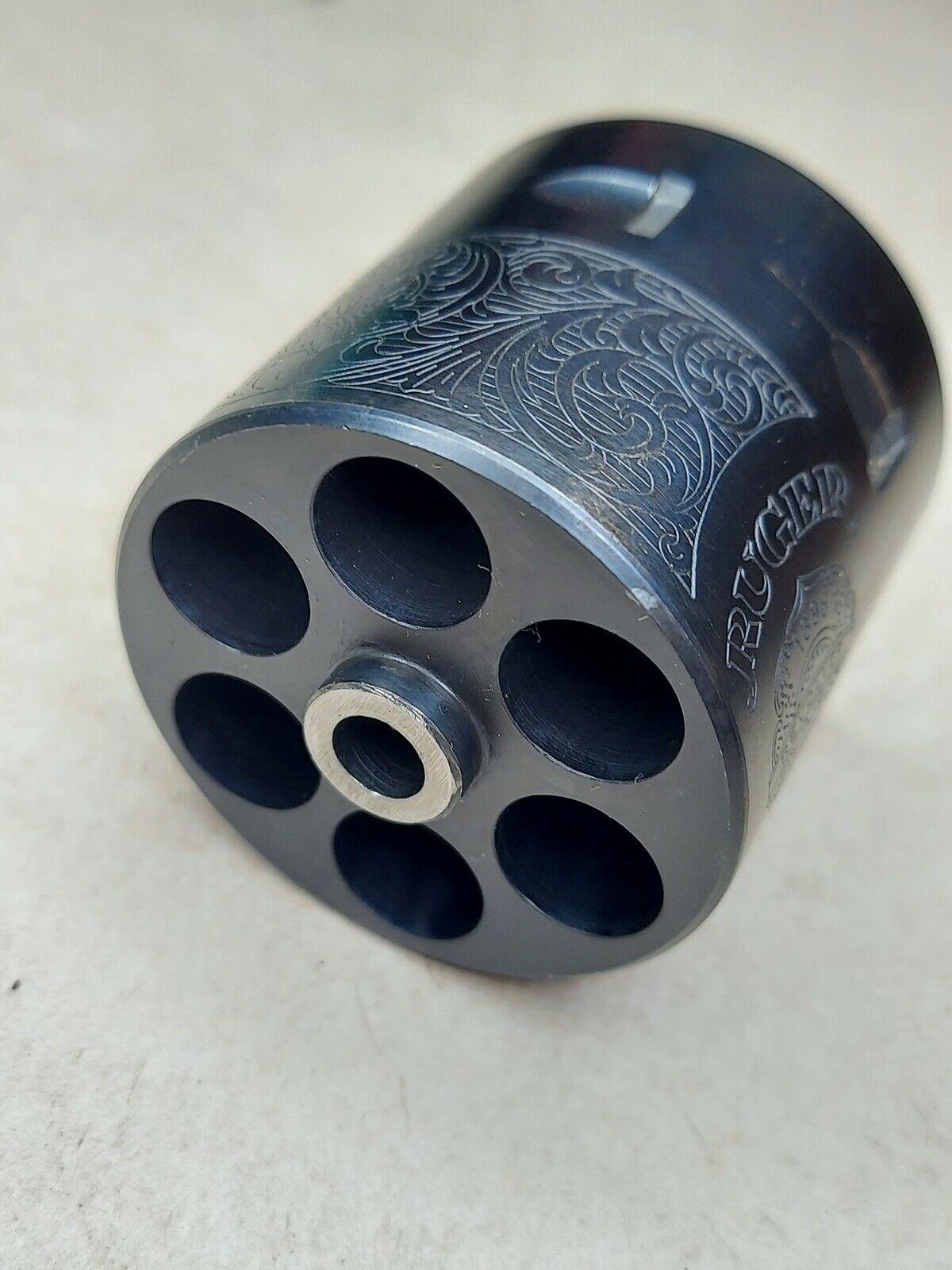
This Bisley .45 Colt cylinder was a perfect drop in fit for my .45 convertible Blackhawk.
Hondo44
Hawkeye
The cyls are not heat treated. And heat treating would just spoil the blue finish.If you do this you might want to re heat treat
Barrels and cylinders are not machined from castings, but are produced from bar stock or forgings, depending upon the gun model. Barrels and cylinders are generally heat treated to Rc35 Min at Ruger, whereas other makes are typically 20-24. Ruger frames are generally Rc 28-35, whereas a lot of S&W frames used in the Model 10 and similar guns won’t even register on the C scale, but may be around 80-90 on the B scale. Depth of hardness will be machined out of chambers. Ruger cylinders are heat treatedThe cyls are not heat treated. And heat treating would just spoil the blue finish.
https://www.grantcunningham.com/2012/03/ed-harris-on-metallurgy-for-firearms/
http://www.modernapplicationsnews.com/articles/m0401stainless.htm

crstrode
Blackhawk
:-OIf you do this you might want to re heat treat
Hondo44
Hawkeye
I should have been more specific. Cyls are not heat treated after reaming for a different cartridge. Cyls are not annealed for rechambering, the reaming does not affect the factory heat treatment, and therefore re-heat treating would only degrade the original factory heat treatment quality. Heat treatment doesn't have a depth of hardness, it's the same all the way through; it's not to be confused with case hardening. Rechambering reamers are sufficiently hardened and durable to be able to ream heat treated cyls.Barrels and cylinders are not machined from castings, but are produced from bar stock or forgings, depending upon the gun model. Barrels and cylinders are generally heat treated to Rc35 Min at Ruger, whereas other makes are typically 20-24. Ruger frames are generally Rc 28-35, whereas a lot of S&W frames used in the Model 10 and similar guns won’t even register on the C scale, but may be around 80-90 on the B scale. Depth of hardness will be machined out of chambers. Ruger cylinders are heat treated
https://www.grantcunningham.com/2012/03/ed-harris-on-metallurgy-for-firearms/
http://www.modernapplicationsnews.com/articles/m0401stainless.htm
Just FYI . . . RENE shows the following last serial numbers for the two guns . . .
OM .44 Flattop = 29860 (pre-prefix numbering, 1956-1962)
OM .45 Blackhawk = 45-23031 (prefix numbering, 1971-1973)
Love the OM .45's! ;)
OM .44 Flattop = 29860 (pre-prefix numbering, 1956-1962)
OM .45 Blackhawk = 45-23031 (prefix numbering, 1971-1973)
Love the OM .45's! ;)
Last edited:
I have a NM Blackhawk that needs a 45 Colt cylinder, Can I use an OM cylinder to fit it. I've found a 44 Magnum cylinder that I want to bore out to 45, however, I don't know if it is a OM or NM cylinder. Will this work. The seller is unable to tell what edition the 44 mag cylinder is. Thanks for your help! Anyone has a 45 Colt cylinder for sale? Bought the gun with the ACP cylinder, guy had lost the Colt cylinder and at the time it was the ACP I was looking for.
The only way is to get cylinder, see would it fit, or fit it, try to cycle revolver and check bore alignment.
Some 25 years ago we were at fellow shooter's house, just after returning from the range. Our host mentioned that he purchased 3 screw Blackhaw in 30 Carbine. My friend pulled out his Ruger Flattop in 44 Magnum, and suggested to try to swap cylinders, to see would they fit. To our amazement, 30 Carbine cylinder had perfect fit in 44 Magnum Flattop, and 44 Magnum cylinder had also perfect fit in 30Carbine revolver. Both revolvers cycled normally, no hard turning or sloppiness in the frame, even cylinder to barrel gaps looked fine. Conclusion was never to have those two revolvers same time on same facility.
Thanks Doc for links for excellent articles! I knew about steels for SRH 454, but first one was real eye opener, even for me, BSME, quite familiar with metal machining and cutting tools.
BamaGreg
Bearcat
Good info
It is my understanding that Ruger gets long rods from the steel mill via rail car, this is what they machine cylinders out of. It is heat treated at the factory, but I must truthfully say, it is VERY inconsistent! Hardness varies greatly, and there seems to be absolutely no rhyme or reason to this anomaly. I have been reaming and now honing cylinders for years, probably the 44 and 45 cylinders I have done are in the thousands.I should have been more specific. Cyls are not heat treated after reaming for a different cartridge. Cyls are not annealed for rechambering, the reaming does not affect the factory heat treatment, and therefore re-heat treating would only degrade the original factory heat treatment quality. Heat treatment doesn't have a depth of hardness, it's the same all the way through; it's not to be confused with case hardening. Rechambering reamers are sufficiently hardened and durable to be able to ream heat treated cyls.
It is VERY common to start reaming a 45 Colt cylinder with a Manson reamer, and have half the throats, the throats on one side of the cylinder ream normally, and the other half of the throats you think you are going to literally twist the shank of the reamer right off. The reamer will be extremely difficult to turn, it will often SQUAWK loudly, and I have had to beat the reamer through to finish the throat 3-4 times.
The end result of this unfortunate learning is that the throats in the harder side of the cylinder are smaller in diameter than the throats on the other side of the same cylinder that reamed in the normal way. I have tried to pass a .452" gage pin through the throat that I just beat the .4525" reamer through, and it wouldn't even start. Go figure!
Quite mystifying if you ask me! Reamers made of HSS will actually crush, if you look the flutes are not perpendicular to the center, and the cylinder, if it is hard enough, and you force the reamer, it WILL go through the hole, but it won't be the size you think it should be.
Some fellas get lucky, they ream their own cylinders and have 3 or 4 Blackhawks in 45 Colt that the reaming operation goes smoothly. And then there are the ones that buy the reamer and the pilots and the first couple of throats they try to ream turns into a wakeup call from hell when the brand new reamer won't cut the cylinder like it should. Welcome to Ruger's heat treat fellas, it is all over the map.
For this exact reason I gave up reaming cylinder throats and invested in a Sunnen precision automotive hone. It is stepless, there is no fixed size, you adjust it to hone to whatever diameter you choose, keep checking with gage pins, etc, until the final diameter pin goes through the throat.
Do I notice the same varying hardness with the Sunnen? Of course. It takes a BUNCH longer to hone those hard throats, but the end result is that they can be honed within a couple of tenths of a thousandth of each other, this right here, is the goal, consistent throat diameters.
Having consistent throat diameters is the single most important thing about any revolver cylinder.
This CANNOT be done with a reamer, UNLESS you just luck out and that cylinder doesn't have any significant variation in hardness from one throat to another. I would say these even tempered cylinders would account for roughly 65% of the total production in 45 caliber, while the other 35% have hard spots and throats won't come out the same size when using a reamer.
Let me also add this.. Ruger used to use a Hitachi machine with 3 chucks and they would gang ream 3 holes, index over one hole and plunge the other 3. As reamers wore, they would replace the worn ones and if the other two were still serviceable, they would keep using them until one wears enough that it needs replacing, so it was very common that a cylinder would get reamed with 3 different sized reamers, each reamer would cut a "pair" of throats, adjacent to each other, and you would have a cylinder with 3 pairs of throats of varying diameter. It was the norm to find a 70s or 80s Super Blackhawk with a pair of .429" throats, a pair of .430" throats and a pair of .4325" throats because that reamer had been just recently replaced, it was new, and cut larger holes than the other two worn reamers.
You can also figure in the variations in hardness of the cylinder blanks as described above, and this would also attribute to varying throat diameters. Throats in the normalized steel of the blank are larger than the throats in the harder steel, all in the same cylinder.
Bottom line? At least they didn't punch them out one size fits all, they have been notorious about having tight cylinder throats, but this leaves metal in the throat that we can custom tailor to fit our needs. If Ruger did this? People wouldn't complain about cylinder inconsistencies, but then the price of the guns would be double.
Last edited:
^^^^THIS^^^^ :)
I have had several blue Ruger .45 cylinders reamed by a professional 'smith of my acquaintance. We discovered that the throat sizes varied all over the place in a single cylinder, some starting out as small as 0.448" and not even round. We also noted that after reaming there would be the occasional "bulge" in a chamber that the reamer wouldn't touch, as if there had been a hollow or "bubble" in the metal. :oops:
I have had several blue Ruger .45 cylinders reamed by a professional 'smith of my acquaintance. We discovered that the throat sizes varied all over the place in a single cylinder, some starting out as small as 0.448" and not even round. We also noted that after reaming there would be the occasional "bulge" in a chamber that the reamer wouldn't touch, as if there had been a hollow or "bubble" in the metal. :oops:
Last edited:
I suspected long time ago, since I fired first shots from my 357 Magnum Bisley, that Ruger was using machine head with 3 reamers. I was getting 3 different, clearly visible, groups all the time. Each group (2 shots) was about 1" on 25 yards, however, whole group (6 shots) was 2.5"-3". After just few months I sold that 357 Magnum Bisley, just too large and too heavy revolver for a such caliber. Several weeks after I found 41 Magnum Bisley, and never looked back....Ruger used to use a Hitachi machine with 3 chucks and they would gang ream 3 holes, index over one hole and plunge the other 3. As reamers wore, they would replace the worn ones and if the other two were still serviceable, they would keep using them until one wears enough that it needs replacing, " throats and a pair of .4325" throats because that reamer had been just recently replaced, it was new, and cut larger holes than the other two worn reamers.
CAJUNCHEF
Single-Sixer
Thanks Doug Guy, I have been thinking of reamed Ruger BlackHawk cylinder to .45 ACP.It is my understanding that Ruger gets long rods from the steel mill via rail car, this is what they machine cylinders out of. It is heat treated at the factory, but I must truthfully say, it is VERY inconsistent! Hardness varies greatly, and there seems to be absolutely no rhyme or reason to this anomaly. I have been reaming and now honing cylinders for years, probably the 44 and 45 cylinders I have done are in the thousands.
It is VERY common to start reaming a 45 Colt cylinder with a Manson reamer, and have half the throats, the throats on one side of the cylinder ream normally, and the other half of the throats you think you are going to literally twist the shank of the reamer right off. The reamer will be extremely difficult to turn, it will often SQUAWK loudly, and I have had to beat the reamer through to finish the throat 3-4 times.
The end result of this unfortunate learning is that the throats in the harder side of the cylinder are smaller in diameter than the throats on the other side of the same cylinder that reamed in the normal way. I have tried to pass a .452" gage pin through the throat that I just beat the .4525" reamer through, and it wouldn't even start. Go figure!
Quite mystifying if you ask me! Reamers made of HSS will actually crush, if you look the flutes are not perpendicular to the center, and the cylinder, if it is hard enough, and you force the reamer, it WILL go through the hole, but it won't be the size you think it should be.
Some fellas get lucky, they ream their own cylinders and have 3 or 4 Blackhawks in 45 Colt that the reaming operation goes smoothly. And then there are the ones that buy the reamer and the pilots and the first couple of throats they try to ream turns into a wakeup call from hell when the brand new reamer won't cut the cylinder like it should. Welcome to Ruger's heat treat fellas, it is all over the map.
For this exact reason I gave up reaming cylinder throats and invested in a Sunnen precision automotive hone. It is stepless, there is no fixed size, you adjust it to hone to whatever diameter you choose, keep checking with gage pins, etc, until the final diameter pin goes through the throat.
Do I notice the same varying hardness with the Sunnen? Of course. It takes a BUNCH longer to hone those hard throats, but the end result is that they can be honed within a couple of tenths of a thousandth of each other, this right here, is the goal, consistent throat diameters.
Having consistent throat diameters is the single most important thing about any revolver cylinder.
This CANNOT be done with a reamer, UNLESS you just luck out and that cylinder doesn't have any significant variation in hardness from one throat to another. I would say these even tempered cylinders would account for roughly 65% of the total production in 45 caliber, while the other 35% have hard spots and throats won't come out the same size when using a reamer.
Let me also add this.. Ruger used to use a Hitachi machine with 3 chucks and they would gang ream 3 holes, index over one hole and plunge the other 3. As reamers wore, they would replace the worn ones and if the other two were still serviceable, they would keep using them until one wears enough that it needs replacing, so it was very common that a cylinder would get reamed with 3 different sized reamers, each reamer would cut a "pair" of throats, adjacent to each other, and you would have a cylinder with 3 pairs of throats of varying diameter. It was the norm to find a 70s or 80s Super Blackhawk with a pair of .429" throats, a pair of .430" throats and a pair of .4325" throats because that reamer had been just recently replaced, it was new, and cut larger holes than the other two worn reamers.
You can also figure in the variations in hardness of the cylinder blanks as described above, and this would also attribute to varying throat diameters. Throats in the normalized steel of the blank are larger than the throats in the harder steel, all in the same cylinder.
Bottom line? At least they didn't punch them out one size fits all, they have been notorious about having tight cylinder throats, but this leaves metal in the throat that we can custom tailor to fit our needs. If Ruger did this? People wouldn't complain about cylinder inconsistencies, but then the price of the guns would be double.
Now I know,
Will just look to buy a factory .45 Colt/.45 ACP convertible, and use gauges to enhance the chamber throats. My gunsmith can hone to dimension as needed.
I really just want a New Model Blackhawk, Flattop in .45 caliber medium frame, with both cylinders to shoot .45 ACP also.
I have the Blackhawk Flattop Medium Frame in .44 Special and really like this revolver.
Now just to get a .45 ACP convertible ...
He is correct on the price. I recently bought a 45LC cylinder off ebay for $125 plus shipping and today I bought another for $130 which I offered down from $168. Prices can go much higher. There is currently what looks like an old model recessed cylinder on ebay listed at $245. There was also an auction for a stainless cylinder, trigger lower frame that went for $49! I missed it by minutes.Go on a hunt for a NM 45 Colt cylinder. Expect to pay $125-$150 for one.
I had to trim 8/1000 off the front bushing to make the first cylinder I bought but Im very happy with the way it turned out. The last Blackhawk 45 I had was grindy and stiff when pulled back the hammer. This one is smooth as silk.
Slowhand45
Bearcat
I would really like my cylinder throats reamed. I shoot purely lead . Contact info for someone that can do the job?It is my understanding that Ruger gets long rods from the steel mill via rail car, this is what they machine cylinders out of. It is heat treated at the factory, but I must truthfully say, it is VERY inconsistent! Hardness varies greatly, and there seems to be absolutely no rhyme or reason to this anomaly. I have been reaming and now honing cylinders for years, probably the 44 and 45 cylinders I have done are in the thousands.
It is VERY common to start reaming a 45 Colt cylinder with a Manson reamer, and have half the throats, the throats on one side of the cylinder ream normally, and the other half of the throats you think you are going to literally twist the shank of the reamer right off. The reamer will be extremely difficult to turn, it will often SQUAWK loudly, and I have had to beat the reamer through to finish the throat 3-4 times.
The end result of this unfortunate learning is that the throats in the harder side of the cylinder are smaller in diameter than the throats on the other side of the same cylinder that reamed in the normal way. I have tried to pass a .452" gage pin through the throat that I just beat the .4525" reamer through, and it wouldn't even start. Go figure!
Quite mystifying if you ask me! Reamers made of HSS will actually crush, if you look the flutes are not perpendicular to the center, and the cylinder, if it is hard enough, and you force the reamer, it WILL go through the hole, but it won't be the size you think it should be.
Some fellas get lucky, they ream their own cylinders and have 3 or 4 Blackhawks in 45 Colt that the reaming operation goes smoothly. And then there are the ones that buy the reamer and the pilots and the first couple of throats they try to ream turns into a wakeup call from hell when the brand new reamer won't cut the cylinder like it should. Welcome to Ruger's heat treat fellas, it is all over the map.
For this exact reason I gave up reaming cylinder throats and invested in a Sunnen precision automotive hone. It is stepless, there is no fixed size, you adjust it to hone to whatever diameter you choose, keep checking with gage pins, etc, until the final diameter pin goes through the throat.
Do I notice the same varying hardness with the Sunnen? Of course. It takes a BUNCH longer to hone those hard throats, but the end result is that they can be honed within a couple of tenths of a thousandth of each other, this right here, is the goal, consistent throat diameters.
Having consistent throat diameters is the single most important thing about any revolver cylinder.
This CANNOT be done with a reamer, UNLESS you just luck out and that cylinder doesn't have any significant variation in hardness from one throat to another. I would say these even tempered cylinders would account for roughly 65% of the total production in 45 caliber, while the other 35% have hard spots and throats won't come out the same size when using a reamer.
Let me also add this.. Ruger used to use a Hitachi machine with 3 chucks and they would gang ream 3 holes, index over one hole and plunge the other 3. As reamers wore, they would replace the worn ones and if the other two were still serviceable, they would keep using them until one wears enough that it needs replacing, so it was very common that a cylinder would get reamed with 3 different sized reamers, each reamer would cut a "pair" of throats, adjacent to each other, and you would have a cylinder with 3 pairs of throats of varying diameter. It was the norm to find a 70s or 80s Super Blackhawk with a pair of .429" throats, a pair of .430" throats and a pair of .4325" throats because that reamer had been just recently replaced, it was new, and cut larger holes than the other two worn reamers.
You can also figure in the variations in hardness of the cylinder blanks as described above, and this would also attribute to varying throat diameters. Throats in the normalized steel of the blank are larger than the throats in the harder steel, all in the same cylinder.
Bottom line? At least they didn't punch them out one size fits all, they have been notorious about having tight cylinder throats, but this leaves metal in the throat that we can custom tailor to fit our needs. If Ruger did this? People wouldn't complain about cylinder inconsistencies, but then the price of the guns would be double.

Fermin Garza. Fermincgarza.com can do your cylinder throats. Gunsmith retired LEO and overall great man and asset to the handgunner community.
Slowhand45
Bearcat
Thanks very much!


