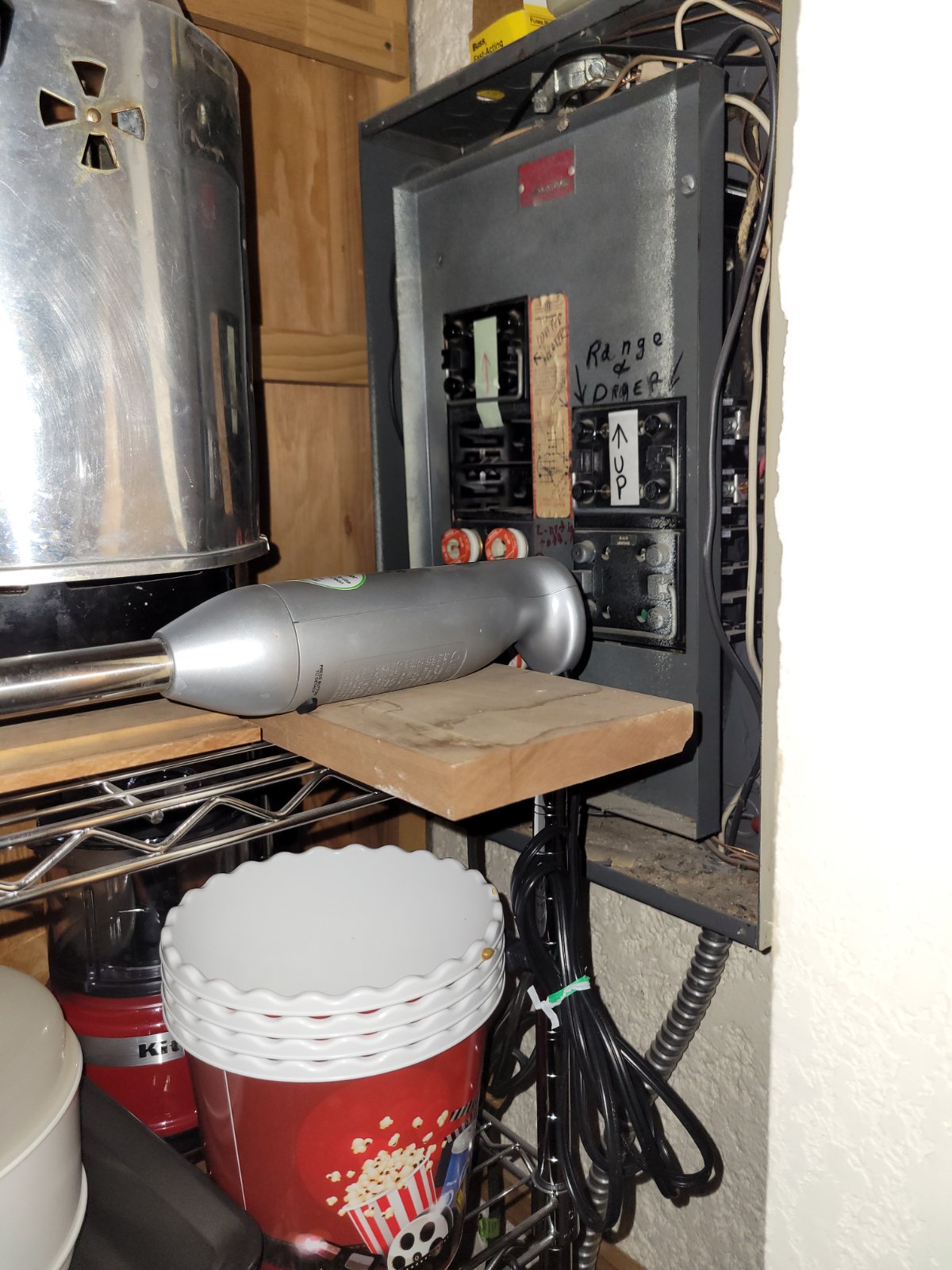
Here's a little tip on what NOT to do before you bolt down your gun safe. If you look closely you can see the two screws on the right hand side of this breaker panel. And you can't see the other two screws on the left hand side. And the silly thing is I had the room to move it over two more inches.

You are using an out of date browser. It may not display this or other websites correctly.
You should upgrade or use an alternative browser.
You should upgrade or use an alternative browser.
Locating your gun safe
- Thread starter Big John
- Start date


Doh! 
Also, RIP Jerry Jeff Walker.
Also, RIP Jerry Jeff Walker.
Busterswoodshop
Hunter
I see problems in the future.
OP
I've got a couple of AC breakers that keep tripping, despite a "soft start" kit installed on the AC unit, so the next recommended action is new breakers.As long as you don't add any more circuits you be just fine... ;)

And unless you are on a slab, make sure your floor is up to snuff. Mine is in the corner of my den right where two bearing walls meet. Not where I originally intended. But I was smart enough to get a friend that was a structural engineer take a look first. He suggested the current position and to install a couple of piers and additional support beams.


As an Amazon Associate we earn from qualifying purchases. Product prices and availability are accurate as of the date/time indicated and are subject to change.
OP
The future is nigh. To quote Pogo, "We have met the enemy and he is us."I see problems in the future.
If your service will handle it, increasing the amperage on the breaker may help. But if you have a small service like I originally had, house was built in the late 40's and had, if I remember correctly, a 50 amp service.I've got a couple of AC breakers that keep tripping, despite a "soft start" kit installed on the AC unit, so the next recommended action is new breakers.
If you do need to upgrade your service and panel, make sure you go as big as you can and that it has the facility for solar power and/or a whole house generator.
OP
I'm on a slab, so I'm good there. And the 'Safe Queens' get to strut their stuff for a while.And unless you are on a slab, make sure your floor is up to snuff. Mine is in the corner of my den right where two bearing walls meet. Not where I originally intended. But I was smart enough to get a friend that was a structural engineer take a look first. He suggested the current position and to install a couple of piers and additional support beams.
OP
I've got twin 40 amps in there now, we'll see what gauge wire I have and go from there.If your service will handle it, increasing the amperage on the breaker may help. But if you have a small service like I originally had, house was built in the late 40's and had, if I remember correctly, a 50 amp service.
If you do need to upgrade your service and panel, make sure you go as big as you can and that it has the facility for solar power and/or a whole house generator.
I went whole hog. My house was only two wire. After I had the pros panel, I took my time and rewired the whole house. I was able to do it at my pace and other than being hot in the attic on a couple of days it went smoothly. I was worried about firestops in the wall, but I just pulled the new wire through with the old. I guess there wasn't anything really securing the wire inside the walls.I've got twin 40 amps in there now, we'll see what gauge wire I have and go from there.

Murphy is an optimist. 

What? I hadn't heard he died.Doh!
Also, RIP Jerry Jeff Walker.
What a dumb ass. Glad I have never done anything that silly.Here's a little tip on what NOT to do before you bolt down your gun safe. If you look closely you can see the two screws on the right hand side of this breaker panel. And you can't see the other two screws on the left hand side. And the silly thing is I had the room to move it over two more inches.
Oh wait.
We live in a home built in the 1930's
My wife wanted wire racks put in where the fuse box is (yes, fuses) in a kitchen pantry.
I never thought about panel that has to swing open to access fuses.
Had barely enough room to remove cover to fix a burnt fuse, then replace cover.
Have to rethink the rack.
I feel your pain.

contender
Ruger Guru
We've ALL had the occasion to do stuff, that once done,, we figured out how we screwed something up, or got it wrong.
Bit tip; Just go ahead & figure out how to move it now before you NEED to move it.
Bit tip; Just go ahead & figure out how to move it now before you NEED to move it.
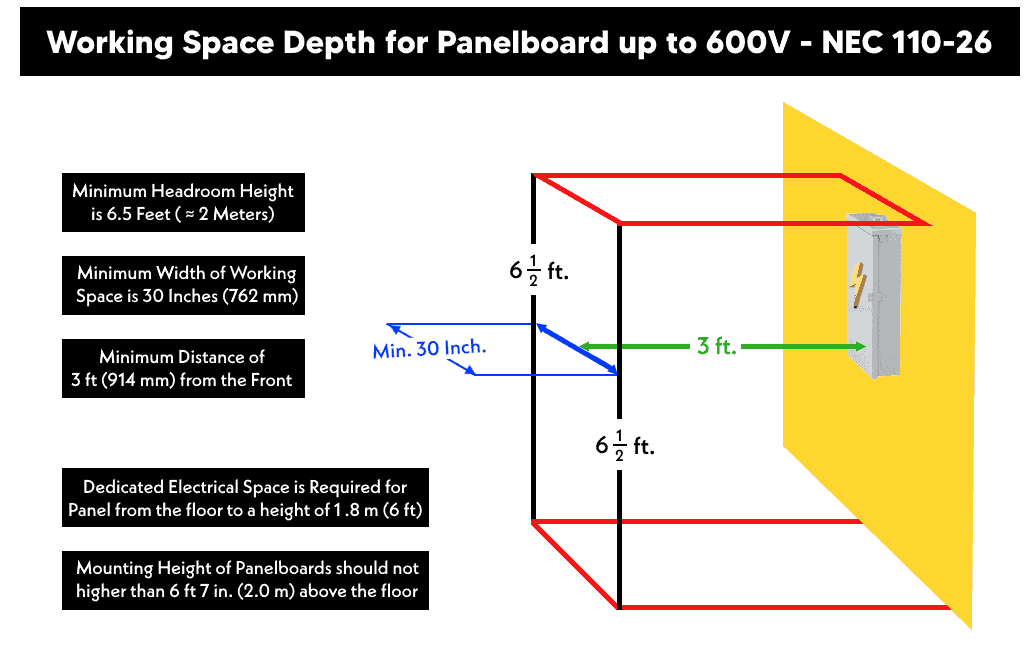
Good informationHard to be 100% certain from just a photograph but it is nearly certain that is a code violation. The NEC describes certain minimum clearance requirements... width, height, depth:
View attachment 80751
 I am removing rack today. Will relocate to a better spot.
The only things that are in the room (8' x 5') where my electrical/circuit breaker panel is located is the washer and dryer and opposite from the breaker panel, a wall mounted cabinet for cleaning supplies and rags/old towels.
My safes and gun cabinets, 8 total, are in two different rooms in the basement (humidity is controlled very well, rarely above 45% , typically stays at about 30% - 35% year round).
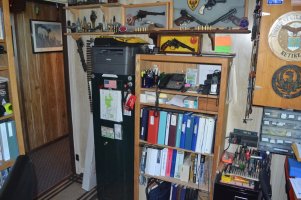
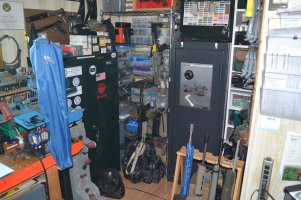
My safes and gun cabinets, 8 total, are in two different rooms in the basement (humidity is controlled very well, rarely above 45% , typically stays at about 30% - 35% year round).


I was really thinking about getting a heavy duty safe a bolt it down in the garage.

At our prior house I bolted mine down and then built a wall around it. My office was part of my shop… the walls around and above the safe were reinforced with t-posts, rebar, and gravel. I figured anyone that tried to get in with any sort of saw would be in for a big surprise…

While not intending to move anywhere but the cemetery, my big safe goes with the house. I'd rather buy a new one and have it fit the space and be delivered.
Never hired a mover yet, don't intend to. Then again I haven't moved in over 40 years so what do I know.
Never hired a mover yet, don't intend to. Then again I haven't moved in over 40 years so what do I know.

When I lived in San Diego in the 1980’s, I had my safe bolted to the concrete garage floor. Thing sat right next to the car. Never gave it a second thought. When I moved to Illinois, we had a small house so in the garage it went. Got very cold in there in winter and hot in summer. Still not a problem. We moved to a bigger house with a basement and we put the safe downstairs in the basement. Took four men to get it down there . Basement was damp with mildew . We later got our current home and I really wanted the safe inside the house on a main floor. Wife said no room so into the garage it went yet again. I never felt safe with it stored in the garage. We had plenty of room in the basement but the access to the basement was tight. Called up a safe moving company and they came out with their equipment and it was moved easily by two men. No hassle, broken trim or damaged drywall. Worth every penny! I moved that safe four times, never again.

- Joined
- Apr 3, 2012
- Messages
- 10,877
I bought my safe cheap with no delivery. Hired a moving company to pick it up bring it to my house and carry it inside.
It was cheaper than the safe company wanted to deliver it to my driveway.
It was cheaper than the safe company wanted to deliver it to my driveway.


