Webb telescope

Joined
Nov 17, 2009
Messages
15,200
City & State/Province
Webster, MD.
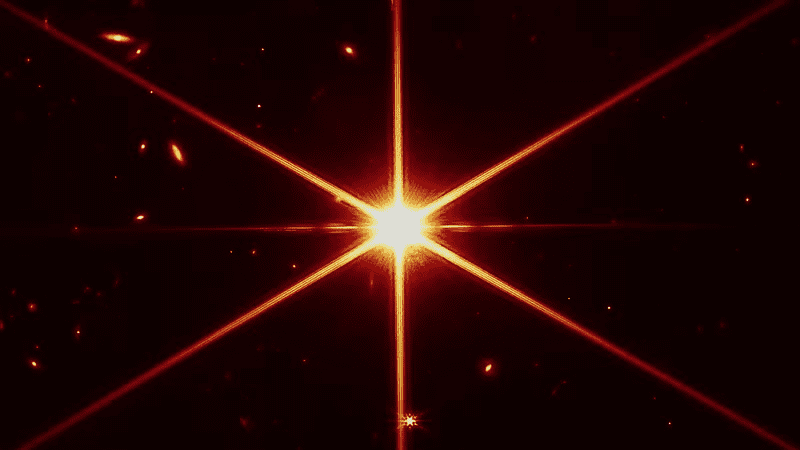
Solar systems in the background are billions of light years distant.
1647483041034.png
 
and "In the beginning", how long did it take for the light from all those stars to be seen on Earth?


jd
 
I'm far from being an expert on this... but we've gotten too wrapped up in the speed of light... seems I was passing by some PBS program the other day and they were saying that most of the universe is made up of some other stuff... dark matter..... that we don't understand.. also there is gravity which I'm pretty sure does not work via light .... in other words Gravity is instantaneous, The really hard thing to wrap our heads around is how many stars (solar systems) there are out there...... it seems there are billions in just our Galaxy and there are ... well I don't know how many Galaxies they've discovered so far.....
 
As an Amazon Associate we earn from qualifying purchases. Product prices and availability are accurate as of the date/time indicated and are subject to change.
This is just a pet theory, but there has to be something that is faster than light. The distances in the the Universe cannot be covered otherwise, because it is too big. OK, I’m done.🤨
 
Last edited:
This is just a pet theory, but there has to be something that is faster than light. 🤨
True. Tachyons are theroretical particles that are faster than light. The problem is that nothing that weighs anything at all can ever accelerate faster than the speed of light. According to the Special Theory of Relativity as something approaches the speed of light it's mass increases. So if a subatomic particle reaches the speed of light it's mass would become infinite and take a infinite amount of force to accelerate it the last little bit to match the speed of light.
 
13.8 billion years is what we who dealt with physics , chemistry am math, professionally, on a daily basis called a S W A G. For the uninitiated that’s a Scientific Wild Assed Guess.

SWAG’s are generally made by folks who really don’t have a clue what’s factual but want to impress others. They are pretty much always wrong.
 
Have read some guesses that the number of stars in the SWAG universe is somewhere between the number 4 and 5 followed by I think 26 zeros. That's a lot of stars.
Science fiction writers are big on what many of them call FTL ( faster than light ) travel. This is a lot faster than WFO!
 
I gave this to my gf. A beautiful colorized picture of several galaxies/nebulas along with these words..."The universe keeps expanding because it can't hold the love I have for you!" Feel free to relate to your significant others and enjoy what follows...
 
I gave this to my gf. A beautiful colorized picture of several galaxies/nebulas along with these words..."The universe keeps expanding because it can't hold the love I have for you!" Feel free to relate to your significant others and enjoy what follows...
My wife's first question would be "what the @#$% did you do"
 
Scientist have been working on the age of the Universe for a long time. Over 100 years ago Albert Einstein realized his General Theory of Relativity showed that the universe must be either expanding or contracting. This didn't make sense at the time so he added what he called a "cosmological constant". This was a variable added to his equations to make the universe static. Einstein later called that "the biggest blunder of my scientific career".
They now believe the universe is 13.787 ±0.02 billion years. It's not a wild ass guess.
What really gets me are the people that say things like "oh I'm a real scientist and those experts really don't have a clue what they are talking about. They are just making wild guesses."
It's just like the people that try to argue against evolution without even trying to understand what they are arguing about.
It's really not hard to understand. Books would help but here's a video that just scratches the surface:
 
Last edited:
The professor told the students that the sun would burn out in 4 billion years, ending all life on Earth. One student started screaming and crying, to which the professor said “Why are you so upset, 4 billion years is a very long time”. The student responded “ Thank goodness, I thought you said 4 million”.
 
The Big Bang happened 13.8 billion years ago.
It was not an explosion of matter into space. It was an explosion that occurred all throughout the universe when it started out infinity dense.
So did "time" start then also?
What created the infinitely dense matter to go bang?
Does the universe expand forever, or get real big and begin to shrink, to become dense and explode again?
Is today's universe as we know it the first one or is it like cosmic seasons and recycle every 40-50 billion years?
Where is Jimmy Hoffa's body?
Too many questions......
 
Last edited:
True. Tachyons are theroretical particles that are faster than light. The problem is that nothing that weighs anything at all can ever accelerate faster than the speed of light. According to the Special Theory of Relativity as something approaches the speed of light it's mass increases. So if a subatomic particle reaches the speed of light it's mass would become infinite and take a infinite amount of force to accelerate it the last little bit to match the speed of light.
I don’t get get wrapped up in physics, because I end up lost in minutiae, and then I can’t see the forest for the trees.

When I read something that talks about thousands of light years, I know by instinct that there must be something much faster than light.

And that the Universe is a small thing in the end, but we will never figure space/time, and we are mortal. There is something immortal and space with time points that out, it’s inescapable. And if I can figure that out, then everyone can.
 
The fact of the matter is that nobody knows what the true one way speed of light is. What we do have an idea of is the two way speed of light. . The one way speed could very well be instantaneous. And I know what you are thinking. Just take the 2 way and divide in half. Which is where we get the 186,282mps "standard." While it does make sense, that is not how non-matter always works. Now, for the sake of measuring distance, it's as good of a number as any. But for measuring time, it is not scientifically observable. Which is why in the scientific world a light year is a distance measurement and not time measurement. Here is where the problem lays, When dealing with sound, the synchronizing of the two clocks (starting point and ending point) required to measure 760ish mph is not hyper critical. You can measure at multiple distances and get an average "speed of sound." When attempting to measure light, which is a million times faster, the distances required are vast. We have no way to sync two clocks after moving them away from each other. The very movement of one of the two clocks after syncing, causes them to un-sync. And the distances required to get an average are never static. So already we are dealing with two variables that are non-constant. So any attempt to "age" the universe using light is anything but "scientific" due to the fact that the one way speed of light is still unknown.
 
Scientists “believe” that the universe is 13.8 billion years old and of course they must be right.

Of course, the same sorts of folks once “believed” the earth was flat and also the center of the solar system. They had “theories” to support their assertions.

There are many, many “believes” that once sounded plausible. These had die hard adherents. But they turned out to be wrong. Those followers usually refused to even consider the possibility of other positions.

These same “believers” usually branded those who were later proved correct as heretics and burned them at the stake. While folks are usually burned alive anymore the “true believers” still refuse to consider other possibilities. They also, shout down those who do the one thing that all people of science must do. Question everything.
 
How big is the universe? Twice as long as one end to the middle!
 
Post the link, or go back and read it again. I'm sure they know the difference. I stand by my statement.
Have you ever heard of an oval or spiral star?
Found another link that now agrees with what you are saying.
livescience.com. It is there somewhere. I can't copy the entire link for some reason.
 
Last edited:
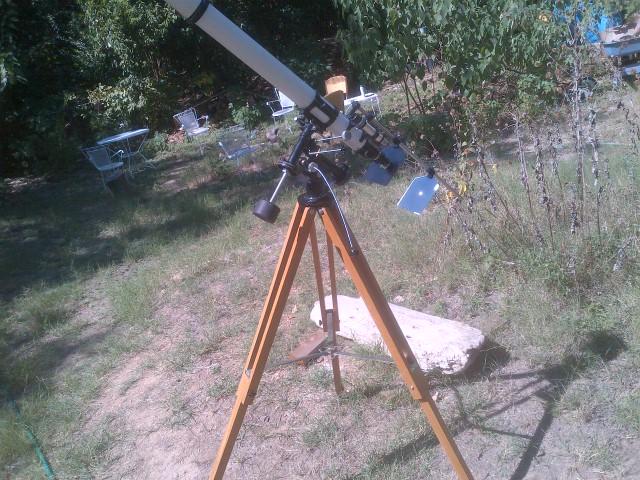
Astronomy became my hobby after the Rooskies launched Sputnik in 1957.
Mowed a lot of lawns so I could buy this (now vintage collectable) Unitron 60mm equatorial telescope in 1962.
It is now owned by my grandson.
Here it is set up with the sun screen apparatus to observe a recent partial solar eclipse.
8C3C54DF-AE6D-448D-A0D3-E25C488C2F38.jpeg
 
Back
Top