SteveSt
Bearcat
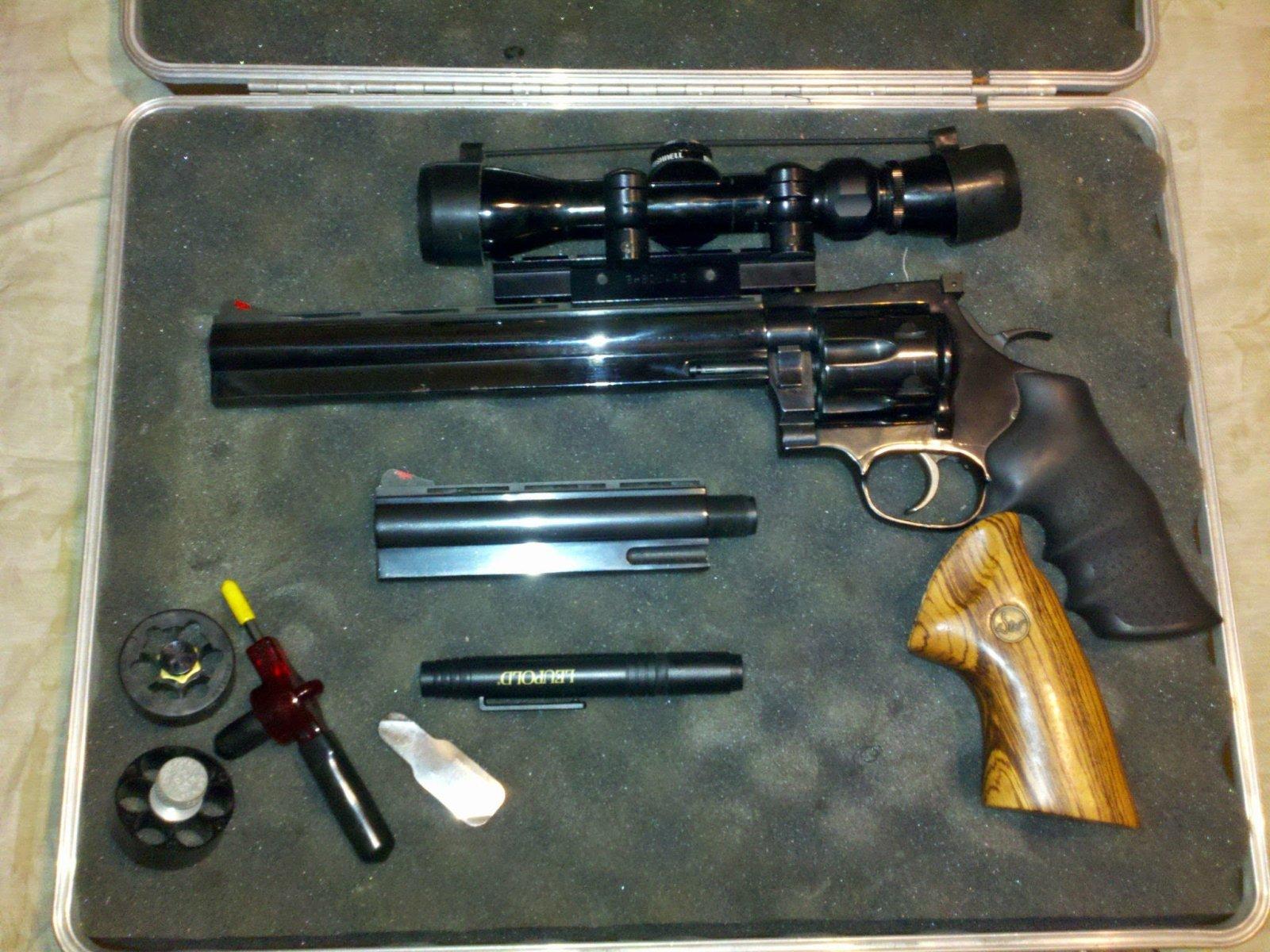
I only have a few 44s and I love shooting them. I am on restriction now due to surgery, so I'm staying smaller than a 38, but I really miss shooting my Dan Wesson 44 with the different barrels. And the other 44s I have as well.


Next to a 357sig pretty much the same. Perfectly adequate within their limitations. Kinda like a 460 Rowland vs the 113 year old 45acp. Next to the new S&W's the 44 is absolutely mediocre in comparison.IF a 44 mag is "only mediocre", what does that make a 9mm? 380?
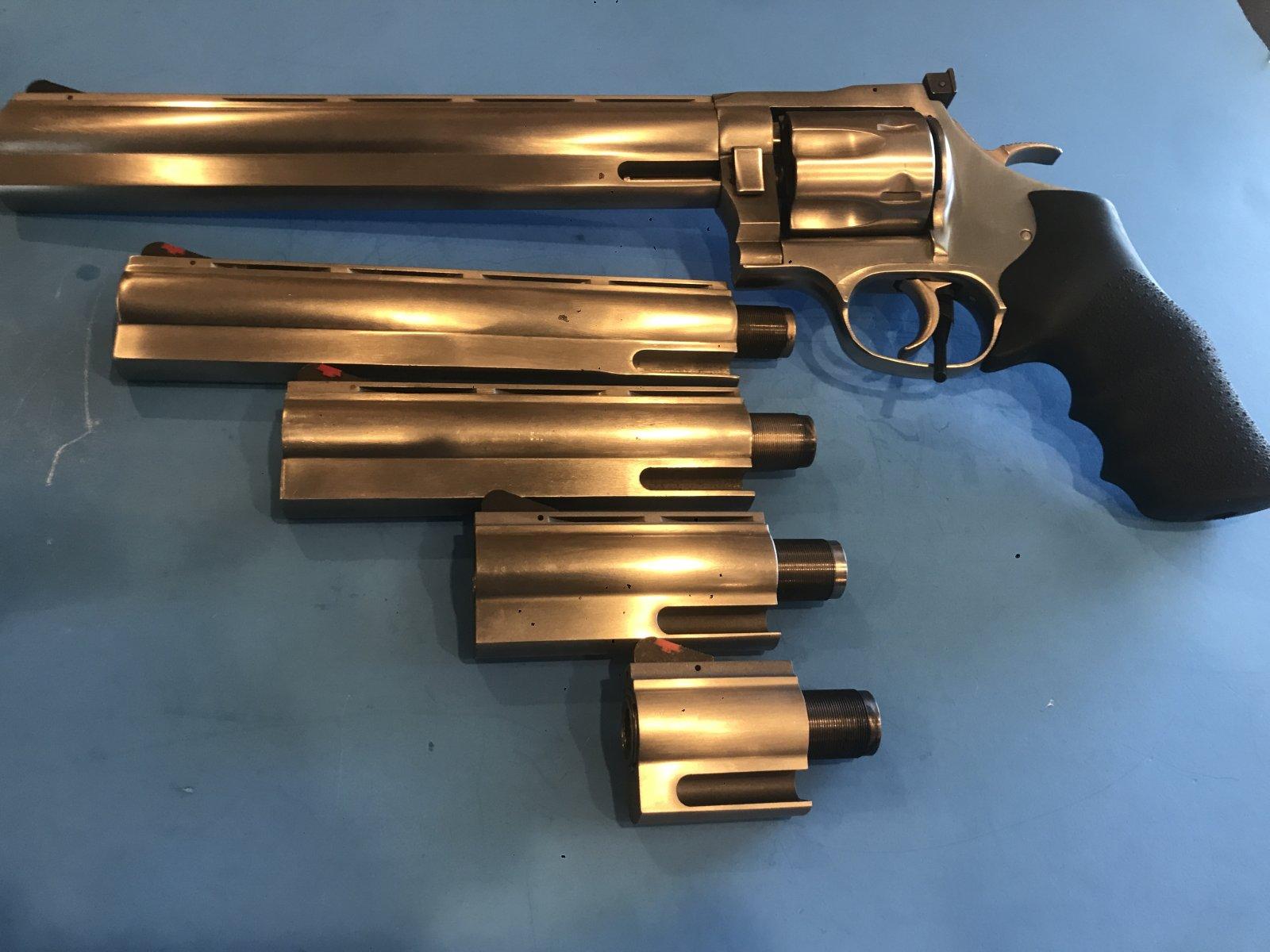
Awesome set. This is my only 44. Dan Wesson was made for Mad Scientists!!! Stock rifling not cutting it with your creations??? A call to Douglas or Pac Nor and you can have custom twist rates and rifling cuts for anything you can hurl!!!I only have a few 44s and I love shooting them. I am on restriction now due to surgery, so I'm staying smaller than a 38, but I really miss shooting my Dan Wesson 44 with the different barrels. And the other 44s I have as well.
View attachment 45311
Listen, I feel your pain, and going through the process of dealing with dead guns is very hard on a person. I have years of experience helping people get through the process, so I offer my services, gratis. Just package them all up, send them to me, and I will take care of the rest. Your guns will be treated with utmost respect and dignity through the entire process.Wish I had seen that earlier, I just bought a couple more last week. Didn't realize they were dead!
Do you walk through the produce aisle and compare apples to watermelons so you can justify buying a box of blue berries?Next to a 357sig pretty much the same. Perfectly adequate within their limitations. Kinda like a 460 Rowland vs the 113 year old 45acp. Next to the new S&W's the 44 is absolutely mediocre in comparison.
Thanks a lot, now I'm hungry. But I do see your point.Do you walk through the produce aisle and compare apples to watermelons so you can justify buying a box of blue berries?
I see you mentioned 'pushing 454 Casull power', but that is probably not possible. You may have achieved a bit more power than what you thought was the max .44 Mag power, but not much. The .44 Mag max's out at a power level of 1,544 Ft. lbs., so if you are reloading, you may have never achieved that power level. But even if you did, the .454 Casull max's out at 2,200 ft. lbs., which is 45% more powerful. In other words, there is a hug difference.
It's like comparing the 44 magnum to the newer, hotter 460 or 500S&W. The 357sig similarly eclipses the 9mm in performance from a similar package.Do you walk through the produce aisle and compare apples to watermelons so you can justify buying a box of blue berries?

Agreed! I Don't own a 9 mm so I don't have to load for it, but I do have a 380 and that is the single most irritating round to reload I have ever dealt with.I love my .44s. I shoot them a lot more than my 9mm. They are a lot more interesting to cast bullets for, load and shoot.

I have been involved with guns and ammo for over 55 years, and I never heard of the Power Factor you mentioned, nor how it is derived. Ft. lbs. IS a momentum calculation, and it is based on the mass times the speed squared. So, obviously, speed has a bigger factor in the power rating than the size of the bullet. In general, in handgun and rifle ammo, the most powerful rounds are not the biggest bullet, but a combination between the bullet's size (weight) and its speed. There are a few exception, especially with the smaller calibers, where they have an extremely small bullet at very high speed, and get a high calculated power (in ft. lbs.), which I think is rather misleading, and not realistic for hunting nor for self defense, so I tend to disregard these in general.The .454 is certainly a big step above the .44 Mag.
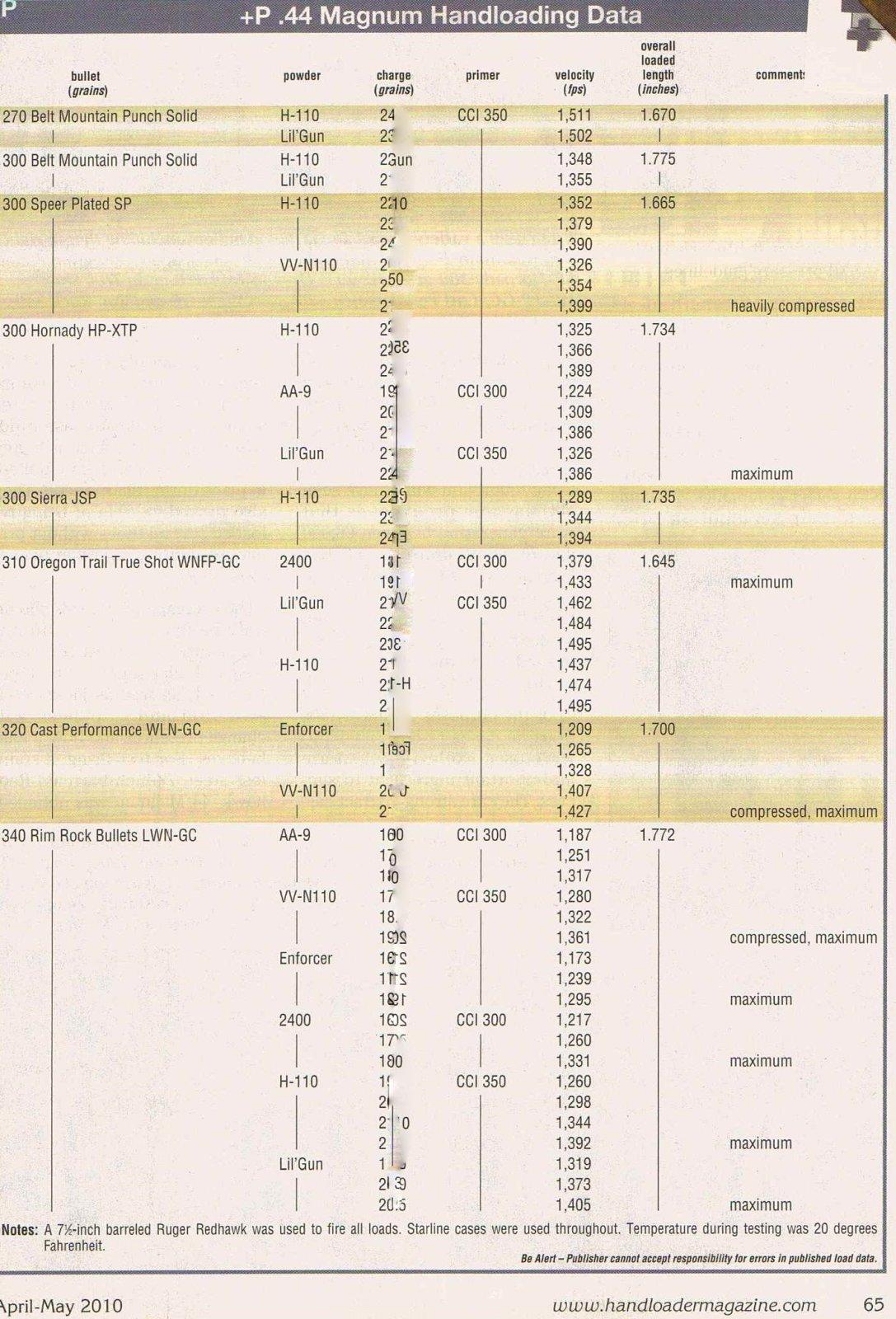
Handloader had a piece about "Redhawk-only" .44 +P loads. I made up a few with H110 and 300 grain SWC-GC bullets that chronoed an average of 1410 FPS. Extraction was slightly sticky, but if I had a real "need" for this sort of thing, I would be willing to make and shoot more of these in small quantities. I labeled the package of ammo ".434 Casull" as a joke.
I'm not interested in foot-pounds. Chasing foot-pounds favors light, fast bullets. I prefer mid- to slightly heavy-for-caliber bullets. Better to calculate Power Factor if you require a number (which is really just another term for momentum). I believe that it is a better proxy for recoil since momentum is conserved on both sides of the primer, if I'm not mistaken. So, a standard .44 load with a 240 grain bullet at the same velocity (reasonable?) would be PF 338, and my +P reload would be 423. Pulling a max load for the .454 from Hodgdon's load data: 325 grain at 1545 FPS gives 502 PF so still quite a bit above the .44 +P. The Redhawk-only loads basically close half of the gap to the Casull.
Based on shooting those +Ps, I could see shooting a Casull (or maybe even a .480 Ruger) for really big animals, but the S&W super-magnums seem quite insane to me!
Back again - I did a few calculations from your table, and turned them into ft. lbs. (1) The 270 bullet traveling at 1,511 produces 1,368 ft. lbs., which is about the max of the .45 Colt ammo (Buffalo Bore). (2) The 300 .44 Mag bullet traveling at 1,390 produces only 1,269 ft. lbs. of ME. (3) The 310 gr bullet traveling at 1,495 produces 1,538 ft. lbs., which is equivalent to the highest powered already-manufactured .44 Mag round made (Buffalo Bore).The .454 is certainly a big step above the .44 Mag.
Handloader had a piece about "Redhawk-only" .44 +P loads. I made up a few with H110 and 300 grain SWC-GC bullets that chronoed an average of 1410 FPS. Extraction was slightly sticky, but if I had a real "need" for this sort of thing, I would be willing to make and shoot more of these in small quantities. I labeled the package of ammo ".434 Casull" as a joke.
I'm not interested in foot-pounds. Chasing foot-pounds favors light, fast bullets. I prefer mid- to slightly heavy-for-caliber bullets. Better to calculate Power Factor if you require a number (which is really just another term for momentum). I believe that it is a better proxy for recoil since momentum is conserved on both sides of the primer, if I'm not mistaken. So, a standard .44 load with a 240 grain bullet at the same velocity (reasonable?) would be PF 338, and my +P reload would be 423. Pulling a max load for the .454 from Hodgdon's load data: 325 grain at 1545 FPS gives 502 PF so still quite a bit above the .44 +P. The Redhawk-only loads basically close half of the gap to the Casull.
Based on shooting those +Ps, I could see shooting a Casull (or maybe even a .480 Ruger) for really big animals, but the S&W super-magnums seem quite insane to me!
Momentum and kinetic energy are NOT the same thing. This is basic physics. Consult any physics textbook.I have been involved with guns and ammo for over 55 years, and I never heard of the Power Factor you mentioned, nor how it is derived. Ft. lbs. IS a momentum calculation, and it is based on the mass times the speed squared.
PF is mass times velocity, which is the same as momentum. When using grains of bullet weight and feet per second, the result is divided by 1000 to give a more convenient three digit number (or four digit for a big rifle cartridge). PF is used in gun games (e.g. IDPA or USPSA) as a proxy for recoil, so competitors have to shoot samples of their ammo to be sure they're not using excessively light ammo to gain an advantage in split times.So, how is this Power Factor calculated? And is it used anywhere else outside of guns?
Also this.IHMSA is about energy transfer. A fast bullet that vaporizes on impact doesn't transfer a lot of energy to heavy steel targets.
Hopefully you're not so old that you can't learn something new.I have been involved with guns and ammo for over 55 years, and I never heard of the Power Factor you mentioned, nor how it is derived.
Ouch. Let's turn down the snarky just a bit. A lot of information and camaraderie on this forum. No need to throw gasoline on it.Hopefully you're not so old that you can't learn something new.
Of course not, and that is why I asked what a Power Factor is and how it is calculated. So, now I see it is simply mass times velocity, whereas real power is mass times velocity squared. And it appears to be used only in games? If this is the case, then no wonder I have never heard of it before. I do not play any computer games. Is it used in the real world as well? PF is not mentioned on any ammo or gun manufacturer's web sites. But of course, ft. lbs. is referenced almost everywhere.Hopefully you're not so old that you can't learn something new.
Power factor helps determine what class you will compete in. Major or Minor for example. 9mm would usually be a minor and 40+ usually major. Though it's possible to get loads that aren't.Of course not, and that is why I asked what a Power Factor is and how it is calculated. So, now I see it is simply mass times velocity, whereas real power is mass times velocity squared. And it appears to be used only in games? If this is the case, then no wonder I have never heard of it before. I do not play any computer games. Is it used in the real world as well? PF is not mentioned on any ammo or gun manufacturer's web sites. But of course, ft. lbs. is referenced almost everywhere.
'Major' and 'Minor' what? Is this some sort of official classes of shooting at real shooting ranges?Power factor helps determine what class you will compete in. Major or Minor for example. 9mm would usually be a minor and 40+ usually major. Though it's possible to get loads that aren't.
The use of major and minor power factors started with Jeff Cooper and IPSC way back in the 70's or perhaps even earlier as a way to measure the momentum of a cartridge. To score major a round had to factor at least 175 using bullet weight X velocity. A cartridge scoring minor had to score a minimum of 125. In target scoring on the IPSC target both rounds would receive 5 points for a center hit (A zone) but the minor round received a lower score for hits in the B,C, and D zones than the major cartridge (google IPSC target scoring rings for an illustration). As an example a 200 grain bullet at 900 FPS has a power factor of 180 while a 115 grain bullet at 1100 FPS had a PF of 126. The purpose was to reward the more powerful but heavier recoiling round while penalizing the lighter, softer shooting rounds. Bullet diameter did not play into the measurement.'Major' and 'Minor' what? Is this some sort of official classes of shooting at real shooting ranges?

It's sort of a difficulty factor. Controlling a minor is easier than a major. Minor rounds are usually smaller giving a capacity advantage as well. A 9mm will usually hold more than a 45 and recoil less. Also a hit with a major can generally be considered more effective.'Major' and 'Minor' what? Is this some sort of official classes of shooting at real shooting ranges?
Well, this sounds like this term is used solely in some sort of competitive shooting and contests then? I fully agree that shooting the much smaller, and lighter rounds would be a lot easier. But I also question this measurement, especially when you tell me that it has been around for at least 50 years. The reason why I question it, is not that I doubt its validity, but that it is not mentioned anywhere - not by any ammo or gun manufacturer, nor online with any of the gun/shooting videos, and I have watched a lot of them. Of course, there may be some references somewhere online, and that there may be a world that uses this term and measuring method, but it does not seem to have any real significance.The use of major and minor power factors started with Jeff Cooper and IPSC way back in the 70's or perhaps even earlier as a way to measure the momentum of a cartridge. To score major a round had to factor at least 175 using bullet weight X velocity. A cartridge scoring minor had to score a minimum of 125. In target scoring on the IPSC target both rounds would receive 5 points for a center hit (A zone) but the minor round received a lower score for hits in the B,C, and D zones than the major cartridge (google IPSC target scoring rings for an illustration). As an example a 200 grain bullet at 900 FPS has a power factor of 180 while a 115 grain bullet at 1100 FPS had a PF of 126. The purpose was to reward the more powerful but heavier recoiling round while penalizing the lighter, softer shooting rounds. Bullet diameter did not play into the measurement.
As noted above this method of "power" calculation has been in use for at least 50 years among those shooting in the "practical" shooting sports.

Great comment 41Dude! Thanks.Ouch. Let's turn down the snarky just a bit. A lot of information and camaraderie on this forum. No need to throw gasoline on it.