Speed Six Value Confusion

davidkachel

Bearcat
Joined
Feb 20, 2011
Messages
34
I usually just look at what a gun has recently sold for on Gunbroker, but this one has me confused...
The Speed-Six is apparently "very hard to find", "quite collectible" (I don't personally care about that, but...), and at the same time, doesn't seem to sell for the kind of price those characteristics would indicate. The one I bought yesterday is .357, 2.75" bbl, and blued. No box or papers, bluing is above 90%. I paid $500.

All opinions and information welcome. TIA
 
Speeds bring a wide wide range of prices.
Details matter.
$350 to $2000 is in the range of possibilities.
Again; details matter.
 
Pictures help.
Factory wood or rubber grips?
Round or scalloped recoil shield?
LEO markings?
No special markings of any kind. Blued. Wood. SN 160-22XXX. Just a plain Jane. The recoil shield is flat on the face. I have no idea what you mean by scalloped or where that characteristic might be located. Assume it is the most common. Though I like the few Rugers I own, there is zero chance I would become a collector. I'm a shooter and own what I can shoot well. I keep track of value because when I decide to swap something out for something else, I don't like to leave money on the table. The only thing I ever collected was turn-of-the-century pocket automatics, which all got sold for more "social" weapons.
 
As an Amazon Associate we earn from qualifying purchases. Product prices and availability are accurate as of the date/time indicated and are subject to change.
We're not insinuating anyone become a collector. You asked a value, and we just needed more details. For a 160- s/n, you did well. There is not a single Speed Six of mine that I would sell for $500.
Which brings me back to my original question... Why, if they are as sought after and scarce as represented by some, are they worth comparatively little?
 
I think it may be a couple of things. First, when new, they were less expensive than other (Colt and S&W) competitive revolvers.
When they first came out, lots of people poor-mouthed them because they were "cast" instead of forged.
As to scarcity: Colt and S&W made medium frame revolvers a lot longer than Ruger. And I think the Speed Sixes were probably made in lower numbers than the Service Six and Security Six.
A big part of their attractiveness/desirability (at least for me) has been their historically low cost for their quality and durability.
You bought that gun at a very good price, if Bubba didn't do any damage other than to the mainspring.
 
Last edited:
david,, you have been given good info here.
Collectors seek out the really harder to find, rarer marked or low production types. Those can bring a premium.
As I mentioned in your other post,, your gun was made in 1984.

Value & worth are actually two different viewpoints. While similar,, each is determined by the approach of who is involved. A seller may value a gun at one level,, while a buyer may feel it's only worth a different price.

Many folks feel the older DA revolvers are superior to the SP or GP newer ones.

From the info you've provided,, the model you have is most likely a SS-32. (Blued, Speed-Six, .357 Mag with a 2-3/4" bbl.) Your serial number indicates it's a "high back" version.
And from what you've provided,, a more "common" version.

You got a good shooter at a fair price.
 
Youngsters or other newer shooters have little interest in revolvers.

Accumulators (a term less offensive than collector), such as myself, mostly have this model, and if it's not an upgrade, we would buy it to share it with someone else. No reason to hygrade the value.

We are looking for condition, and features that make it less typical.

So, such a revolver, in such condition, is reasonably priced, for the current market. Values can escalate or decline, for reasons we don't always comprehend.

Again, in collector circles, many of us see the Speed/Security Six as superior to the newer GP100. Folks less experienced would rather have a brand new GP100 for not much more money. That will help keep the value of the older revolvers in check.
I never knew the term "collector" to be offensive to anyone. Sounds like there may be an interesting story behind that. I depend on "collectors" for a living (www.davidkachel.com), so I'm stuck with the term. ;-) "Accumulator" sounds like something the Terminator brought back in time with him! ;-)
I'll have to look for a period magazine article comparing the Speeds to the GPs; should be interesting. Thanks.
 
david,, you have been given good info here.
Collectors seek out the really harder to find, rarer marked or low production types. Those can bring a premium.
As I mentioned in your other post,, your gun was made in 1984.

Value & worth are actually two different viewpoints. While similar,, each is determined by the approach of who is involved. A seller may value a gun at one level,, while a buyer may feel it's only worth a different price.

Many folks feel the older DA revolvers are superior to the SP or GP newer ones.

From the info you've provided,, the model you have is most likely a SS-32. (Blued, Speed-Six, .357 Mag with a 2-3/4" bbl.) Your serial number indicates it's a "high back" version.
And from what you've provided,, a more "common" version.

You got a good shooter at a fair price.
Thanks. I have a GP-100 in 44 Special. It will be interesting to compare the two.
 
One item often discussed about the "Six" series of DA revolvers vs the newer GP design, was that Bill Ruger may have said that he never made money on the "Six" series. So he had them redesign the DA line. I seriously doubt that story,, as he made a LOT of the Six series guns. And he was NOT the type to build so many & lose money like that. He was too frugal.

The term "collectors" isn't usually offensive. But many feel they aren't "real" collectors because they don't focus on one specific type or area or whatever. And they may never do a display or whatever. So,, that type often prefers the term "accumulator" over collector.
 
As for the "scallop" on the Speed Six; right hand side, rear of frame can be rounded or scalloped, meaning they removed some material to help lighten it a bit. Being a 160-xxxxx serial number your Speed Six will have the "Scalloped" frame and the REDESIGNED/updated (in 1974) grip frame also known as the high back frame. The first grip frame (called the low back frame) didn't go over very good with a lot of people who tested it and those who bought it and since Mr. Ruger wanted to make inroads into the law enforcement sales, the redesigned it to give a better feel, thus the new "high back frame".

The Six Series revolvers (Security Six, Police Service Six and Speed Six) values really depend on where you are buying in the US (West Coast, Northwest and Northeast you'll pay more than in the midwest and southern US) and what the configuration is (blued or stainless steel) and other considerations (were they sold to a particular LE department, overseas contracts, special contracts in the US (USPS, military, etc.). Those things can all contribute to a higher price. Also, if there weren't many made, for example the first stainless steel Security Sixes (low back frame 6" barrel - 3 are known of at this time) and Speed Sixes ( low back frame, made in 1974 ) are pretty darn rare and hard to find and will command a much higher price.

What you paid for your particular Speed Six is what I (and I am a collector of the Six series revolvers) would consider to be a fair price these days. The past 7-8 years there has been a pretty good resurgence of interest in the Six series revolvers that has lead to their increases in price.
 
Thanks for the response. That helped. I always felt Rugers were a little bit clunky compared to S&Ws and Colts, but then a tank that rolled over a Ruger revolver would be the combatant to suffer damage, not the revolver.
 
Yes, it's the old story, when you buy a gun, it's 'rare and collectable', but when you try and sell it, it becomes 'odd ball'.
I accumulate Service/Security/Speed Six revolvers because I don't have a plan to make a collection of various calibers, finishes and barrel lengths. If I see one and I like it and the price is right, then I buy it. I think they are excellent, durable machines.
$500 for a 4 inch Security Six of any vintage is a fair deal these days, depending on condition or course. For example, LCRs retail above $600 for a polymer and aluminum framed gun.
Additionally, try pricing a comparable Smith & Wesson or Colt (6 shot 357, adjustable sight, 4 inch barrel of similar manufacture date) revolver to see the value of the Ruger.
Oh, and nice snag on that 44 Spl GP 100. I want one too.
 
As for the "scallop" on the Speed Six; right hand side, rear of frame can be rounded or scalloped, meaning they removed some material to help lighten it a bit. Being a 160-xxxxx serial number your Speed Six will have the "Scalloped" frame and the REDESIGNED/updated (in 1974) grip frame also known as the high back frame. The first grip frame (called the low back frame) didn't go over very good with a lot of people who tested it and those who bought it and since Mr. Ruger wanted to make inroads into the law enforcement sales, the redesigned it to give a better feel, thus the new "high back frame".

The Six Series revolvers (Security Six, Police Service Six and Speed Six) values really depend on where you are buying in the US (West Coast, Northwest and Northeast you'll pay more than in the midwest and southern US) and what the configuration is (blued or stainless steel) and other considerations (were they sold to a particular LE department, overseas contracts, special contracts in the US (USPS, military, etc.). Those things can all contribute to a higher price. Also, if there weren't many made, for example the first stainless steel Security Sixes (low back frame 6" barrel - 3 are known of at this time) and Speed Sixes ( low back frame, made in 1974 ) are pretty darn rare and hard to find and will command a much higher price.

What you paid for your particular Speed Six is what I (and I am a collector of the Six series revolvers) would consider to be a fair price these days. The past 7-8 years there has been a pretty good resurgence of interest in the Six series revolvers that has lead to their increases in price.
Ron,
"meaning they removed some material to help lighten it a bit."
A closer examination of the scalloped and non-scalloped Speed and Service Six guns shows no weight change - the "extra" or "missing" metal from the scallop was added to the top strap! I first noticed it when I noticed the fixed sight grove was deeper on a scalloped gun. A precise measurement of the thickness of the two top straps confirmed what my eyes thought they saw.
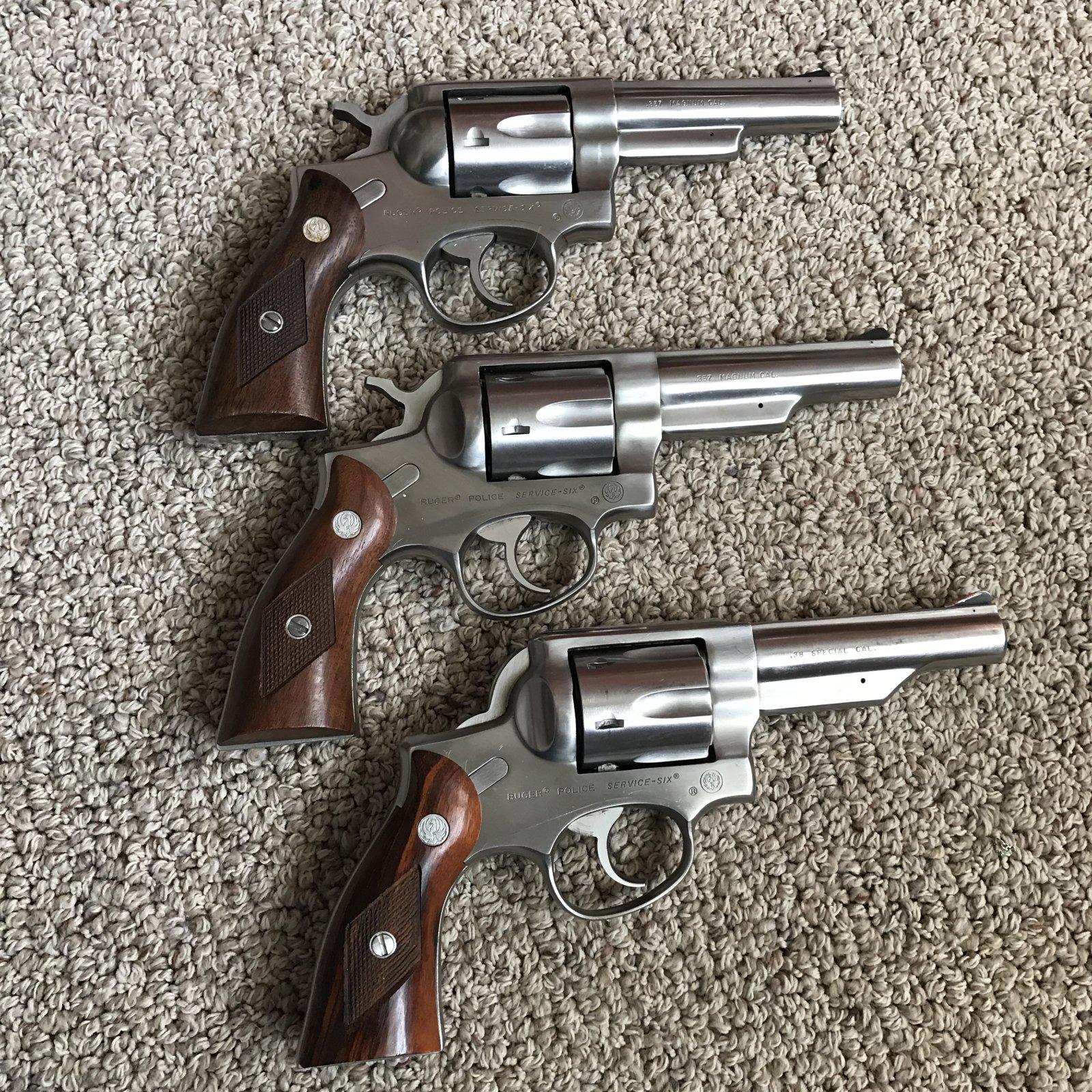
This photo shows non-scalloped on top, scalloped in the middle and bottom. It also shows the 3 different barrel (ejector rod) profiles and the factory DAO hammer on the bottom gun.
1717428040792.jpeg


Terry
 
Last edited:
That might be a rarer Speed Six but IMHO it is NOT worth $5000. ....... I'll take that back, it might be worth that to someone out there with more money than brains. (I did see in the ad that it had a "Make Offer" button.

Ron, your "Six-series" expertise is well known here, and your input is always appreciated.

I wasn't in danger of placing an opening bid in that amount! 😳

I'm firmly in the $500 “shooter” camp, as long as I can still find them for that kind of money... 🤗
 
I heard, and I don't know if it's true, but the scallop was added to give the Security/Service/Speed Six a family resemblance to the Redhawk then a new product.
As to why if they are so desirable to some, then why don't they command greater prices, I can only speculate that since they were always valued less than the S&W and Colts at the time of manufacture, and that prejudice seems to have continued to this day. Additionally, the series was discontinued for the GP100 some time ago and never gained a cult-like following.
Some guys like blonds, some like brunettes, and the discerning like redheads.
 
Honestly I think you did great at that price! I just paid exactly $512 for a stainless Speed Six that needed a good bit of TLC. I couldn't tell from the pics and I didn't think it needed as much as it did but it was still worth it to me. It's believed the Speed Six was made in lower numbers than the Security and Service Six so there's that too. That does make sense because even online I see way more of the Security Six than I do the Speed Six. I would've gladly paid $500 for a 90% condition Speed Six.
 
As for the "scallop" on the Speed Six; right hand side, rear of frame can be rounded or scalloped, meaning they removed some material to help lighten it a bit. Being a 160-xxxxx serial number your Speed Six will have the "Scalloped" frame and the REDESIGNED/updated (in 1974) grip frame also known as the high back frame. The first grip frame (called the low back frame) didn't go over very good with a lot of people who tested it and those who bought it and since Mr. Ruger wanted to make inroads into the law enforcement sales, the redesigned it to give a better feel, thus the new "high back frame".

The Six Series revolvers (Security Six, Police Service Six and Speed Six) values really depend on where you are buying in the US (West Coast, Northwest and Northeast you'll pay more than in the midwest and southern US) and what the configuration is (blued or stainless steel) and other considerations (were they sold to a particular LE department, overseas contracts, special contracts in the US (USPS, military, etc.). Those things can all contribute to a higher price. Also, if there weren't many made, for example the first stainless steel Security Sixes (low back frame 6" barrel - 3 are known of at this time) and Speed Sixes ( low back frame, made in 1974 ) are pretty darn rare and hard to find and will command a much higher price.

What you paid for your particular Speed Six is what I (and I am a collector of the Six series revolvers) would consider to be a fair price these days. The past 7-8 years there has been a pretty good resurgence of interest in the Six series revolvers that has lead to their increases in price.
Sheer dumb luck on my part. I retained little to no knowledge about these revolvers save the fact that some existed and I didn't know one from another. But if I had them all laid out on a table to pick from, I would have selected the one I ended up with. Now that I have changed out the hammer spring, it is far better behaved.
 
I was sure I posted this update yesterday, but can't find it. If this is a duplicate, someone please let me know...
Finally got around to swapping out the hammer spring. Before I did, I ran the pencil test on the Bubba job I found in this gun.
Bubba's work bounced the pencil in the barrel, but it never actually left. The new spring bounced it all the way out of the barrel, as it should, AND the DA trigger, after swapping, also turned out to be substantially improved. I surmised that the two spring rig (Bubba) was binding during firing and stalling out the hammer fall mid-action. Now if it will just stop raining for a long enough period for my range to rise above sea level... !!!
 

Latest posts

Back
Top