Compound Forcing Cone Angles?

Caballero59

Bearcat
Joined
Jun 15, 2025
Messages
45
City & State/Province
Colorado
One of my Ruger Flattops in 45 convertible had a badly cut forcing cone so I bought the tools from Brownells and gave it a go. It turned out great. I went slow with cutting oil and it is nice and smooth. Here is my question: I didn't go quite as deep as the original cone which I believe gives me a compound angle of 11 transitioning to 5. Logically, this seems good to me, i.e., a steeper angle transitioning to a shallower angle. However, every post on the subject asserts compound angles are bad. I asked Grok (AI) and it stated that many gunsmiths prefer a compound angle. l do understand that a 5 degree angle transitioning to 11 would not be good. So guys, what is the truth here?
 
I would say it depends on the transition. A sharp transition could possibly lead to lead buildup. The purpose of the forcing cone is simply to compensate for errors in cylinder alignment, not to swage down a bullet, so it really shouldn't be an issue unless you have significant misalignment of cylinder to barrel where a bullet contacts the transition. I'd say it should be a non-issue, but Murphy can be a MF'er

ETA: If you shoot only jacketed bullets I'd consider it even less of an issue.
 
Last edited:
I am no help on the angles but I did have a rough forcing cone.
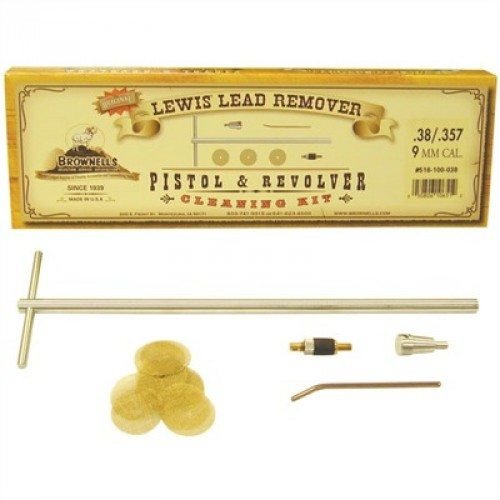
I polished it up using this Lewis lead remover. I replaced the brass discs with some 2000 grit sandpaper and was able to smooth things out to a nice shiny polish. It helped to keep leading at a minimum. Very happy with the result.

PS I did not use the tool in
the barrel. Only used it on the forcing cone to where the rifling starts. Smoothed things out in cone and sharp start of rifling.
products-lewis-lead-remover-38__52381.1615183597.1280.1280.jpg
 
Last edited:
I can't offer direct info about the compound angle from experience.

But,, I will ask a few questions.

Did you shoot some groups as a base line before you worked on the forcing cone?
Did you use a forcing cone depth gauge as you worked on it?
Have you test fired it for groups now?

If so,, did it improve things or not?
 
IMHO, logic would dictate a smooth (i.e. no compound) transition is critical. I have NEVER seen other than a single-angle forcing cone. If it were my gun, I would continue my cut to eliminate the dual angle.

J.
 
As an Amazon Associate we earn from qualifying purchases. Product prices and availability are accurate as of the date/time indicated and are subject to change.
IMHO, logic would dictate a smooth (i.e. no compound) transition is critical. I have NEVER seen other than a single-angle forcing cone. If it were my gun, I would continue my cut to eliminate the dual angle.

J.
I hear that a lot on the forums, but why? What are the physics that are against a compound angle? In fact, look at it this way. A standard 11 degree forcing cone amounts to a compound angle with the first angle of 11 deg and the second of 0 deg. But I get it...a reverse compound of a 5 deg followed by an 11 deg would be a no-go.
 
I hear that a lot on the forums, but why? What are the physics that are against a compound angle? In fact, look at it this way. A standard 11 degree forcing cone amounts to a compound angle with the first angle of 11 deg and the second of 0 deg. But I get it...a reverse compound of a 5 deg followed by an 11 deg would be a no-go.
Every transition is a point where metal from the bullet is forced to further deform and could get deposited on a rough surface. At a minimum I would lap a two-angle cone to make sure the cut transition was absolutely smooth. I doubt there are any benefits to a multi-angle cone.
 
Back
Top