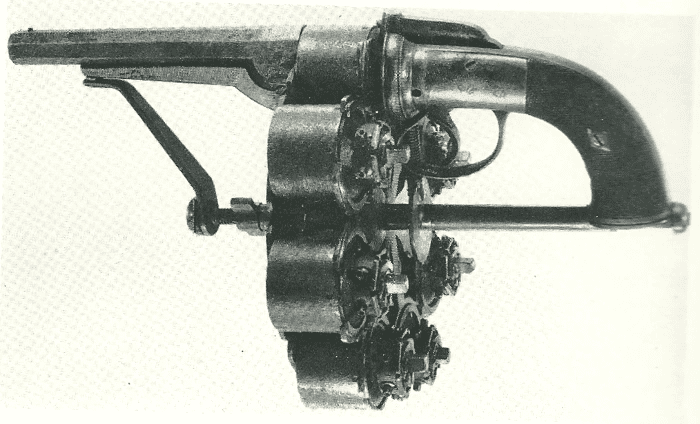
In a cartridge revolver, I'm not sure how well a spare cylinder would work. Would the cartridges stay in? In a cap and ball gun, sure. I understand the Confederate cavalry did that to keep weight down on horseback. A couple cylinders was lighter than another whole gun.
There are two type of revolvers, the single action (SA) and the double action ones (DA). I assume that most people know this difference, but basically if you do not, that the single action requires you to pull back the hammer for each and every shot. The double action just requires the pulling of the trigger, which in turn pulls the hammer back for you.
Given this, the single action revolvers have cylinders that come out easily after pulling the pin from the front that goes thru the center of the cylinder, and then just by pushing the cylinder out sideways. Also, with the single action revolver, the spent cartridges have to be ejected individually, while it is mounted in the gun. With double action revolvers, the cylinder does not come out unless you take the gun apart.
Given these differences, carrying extra cylinder with ammo already loaded makes some sense only with single action revolvers since the cylinder does not come out of DA revolvers. So, when it comes to being able to reload either these types of revolvers quickly varies greatly. With the single action revolvers, you would have to have carry spare cylinders already loaded, and just replace the cylinder, which would take about 30-45 seconds. But the big drawback here would be in ejecting the spent cartridges, with is really designed to be done only when the cylinder is mounted in the gun with the single channel ejector rod. I suppose you could eject these spent cartridges with an external cylinder, but it would take some time to eject them, and then reload it manually.
But to get back to the point at hand here, carrying extra loaded cylinders is feasible, but the concern of adding extra weight that a horse would notice is extremely marginal. I have both a .357 and a .45 Colt Ruger Blackhawks. The .45 Colt ammo is much bigger and if fully loaded (all 6 rounds), it weighs between 3-5 lbs., So if you have 5 extra fully loaded .45 Colt cylinders, it would come to 15-25 lbs, which is nothing on a horse that weighs about 1,200 lbs. (medium sized horse), and is already carrying 250-300 pounds, which would include the man, the saddle, and any extra bags with their internal material, such as ammo.
If DA revolvers are considered, then one only needs to carry auto loaders, which is essentially just the ammo in a very lightweight plastic housing that holds all the cartridges in the proper format that matches the cylinder perfectly, where you just pop out the cylinder to the side, while still attached to the gun, and align the auto loader and push all the cartridges in one motion. So, in this scenario, the extra weight would only be that of the ammo, and would not be noticeably different from just carrying the ammo on a gun belt or in a container. So, in this scenario, a DA revolver would be near ideal on horseback, where the unloading of the cylinder, and reloading via an auto loader would take 2-10 seconds.
I would have to guess that your original question was really in reference to single action revolvers, as these were used during the Wild West days back between 1865-1890.
Here is the history of the DA revolver: Robert Adams, a British gunsmith, patented the first successful semi-double-action revolver in 1851, but it took a long time for the DA version to take hold in the community. In 1889, Colt introduced the Model 1889, the first double action revolver with a "swing-out" cylinder (what is used today), as opposed to a "top-break" or "side-loading" cylinder.