Out of battery detonation.

Joined
Apr 3, 2012
Messages
10,877
Does anyone check their semi auto pistols and rifles for fireing out of battery?

The only way I know is to use a primed case and hold the slide open slightly and pull the trigger.

Maybe start with a pencil down the barrel to see it it's even an issue.
 
Last edited:
To paraphrase Mobuck, ALL modern designs incorporate barriers to prevent this.
It's like a safety. We assume it works as designed or a bullet may go off in a random direction.
But if a gun fires out of battery it won't be a random direction. You might have a bolt flying back into your eye or face.
 
You might have a bolt flying back into your eye or face.
That's what I was thinking. I've seen videos of AR's blowing the upper off, or blowing the magazine off.

It made me wonder about all semi automatic guns and how to test them.


If it is capable of firing out of battery you would never know until the specific conditions were met and it went kaboom.
 
The AR-57 uppers are known for this.

I typically check how far from in battery the action will allow the hammer/striker to release. Listening/feeling this and comparing to the same in battery will typically tell you a bit about whether an OOB event is possible.

For the AR-15 design in particular, OOB should be very rare. Firing pin cannot reach the primer until bolt is locked. I would say you're seeing something else, like an overpressure event.

OOB is most common in blowback actions: .22 semis, AR-9s, etc.
 
As an Amazon Associate we earn from qualifying purchases. Product prices and availability are accurate as of the date/time indicated and are subject to change.
A glock Kb.or KaBoom! Would be an example of this. With the unsupported chamber weak brass would be similar results anyway. Maybe not truly out of battery though.
 
OOB is most often accredited to one of two causes in 'non-locking bolt' designs.
1: Failure of the cartridge to fully chamber in a rimfire--This tends to occur in chamberings such as the 17 HMR due to the heavy action spring required but can also happen in 22LR if the chamber/firing pin track gets really cruddy.
2: Somewhat heavy firing pin flying forward with enough force to impact and detonate the primer--this can happen with an AR9 with dirty chamber.
 
Most firearms made today have a "disconnector" to prevent "slamfires". There are several modes of failure for other firearms that cannot be prevented by the disconnector. "Out of battery" fire is when the firearm can be discharged without the bolt in complete lockup. Two firearms that are susceptible to this failure is the M1 Garand and the M1A/14. Both can be discharged when the bolt in not in fully lockup. This can be avoided by having the headspace a little loose on the "GO" gage but still not acceptable on the "NO GO" gage. Out of battery fire can and will result in a shattered stock or the back of the receiver being "blown out" by the impact of the bolt. In addition the M1, M1A/M14 are susceptible to slam fires due to their "floating firing pins". The repeated chambering of the same round or overly sensitive primer can be detonated by the firing pin pricking the primer during chambering. The Russian SKS, M16/AR15 designs all have "floating firing pins" and are susceptible to slam fires. I have experienced a "slam fire" on a Les Baer AR-15 match rifle once during a Service Rifle Match and know of another competitor have the same thing happen. I fixed a SKS once that was "going automatic" because the firing pin was too long several years ago. I shortened the firing pin tip until the event ceased. I still observed a dent in the primer though, so I continued to chamber that same round until the round went off. The result was detonation on the 5th chambering.
 
OoB is pretty much isolated to blowback actions like 22LR, 9mm, etc.

Most AR kabooms are due to incorrect ammo as was indicated earlier, 300 BLK in a 5.56 chamber.

If your pistol has a locking breech it will be difficult to get it to fire OoB. Some pistols.....cough.....Glock.....have an unsupported chamber which have been known to rupture cases and blow pressure out through the magazine well with over-charged ammo.
 
Last edited:
Good info above and good luck on trying and why??? when things break or stick "Out of position" you'll know , right away,,,why tempt the Gods and try it on your own:unsure::rolleyes:

Main reason I stick with guns that usually don't let that happen.....:cool:

...BUT , never say never..........:cautious:

To your point. I had a Kahr CW-45 for a bit. When I picked it up I grabbed my usual 1911 stash and went to the back yard. Loaded a mag, slammed it in, racked the slide, NOTHING. I smacked the slide in the ass and she went bang, but same story all over again. I went back inside and adjusted my seating die down .010" and pushed 'em in a bit. Went back out back and that gun ran flawlessly with that ammo.

That gun would not fire because the slide was literally the width of a fat hair from being in battery.
 
AR9's are somewhat 'sketchy' unless a FP retractor spring is used or a titanium FP. Both of mine show a distinct dimple from the FP tapping the primer as the bolt SLAMS closed. I'm far less concerned with that than maybe some other firearm since that was the principle of some sub-machine guns--the trigger didn't hold a hammer, it held the bolt back.
 
What about mini-14's.... do they have the same "potential problem" with their type of actions/firing pins? I'm not a 'semi' guy so really have no idea.

J.
 
Much less an issue with 'rotating bolt' type semi-auto actions. Cams or simply length of FP protrusion can easily limit FP to primer contact prior to full bolt lock.
What's a 'rotating bolt' semi-auto; example? Assume mini-14 is NOT one?
Thanks,
J.
 
The mini 14 has a rotating bolt. M1 Garand, M16, AR15, All have rotating bolts.

Think about a bolt action rifle, you push the bolt forward then rotate it to lock it.


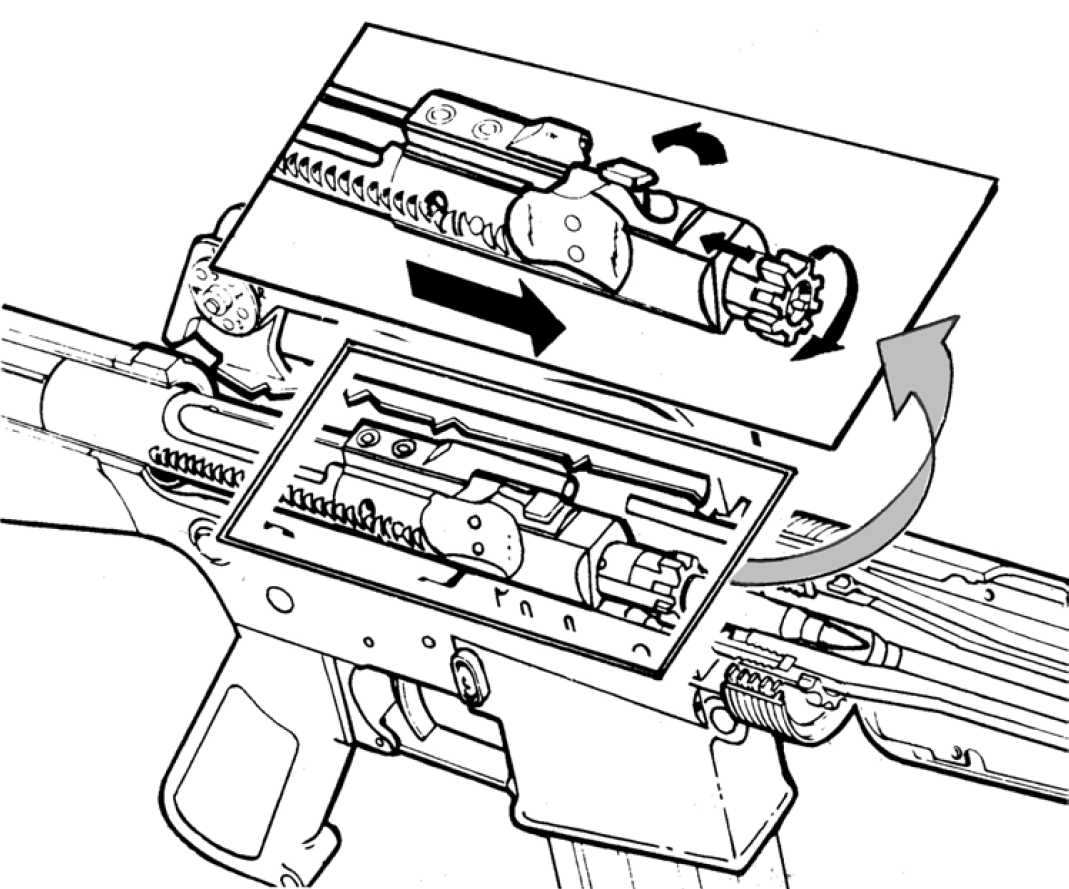
You have to look at how the bolt locks. That gear looking thing at the end of the bolt Passes through then rotates behind locking lugs Sometimes it isn't a gear just a couple of lugs, the key is that they pass by and rotate behind coresponding lugs in the receiver
IMG_8769.png


A blow back gun doesn't lock, it relies on spring pressure and inertia to control the bolt. Rim fire and pistol caliber carbines are usually blow back.
 
Last edited:
The mini 14 has a rotating bolt. M1 Garand, M16, AR15, All have rotating bolts.

You have to look at how the bolt locks. That gear looking thing at the end of the bolt Passes through then rotates behind locking lugs Sometimes it isn't a gear just a couple of lugs, the key is that they pass by and rotate behind coresponding lugs in the receiver View attachment 78317

A blow back gun doesn't lock, it relies on spring pressure and inertia to control the bolt. Rim fire and pistol caliber carbines are usually blow back.
MANY THANKS FOR THAT PERFECT EXPLANATION..... really appreciate it.

J.
 
Good info above and good luck on trying and why??? when things break or stick "Out of position" you'll know , right away,,,why tempt the Gods and try it on your own:unsure::rolleyes:
The reason to try to duplicate it?

You find out right away when the bolt comes flying through the back of the receiver.

I want to verify that the gun cannot fire out of battery safely, before it happens unsafely.

The real reason is my kids safety. I know safety glasses are mandatory a face full of shrapnel is probably not going to be fatal.

I'm trying to train my oldest son to clean and maintain guns. Part of it is functional testing of safeties. So I got to wondering about out of battery discharges and how to test for the potential.

Believe it or not, there isn't much info available. So I came here, and I appreciate all the help sincerely.
 
Unless you're training your son to do gunsmithing, checking for potential OOB is not part of normal manual of arms. There are various measurements that can indicate the potential for this event, but this should not be a factor on most properly assembled newer (past 100 years) designs.
 
Back
Top