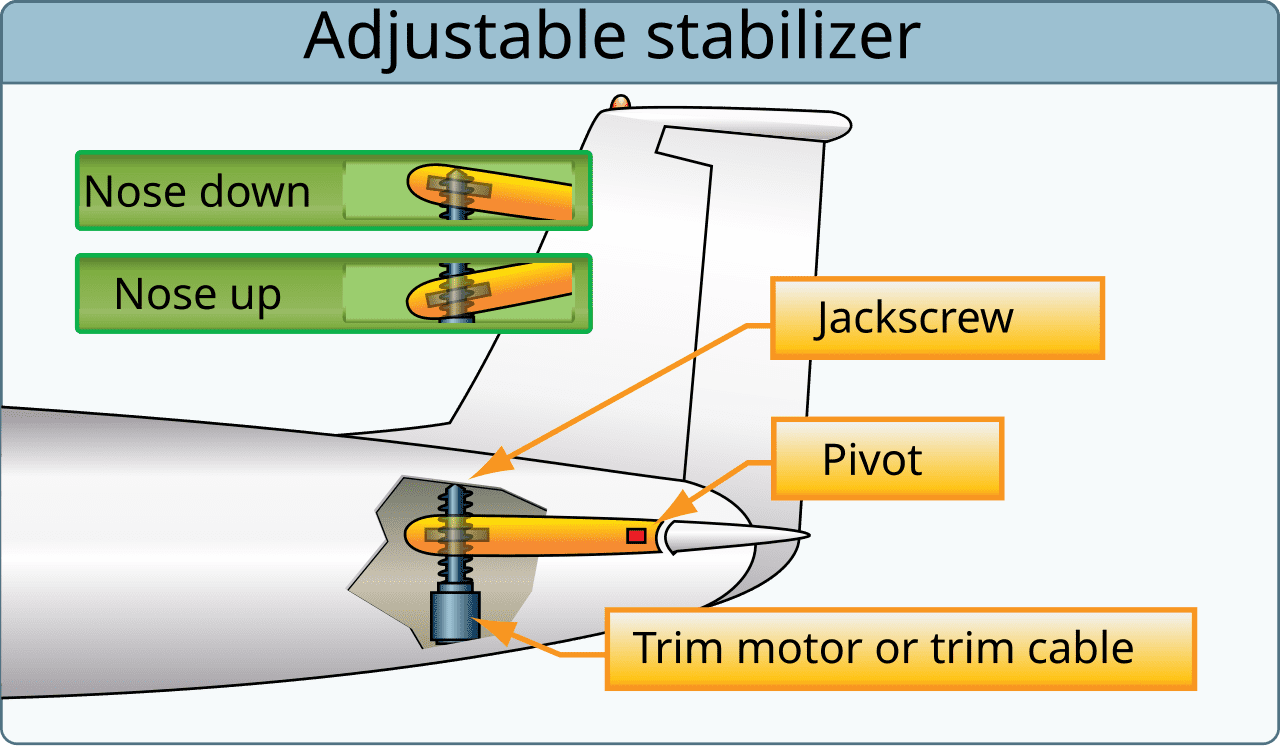
I saw an old ad for the L1011 on Newsmax today and they touted it as the first plane to have adjustable horizontal stabilizers. What exactly were they talking about?
Horizontal stabiles are flap like flight control surfaces on the tail of an aircraft. The vertical stabilizer is the rudder like flight control on the vertical portion of the tail.
Because of the size and mass of large aircraft it’s more difficult to control them. The additional flight surfaces give a larger adjustable surface area and it is quite some distance from the control surfaces on the wings.
I saw an old ad for the L1011 on Newsmax today and they touted it as the first plane to have adjustable horizontal stabilizers. What exactly were they talking about?
Good question. But adjustable horizontal stabilizers (flying tail, stabilator) have been on acft for as long as I can remember. The Bell X1 had to use it for trim as Yeager went supersonic. F-86, IIRC was the first fighter to use it. Both long before Airbus. They're mostly used on large high speed acft for pitch trim (secondary control) & traditional elevators for pitch (primary) control.. Fighter acft & some general aviation, use it as a primary flight control. Military take it a step further & use a split system to help turn faster. In a turn, one will move the leading edge up & the other down. The B-1B, which I worked, Is the largest one that uses the split system.
Thanks guys, that's exactly what I thought they were. It just surprised me that large commercial aircraft like the L1011 was said to be the first aircraft to have horizontal stabilizers. I thought all aircraft had them.
Thanks guys, that's exactly what I thought they were. It just surprised me that large commercial aircraft like the L1011 was said to be the first aircraft to have horizontal stabilizers. I thought all aircraft had them.
As an Amazon Associate we earn from qualifying purchases. Product prices and availability are accurate as of the date/time indicated and are subject to change.
[h3]All-flying tail[/h3]
[edit]
Instead of the trimmable horizontal stabilizer (THS) found on most jetliners of its time, the L-1011 incorporated an all-flying tail – a stabilator. The aft portion had a geared (anti-servo) elevator that was linked to and moved with the stabilator, changing the stabilator's camber and improving the overall control surface effectiveness. Lockheed's main drive away from a THS was "[eliminating] mis-trim and runaway trim problems that have contributed to a number of accidents in the past."[28]: 30–31 [29] The fact that the elevators are not moved directly led to the failure in recognizing the jamming (trailing edge up) of the left elevator aboard Delta Air Lines Flight 1080 in 1977.[30]
A stabilator is a fully movable aircraft horizontal stabilizer. It serves the usual functions of longitudinal stability, control and stick force requirements[1] otherwise performed by the separate parts of a conventional horizontal stabilizer (which is fixed) and elevator (which is adjustable). Apart from reduced drag, particularly at high Mach numbers,[2] it is a useful device for changing the aircraft balance within wide limits, and for reducing stick forces.[3]
Jim, I knew that sooner or later you would come along and have a really good explanation for me. But I had to throw out some old facts in my brain to take all that in so I hope it wasn't something important. Shades of Kelly Bundy !
Seriously, anything to do with aviation, I knew you would have it all. Thanks Jim and all you others too.