BULLET SECTIONAL DENSITY

rcs9250

Single-Sixer
Joined
Mar 16, 2025
Messages
363
City & State/Province
NE Ohio
Do you pay attention to SECTIONAL DENSITY (SD).
Once you learn that the SD on a certain diameter increases as the length of the projectile increases, is there a need to know the specific SD?
Or do you just throw SD figures around when talking reloading and ammo selection to someone that is clueless about what you’re talking about?

Or is there some formula that you throw some desired digits in and it gives an SD and then you search out a projectile with that SD? Asking for a friend. 😂
 
SD matters for accuracy and really stability at long range mostly. I read why the 6.5 creedmore was better at long range over the .243 Winchester. I think they started out in a similar load. The extra sectional density and resulting stability from the faster twist rate also benefitted the 6.5 only beyond 400 or was it 600 yards? Just made me realize that my .243 is about perfect. I don't think even in open country I've ever attempted a legit shot at 400 yds. I'd need a bipod and a 12 power scope to hit anything that far out anyway.
 
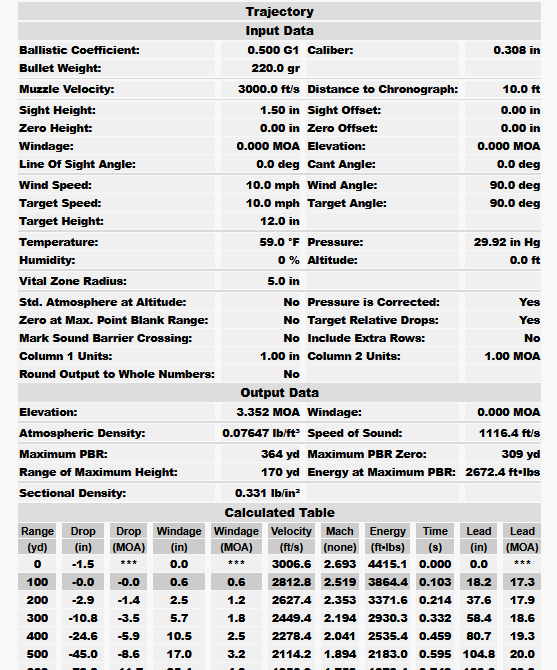
Looking at the jbmballistics link, it does not require SD as an input.

That's correct. It's not an input. It's a calculated value based on the bullet and displayed in the output. Hornady & others will tell you the SD they calculated for their bullets in the bullet specs:

https://www.hornady.com/bullets/rifle/30-cal-308-220-gr-interlock-rn#!/ Same bullet as in the JBM example

JBM example:

1763938912421.png
 
Last edited:
Gunny mentions JBM. If ya want the bottom line for various bullets & calibers performance(drop & energy) at a given yardage, this is the next to last step. The last step is to verify on the range.

But SD isn't really mentioned just as Gunny mentions in post as I was typing. I suppose the program figures all that in when you feed it the info it request. I shoot a lot of long range steel & JBM is used often.
 
Gunny mentions JBM. If ya want the bottom line for various bullets & calibers performance(drop & energy) at a given yardage, this is the next to last step. The last step is to verify on the range.

But SD isn't really mentioned just as Gunny mentions in post as I was typing. I suppose the program figures all that in when you feed it the info it request. I shoot a lot of long range steel & JBM is used often.

It's interesting to note that the shape of the bullet has nothing to do with the SD. A 220grn .308 rnd nose has exactly the same SD as it's pointy nose cousin. Which is the main reason I ignore it. See the Hornady bullet page to compare whatever you like. :)

Theoretically it is one of several factors that does influence terminal ballistics. All things being equal a higher SD will penetrate deeper (if you're lucky) than a bullet with low SD of the same caliber and weight. But as we know there are many, more consequential, factors that effect penetration. Ain't ballistics fun? :LOL:
 
Last edited:
Appears the consensus is what I figured, it’s sort of ignored for the most part. BC, velocity, temp., atmospheric pressure, etc. are more important.
Thanks all for posts.
 
As far as self-defense and hunting rounds I doubt anybody considers SD. The type of bullet is more important. Only long-range target people think it matters.
 
Got it. Thanks.

Here's a little at home experiment you can do. Next time you buy groceries, buy a couple green banana's - the greener the better. When you get home, peel one and shape the meat so that it's the same diameter of your chosen bullet - let's say 220 grn .308", but make it about 3 inches longer. Put your banana bullet on a scale and trim the butt end a little at a time until it weighs the same as your .308 jacketed lead bullet. You'll find the banana bullet is quite bit longer. But hey, it has the same SD! Wow. How cool is that! ;)

Finally, smash your banana bullet - pointy end first - into your forehead as hard as you can and note depth of penetration. Or have your wife/GF/neighbor do it for you. You can do the same with your jacketed bullet, but it isn't really necessary to get the point across. :LOL:
 
Last edited:
I have never been a long range shooter, so sectional density was a factor in choice of hunting bullets. Ruling out bullets that open up early, I would choose the bullets with the highest sectional density. The bullet needs to get inside where the killing takes place and a blood hole on both sides can be good if you end up needing to track. My favorite hunting rifles have been 6.5x55 and the 156 gr. bullets always worked out very well.
 
Rifle bullets used for hunting and long range match or target, yes. But it's just part of the picture which includes SD, BC, weight, length, speed, actual bullet construction.
Handguns: no
 
Do you pay attention to SECTIONAL DENSITY (SD).
Once you learn that the SD on a certain diameter increases as the length of the projectile increases, is there a need to know the specific SD?
Or do you just throw SD figures around when talking reloading and ammo selection to someone that is clueless about what you’re talking about?

Or is there some formula that you throw some desired digits in and it gives an SD and then you search out a projectile with that SD? Asking for a friend. 😂
SD is something I have not given much thought to, primarily since I do not hunt and I am mostly interested in 25 yards or less shooting. However, I think it would be a very interesting subject to study, and learn something about.
 
SD is a good predictor of penetration, more appropriate to solids but still relevant. If you've ever uttered the words, "heavy for caliber", then SD is exactly what you're talking about. People may not pay attention to the SD number, but if you concern yourself with a bullet's weight relative to its diameter, sectional density is exactly what you're paying attention to. SD just puts a value on it. It's also an easy way to compare bullets from one caliber to another. Using SD you'll know that a 250gr .41, 270gr .44, 300gr .45, 325gr .475 and 400gr .500 will all have a similar propensity to penetrate, if all else is comparable. Same for rifles, give similar construction and impact velocity, one might expect similar results from a 120gr 6.5, 140gr 7mm and 165gr .308" diameter projectiles. By the same token, one should know that a 140gr 6.5 is going to penetrate much better than a 140gr .300. It's one tool and one factor of many.
 
SD has it's place in ballistics conversations BUT it's really only important when discussing ranges in excess of most shooters' needs or capabilities.
I've fired quite a bit of .308 ammo at extended ranges. Generally speaking, to get optimal long range performance requires bullets 165 grains and up. To get the velocity necessary requires barrel lengths of 24"+. Enter the 6.5 Creedmoor which delivers similar performance with 140 grain bullets and 22-24" barrels due to the higher SD and faster twist rifling. Even w/o considering the long range aspects, lighter weight rifle plus lower recoil makes most shooters :D .
 
SD has it's place in ballistics conversations BUT it's really only important when discussing ranges in excess of most shooters' needs or capabilities.
I've fired quite a bit of .308 ammo at extended ranges. Generally speaking, to get optimal long range performance requires bullets 165 grains and up. To get the velocity necessary requires barrel lengths of 24"+. Enter the 6.5 Creedmoor which delivers similar performance with 140 grain bullets and 22-24" barrels due to the higher SD and faster twist rifling. Even w/o considering the long range aspects, lighter weight rifle plus lower recoil makes most shooters :D .
But in long range shooting are you even looking at SD or is it always BC? I don't do long range shooting so BC is the factor I'm happy to ignore.
 
But in long range shooting are you even looking at SD or is it always BC? I don't do long range shooting so BC is the factor I'm happy to ignore.
Both, along with MV, bullet design, weight, barrel twist, and many other factors are all preliminary bits of info before you ever pull the trigger for any serious purpose other than sighting in. It's all related to building your confidence in the consistent performance of your weapon system. In many cases you only get one shot to make the kill. That shot has to count, or your wasting your time and your ammo; which is ok if you're only interest is in making noise on the square range. :)
 
Last edited:

Latest posts

Back
Top