I have 2 Blackhawks

Joined
Feb 26, 2010
Messages
419
City & State/Province
South Carolina
I have 2 Blackhawks. One is a 30 Carbine the other an old flat top .357.
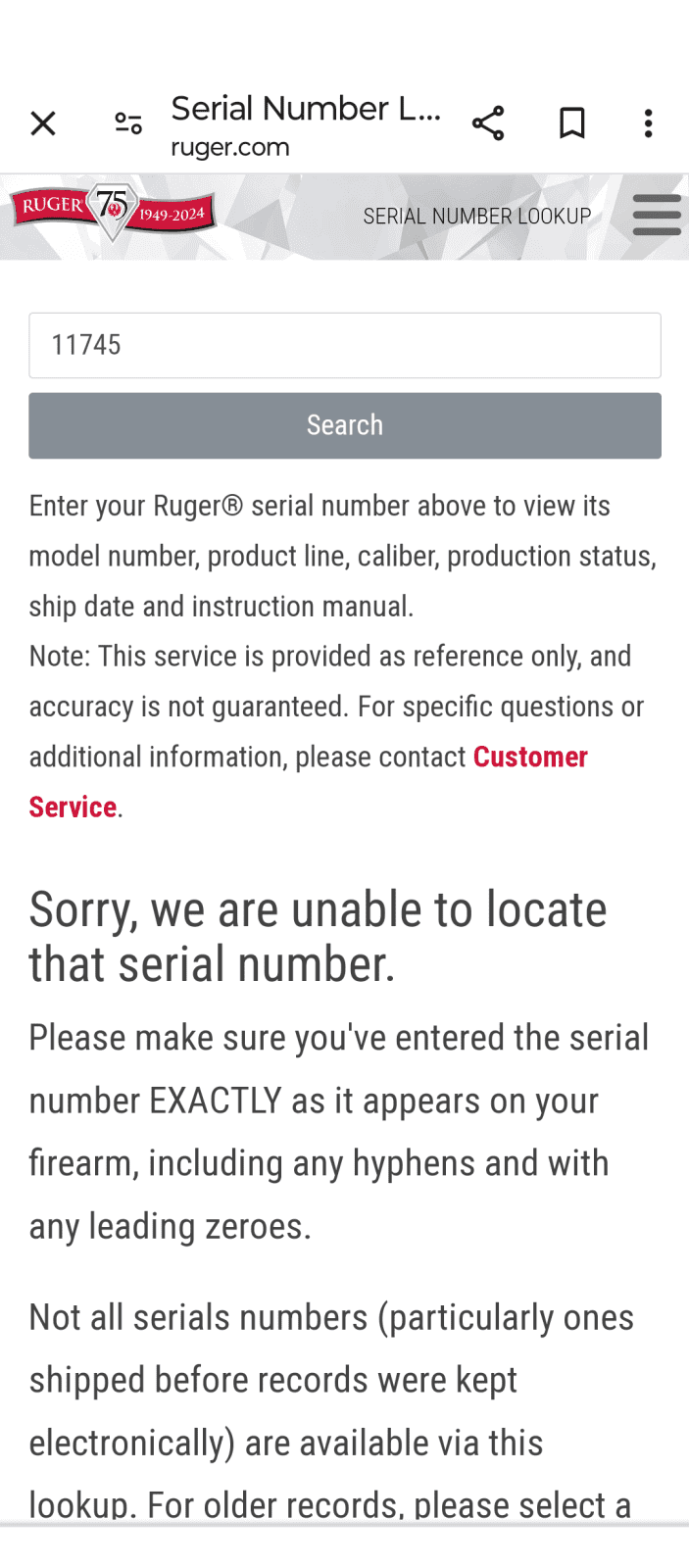
I went to the Ruger website to look up ser#'s both returned not able to find.
Is that common when looking up old models or unusual caliber?
 
Maybe I'm on the wrong website.
This is what I get.
 

Attachments

  • Screenshot_20240316-084035.png
    Screenshot_20240316-084035.png
    66.9 KB
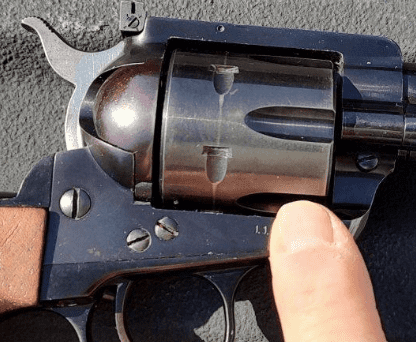
I'm guessing that 745 would solve the mystery part of this SN? :D
1710678794706.png


1710678692655.png


Anyway, much of the older prefixed serial number data has not yet been entered into the data base. And the even older non-prefixed numbers would be ambiguous unless they change the lookup form to also ask for the model of the gun. Prior to GCA68, Ruger started numbering every model at 1, so there will be multiple models with the same number. For example, there is a serial number 1234 Standard Auto, Single Six, .357 Blackhawk, .44 Blackhawk, Bearcat, Super Blackhawk, Hawkeye pistol, 10/22, Deerstalker, .41 Blackhawk, .30 Blackhawk, and #1 rifle. I might have missed some, but you get the idea. So by itself, Ruger has no way of knowing what model serial number 11745 is.

The feds didn't like that ambiguity, which is why GCA68 specifies that going forward (from 1969) a serial number from a manufacturer must identify one and only one firearm in a known caliber. Ruger complied by adding a serial number prefix that identified the model line (and caliber, at least for the Blackhawks). The double action revolvers were mixed calibers from the start, so a -Six DA might be .38, .357, 9mm, .380 Rim. Same with the Redhawk, GP and SP lines, and beyond. Recently, Ruger has even changed their Blackhawk practice with guns of many calibers being numbered with the 38- prefix. But internal to Ruger, they know what caliber a given number left the factory as and can provide the lookup data to everyone since it is all computerized.

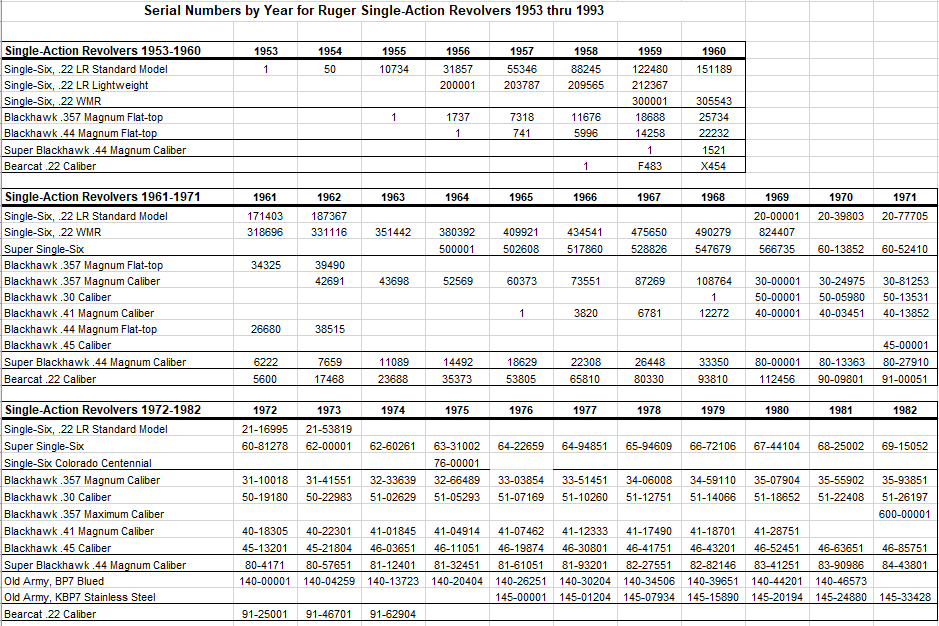
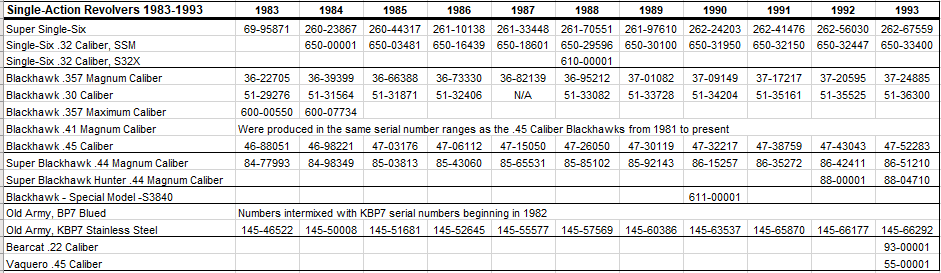
The yearly range tables for models are approximate and should not be considered gospel. There were many reasons for certain individual guns being held back and not shipped in the year expressed in those generalized tables. You would need to get the $10 letter from Ruger to know for sure.

Fun fact: when Ruger fist published the generalized SN range tables, they didn't have their own data compiled into one convenient location. So they took the early tables from Chad Hiddleson's "Red Eagle News Exchange". The two sources may have diverged over the years, but that is where Ruger started.
 
THANK YOU, ROB!

You just prevented me from committing a heinous crime against Ruger collecting.
Years ago I bought Single Six 436716 from a member here. It was missing the cylinder
and since it was marked Single-Six I assumed it was originally a L.R.

But thanks to your chart I see that it should have been a 22 Mag.
Now to find a mag cylinder for it!
 
But thanks to your chart I see that it should have been a 22 Mag.
One big flaw in that chart is the big blank area for regular Single Sixes from 1963 to 1968. All the Single Sixes (standard and WMR) were numbered in the 3xxxxx, 4xxxxx, and 8xxxxx ranges in that period. If the gun has a 6.5" barrel, it would absolutely have a Mag cylinder (RSSM) and possibly a LR cylinder (RSSMX). Other barrel lengths would be the opposite with a definite LR cyl (RSSn, where n=4,5,9) and possibly (probably) also a WMR cylinder (RSSnX). The convertible first appeared in 1961 and as time went on became the more prevalent configuration. It was in the upper end of 3xxxxx that Ruger lumped all the barrel lengths together, having exhausted the 1xxxxx range and with the 2xxxxx range primarily reserved for Lightweights (with a few steel frame exceptions before deciding to skip to 3xxxxx).
 
Just scroll down a little further.

You can view approximate starting serial number (by year) for products prior to 2000 using the selection box below.
serial numbers will only show up on this particular page "IF" the number was digitally entered onto this system. I have not been able to research any individual serial number older than 1976, and from 1976 to about 1984 it is real iffy if those will show up as well.
So if somebody wants generality, they need to look at Ruger's yearly charts of dates of manufacture.
Just google "Ruger Single Six Dates of Manufacture" (or whatever series).
 
OK, It's becoming clear as mud. It's a 5 1/2 incher.
So a L.R. cylinder would likely be correct.
Well, it would at minimum have a LR cyl. It may very well be a convertible that is also missing the WMR cyl.

At that point, the single cylinder guns were pretty scarce. A letter would be the only way to know for sure.

In the mid-1960s period, your gun would be either a RSS5X (convertible) or RSS5W (single LR cyl). They started using the W, which in the XR3 days stood for Wood grips, to denote single cylinder guns in that early XR3-RED period. I have RSS5Ws in the 38xxxx and 39xxxx ranges and also two in the 82xxxx range. But there should also be a few in the 4xxxxx range.

Inconsistency was the only consistent thing about Ruger's catalog numbers and serial numbering.
 

Latest posts

Back
Top