(Update),Quick Automatic Transmission Fluid Question

Joined
Nov 15, 2005
Messages
15,630
City & State/Province
Greenville, SC: USA
There is a maximum level on the dip stick for automatic transmissions... what happens if you put too much in?

Our new rebuilt transmission (last year).. 2009 Ford Flex with 90,000 miles is leaking a bit, my local mechanic noted it a few months ago and I have not had time to get it back to the dealer..... been adding fluid but it is hard to determine the level.... almost impossible to see this thin stuff.... and a few days ago I added some more and now with it cold, engine running or not, the level (which I can now see) is slightly above the max at hot. I've got a couple hundred mile road trip tomorrow... should I crawl under there and try to figure out how to drain some out or not worry about it?
 
If it's way over full it'll come out the vent if you're towing and really getting it hot, if you're a little over full I wouldn't be concerned at all.
 
So, how do you know if it is a 'little' over full or too much? I guess we'll all know later today or by tomorrow...

I'm going to look in the owners manual and see what the trans holds and figure out if the half a quart I put in is too much....
I'll have to use reverse transmigrational calculations to figure this out.
 
As an Amazon Associate we earn from qualifying purchases. Product prices and availability are accurate as of the date/time indicated and are subject to change.
There is a maximum level on the dip stick for automatic transmissions... what happens if you put too much in?

Our new rebuilt transmission (last year).. 2009 Ford Flex with 90,000 miles is leaking a bit, my local mechanic noted it a few months ago and I have not had time to get it back to the dealer..... been adding fluid but it is hard to determine the level.... almost impossible to see this thin stuff.... and a few days ago I added some more and now with it cold, engine running or not, the level (which I can now see) is slightly above the max at hot. I've got a couple hundred mile road trip tomorrow... should I crawl under there and try to figure out how to drain some out or not worry about it?

"Slightly above max hot" Hot and running? Slightly as in 1/8" , 1/4" ?

ATF is checked hot and running. That makes sure the coverter is full as some fluid drains to the pan while sitting.
 
Run a small hose down the "inlet" tube, add a suction device and suck out transmission fluid. Check the level periodically until you hit "FULL COLD" Or if the transmission is hot hit "FULL HOT"; squirt what you extract into a measuring cup to see how much too much you had. Problem solved !!
 
A long time ago, in a galaxy far, far away, the max line was used when checking the fluid hot. Just like your coolant level reservoir.
My Tacoma doesn't have a dipstick. 🙁
 
Well..... I made it home with out doing the calculations or trying to suck the stuff out. I actually thought of just draining some out from the bottom but would have had to crawl under there and try to figure out a drain plug.... the realty is I did not have time ... wife and I needed to load up and get out of the beach house by 10:00.... in the back of my mind I kept thinking.... the dean thing has a leak already so should not any excess just leak out.... then again I'm reminded of a road trip 14 years ago.... in my wife's Porsche ..... I topped all the fluids off before we headed out... and over filled the coolant reservoir.... found out when we stopped in VA that if you do this it will overflow and syphon all the coolest out ..... got lucky and got her mechanic on the phone late in the day... here was the solution... jack the back end up.... pull the cover off the coolant reservoir in the back truck... release the pressure relief valve on the side and over the next hour slowly pour antifreeze in until you have at leas a gallon in there.... then over the next couple of days keep adding.... the two radiators were in the front behind the head lights... engine is in the middle behind the seats and in front of the rear truck....
 
If I am changing the fluid and screen, first thing I add is a drain plug in the pan. Makes service much easier going forward.
 
A lot of the newer transmissions are "sealed" units that have no way of you checking. Supposedly the fluid is some synthetic stew that doesn't need changing or maintenance. Theoretically, the service provider can hook it up to a "black box" analyzer and tell the fluid level. Right.
 
So, I check the level yesterday, again with a cold engine running... before it was above the max at hot line now it is half way down to the cool line.... this after a drive of 225 miles.
Cold engine?

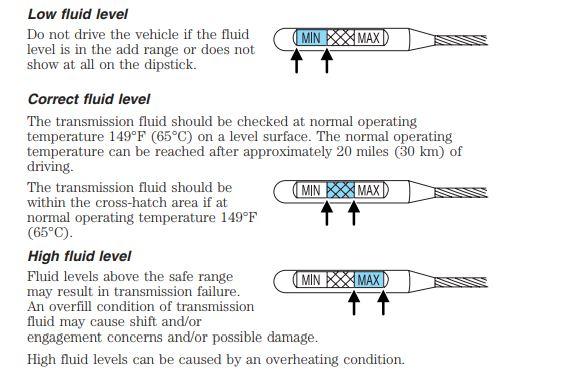
From 2009 Flex owners manual.

Automatic transmission fluid expands when warmed. To obtain an accurate fluid check, drive the vehicle until it is warmed up (approximately 20 miles [30 km]). If your vehicle has been operated for an extended period at high speeds, in city traffic during hot weather or pulling a trailer, the vehicle should be turned off for about 30 minutes to allow fluid to cool before checking.

1. Drive the vehicle 20 miles (30 km) or until it reaches normal operating temperature.
2. Park the vehicle on a level surface and engage the parking brake.
3. With the parking brake engaged and your foot on the brake pedal, start the engine and move the gearshift lever through all of the gear ranges. Allow sufficient time for each gear to engage.
4. Latch the gearshift lever in P (Park) and leave the engine running.
5. Remove the dipstick, wiping it clean with a clean, dry lint free rag. If necessary, refer to Identifying components in the engine compartment in this chapter for the location of the dipstick.
6. Install the dipstick making sure it is fully seated in the filler tube.
7. Remove the dipstick and inspect the fluid level. The fluid should be in the designated areas for normal operating temperature
 

Attachments

  • atf fill.JPG
    atf fill.JPG
    46.1 KB
Thanks for that Dan.... but if you look and read the instructions then you realize the engineers at Ford have pretty much designed something that can not be maintained or instructions that no one will follow... the picture you showed has a fluid correct area of less than 1/4" inch and no where can I find any way to know how much fluid to add if it is in the minimum area that the instructions say if it is in this area do not drive the vehicle, same for the over full area.... Point being ... you drive the vehicle for 20 miles, stop on level surface (don't have that at my house, check the level... it is too low.... how much do you add to get to that iddy biddy proper level? if you put too much in you should not drive it and if it's too little the same... and oh when you add some down the tube that has the dip stick in it then you can't check the level anyway because it coats the whole stick.

My only point being that I'm glad I did not read those instructions last week.
 
I don't think any of my farm equipment has a "add x amount" on the dipstick. It's sort of a 'hunt and peck' process being on the conservative side but then there's far more leeway with something that holds 25 gallon(I normally run tractors 'full plus 2 gallon' to account for hose and cylinder leakage).
I did have a difficult situation with a Dodge Dakota once upon a time. I changed the trans filter and replaced the oil as directed by the OM. It seems the dimwit who wrote the manual used the amount required for a completely dry system. Yeah, that filled the case and overflowed the filler tube. I spent about 2 hours pulling the extra oil out with a suction tube.
 
My Toyota guy says the only way they can be sure of the amount is to drain it and refill as they measure the amount going in. Must not be a way to measure the level at all, since it lacks a dipstick. There IS an overflow(?) nut on the side of my Transmission, which I have used to install additives.
 
UPDATE: So I made it home with no problems... then a week later coming back from church the car did this thing it does every so often.... all the lights on the dashboard come on and the engine looses power but does not shut off... thought we had fixed this by replacing some electronic throttle control module thingy... when my mechanic did this a few months ago he also mentioned if this thing is bad it will mess up the transmission....! (I wonder now ti the reverse is also possible... if the transmission has a problem it effects this. ) Either way, when this happens the fix is actually pretty simple.. pull over shut the car off and then start it back up...

But this time when I did that and went to put the car in gear it jumped like crazy in Reverse and when I moved it into drive... so I got out and checked the Trans. fluid level with the engine hot and running... none showing... so I add a half a quart and it was good. bottom line... way past due taking it back to the dealership to figure it out. Which we did this past week.... I just assumed the problem would be fixed under the warranty since it has only been a year and a half since the refurbed trans was put in.....

Dealer ships assessment: not the transmission... HUH? Not covered under the warranty! Then they wrote out what is wrong and it boggles my brain... but I actually believe them... I like contender here have to cuss automotive engineers.... the fix is simple but will take two days or more to do....

"bad gasket on the timing belt cover."

I actually think if they were going to 'make something up' they could do a lot better than that....

What in the world does the timing belt have to do with the transmission fluid? This is one of those side ways engines that is installed so that nothing is accessible it seems.... recall that the water pump went out about 2 years ago... that also takes two days to replace.

So it seems the timing belt cover is even harder to get to:

Anywho... Fords estimate to replace the gasket on the timing belt cover is $2,200.
 
I don’t think a timing belt cover would have a gasket. Most run dry and a gasket isn’t needed.
I could be wrong though.
 
Dealer ships assessment: not the transmission... HUH? Not covered under the warranty! Then they wrote out what is wrong and it boggles my brain... but I actually believe them... I like contender here have to cuss automotive engineers.... the fix is simple but will take two days or more to do....

"bad gasket on the timing belt cover."
I bet they fix your trany leak while changing the timing belt gasket not under warranty. Pay for this get that, the ole switch-a-roo
 

Latest posts

Back
Top