primer pocket, and roll crimp on .44 magnum

J. Yuma

Single-Sixer
Joined
Apr 4, 2024
Messages
388
City & State/Province
north carolina
As a relatively new shooter, and a rookie reloader, I'm wondering about two things.

1. primer pocket cleaning.
I took a drill bit, ground the tip flat, dulled the flutes, and use it to "clean" the pocket. But I've also reloaded and shot ammo without cleaning the primer pocket.
Thoughts?

2. roll crimping
I have the 4 piece set of Lee dies, it includes the roll crimper. But I've noticed that when seating a bullet, the seating die squeezes the cartridge neck. Youtube research suggests this taper crimp is sufficient, but in my case (.44 mag) is it worth the extra step?
thoughts?
 
Last edited:
#1: Bad idea using a drill bit to clean primer pockets since a LEE primer pocket cleaner(which won't enlarge the pocket or cut it deeper) is only a few $.
#2: A 'taper crimp' might work on some loads but can result in bullets unseating at higher recoil levels. This will tie up the revolver. A roll crimp will hold the bullet in place better but must be placed at the crimp groove of the bullet to prevent or minimize bullet/case deformation. Adding a roll crimp is a good plan for the 44 mag and worth the extra step in loading process.
 
I use the dulled drill bit gingerly.
I invert it into a wood block, put the case on top and give it just a half twist.
But I agree with you, thanks!
 
When I was shooting PPC I was shooting about 1200-1400 rounds per week. I would clean the cases (tumble or vibrator cleaner) and then reload them. I never purposely cleaned the primer pockets and I never had a misfire. Cleaning that many primer pockets individually would have taken too much time (I was using a single stage loader). I later upgraded to a Dillion Square Deal B which really sped things up and I would clean the pockets about every 3rd reload.
 
Lose the drill bit. Not a good idea.
Get a tool to clean the pockets if you desire them to be clean.

Heavy recoiling rounds like a .44 mag can have the bullet "jump the crimp" and move forward while you are shooting other rounds. As such, it can bind up a cylinder.
Use a roll crimp, and learn how to properly adjust your dies to do so. A taper crimp is used in a few semi-auto calibers due to the fact they headspace on the case mouth AND the fact that the cases are also tapered a bit.
You can back out your die body & increase the depth of the seating plug to if necessary.

I shoot a LOT of ammo in USPSA competition. I use a Dillon progressive loader. I clean my cases using a wet tumble method & stainless steel pins. I do not deprime the cases prior to cleaning. (This method of cleaning can also clean the inside of the case.) Primer pockets do not get enough of a build up or crud to be an issue.
If I'm loading any ammo that I want to be as "perfect" as possible,, I resize & deprime the clean cases, then I run them through the tumbler again, cleaning off any sizing lube and part of the primer pocket. I them use a primer pocket cleaning tool (or if it's new brass or once fired,, I also have a primer pocket uniforming tool.) Next I trim the cases to uniform length. (Most of this is bottleneck cases, as most straight walled cases don't need trimming.) Basically, making the cases as clean & uniform as I can.
 
As an Amazon Associate we earn from qualifying purchases. Product prices and availability are accurate as of the date/time indicated and are subject to change.
You are on the internet so you will get all kind of advice. Mine is to learn to do what works for your situation without just going along with what the majority does.
I learned to wear my own kind of hat early on, because there was no one to mentor me. When it comes to advice, mine or those of others, take what you want and leave the rest.
I like to process all my brass whether once fired or new with a process that includes: full length sizing, cleaning, de-priming, primer pocket uniforming, flash hole deburring, and case length trimming with case mouth chamfering and deburring.
I shoot mainly large bore cartridges so I use a single stage press and roll crimp most cartridges. I process my cases in bulk so they are ready to load when I am. Most of the time I hand seat my primers and do them as a first step when deciding what to load. When I sit down to load it is just a matter of adding powder and seating the bullets. It doesn't take as long as one might think when done in stages like some of us do. I do own a Dillon 550 press, but its priming system has never worked right for long. I never unpacked it from my last move.
My focus when loading is to take my time, load the best ammo I can make with my current knowledge and tailor my load to the gun I am loading for. I have a good friend that shoots only factory because he considers reloaded ammo inferior. I see reloaded ammo just the opposite when I am shooting a cartridge I tailored for that specific firearm.
These days macular degeneration has wrecked my eyesight and thus my groups with most handguns. However, that doesn't mean I don't still enjoy loading for them.
Good luck in your journey. Read the "How to" copy in your loading manuals and you will be surprised how far that will take you.
 
Primer pockets...I don't worry about them, I just deprime and then re-prime. Like @RoninPA wrote, they don't get that gunky.

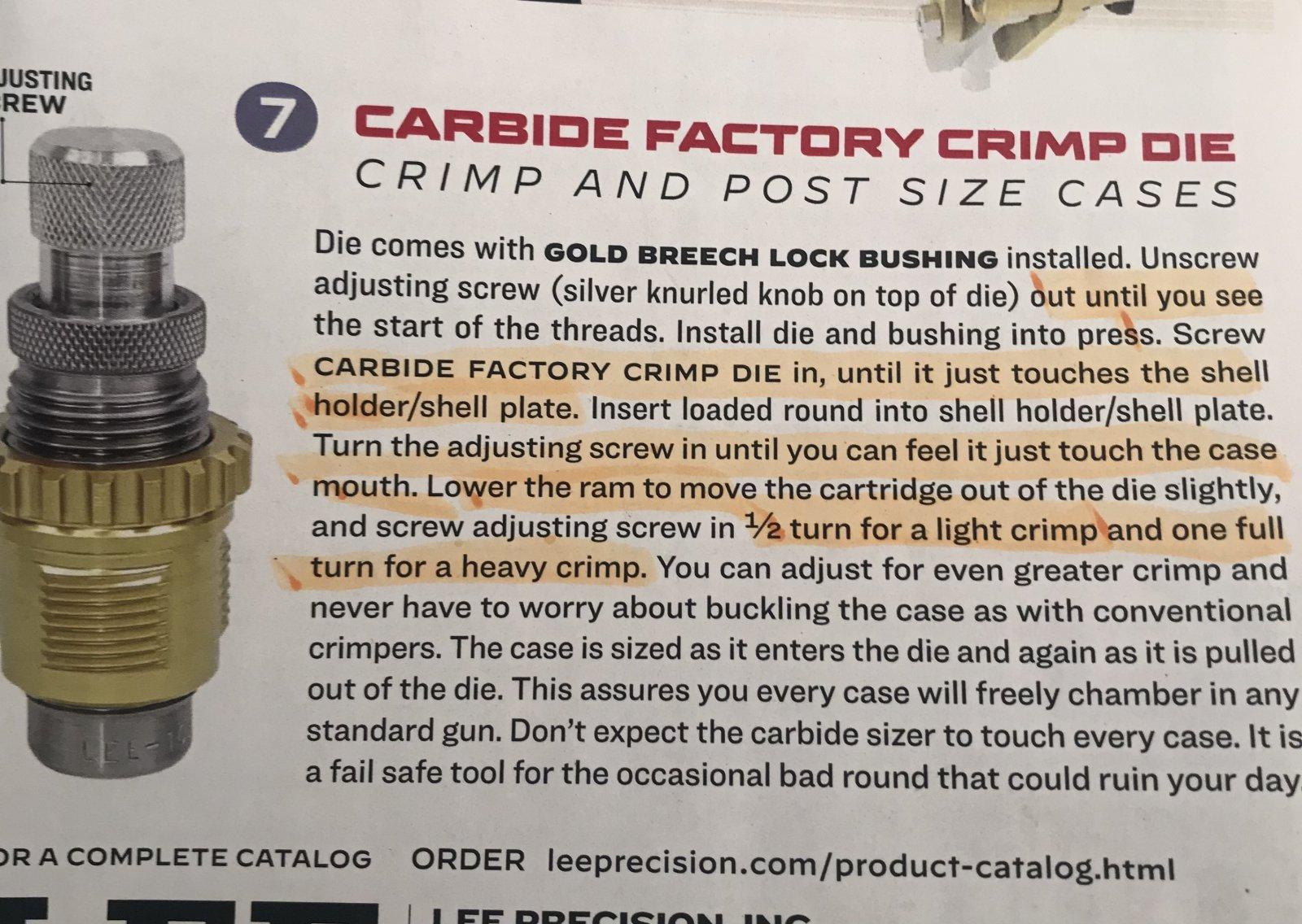
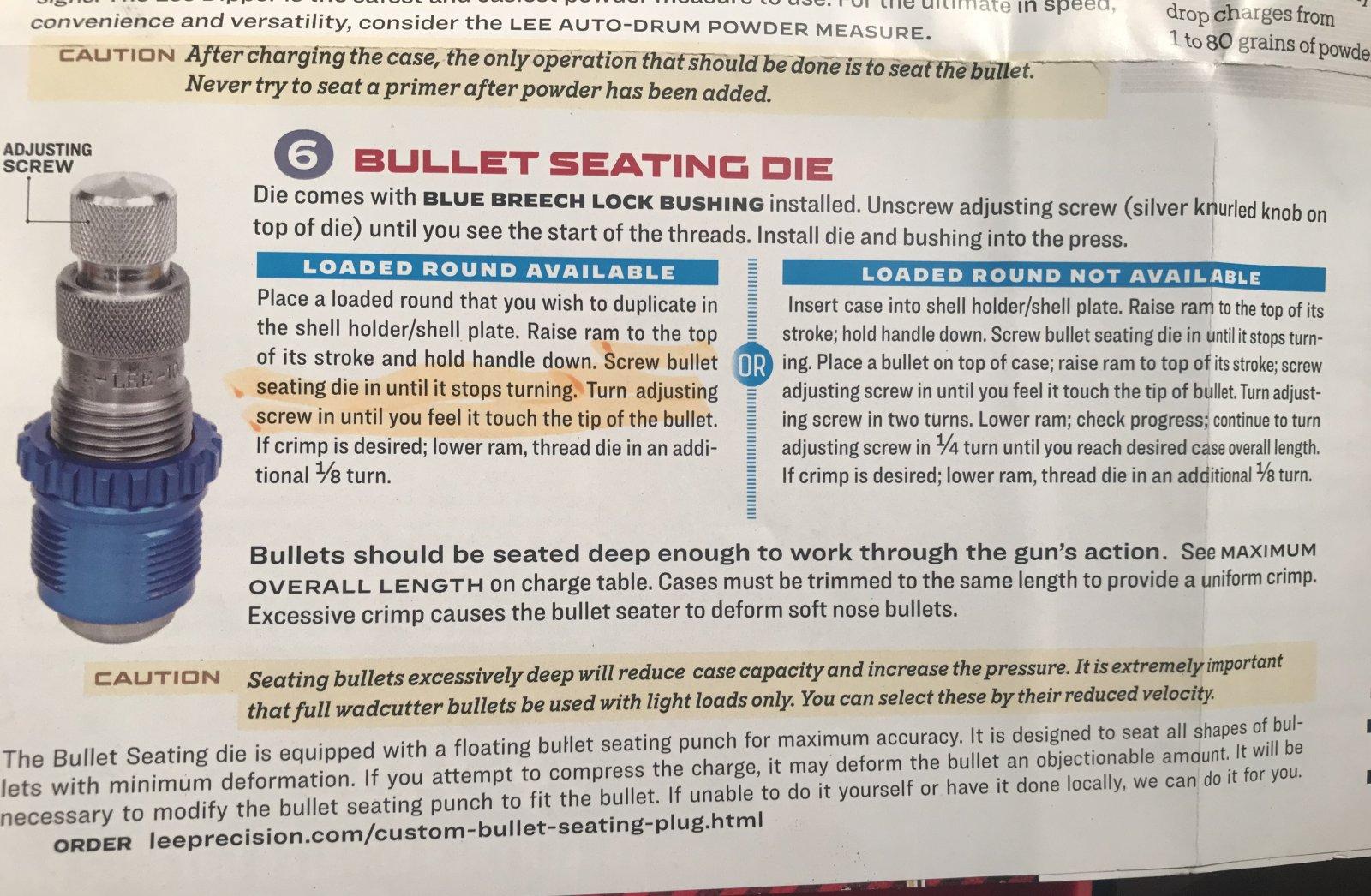
As for crimping dies, you mentioned that you had the 4-die set. What you may have is a standard seating/crimp die that applies a standard roll crimp. The 4th die would be the Lee Factory Crimp die, which would be used in place of the roll crimp. What your seating die is applying is most likely a roll crimp, but you may not be familiar with the difference.

A taper crimp basically swages down the diameter of the case so that the case walls contact the bullet, with the tension/friction holding the bullet in place. These are used for semi-auto pistol (and some rifle, like .30 Carbine) cartridges because those calibers tend to headspace on the case mouth (the flat face of the case wall around the bullet). I highly suspect you have a taper crimp die with your Lee set for .44mag.

A roll crimp "curls" the edge of the case into the crimp groove/cannelure of the bullet, along with some "necking down" to bring the case walls in to contact the bullet. This is what most revolver and rifle cartridges use.

I'm not exactly sure what crimp the .44mag Lee Factory Crimp Die applies, since I don't use it for my revolver cartridges (.38 Special/.357mag, .41mag, .44mag), but if it's anything like the rifle die, it applies a roll crimp with a collet that also resizes the neck for a tighter "grip" on the bullet.

You would only need to apply one crimp, either a roll crimp with your seating/crimp die or seat without crimping (crimp die screwed out so it doesn't contact the case walls, but the seater plug adjusted to seat the bullet) and then crimp with the FCD.

Hope that helps.

Aqualung
 
Do a test. Load 50 without cleaning and 50 with, and see if you get better accuracy.
I agree with RoninPA and Aqualung on 44 mag, or any other pistol case. Not worth the time,
but find out for yourself. That's the fun of reloading:)

Long range rifle match shooting is different.

Cheers,
JAYDAWG
 
I always scrape the Primer Pockets out, that way
I know the Primer edges are not crushing down
residue and even.

I crimp all my different cartridges I reload.
In a separate step always.
Learned my lesson with the 223Rem. Bolt
Action.
Not crimped = not as accurate. Crimped =
improved accuracy. I've seen this in other
cartridges in my years of reloading.

I use only Lee Factory Crimp dies (FCD).
The collet finger squeeze type for Rifle.
The Roll Crimp radiused interior type for
Revolver/Pistol.

My experience. The Best to you and your
Endeavors.
 
Since the replies have correctly explained the crimping, I only add that I use an ultrasonic cleaner to clean all my cases. And it works very well. I don't need shiny cases, anyway.
 
Very good advice. Always clean primer pockets. I use the Lee factory crimp dies. The standard bullet seat dies work. But, after a recommendation from a member here, I bought the Lee dies for each straight wall case I load.
 
You are on the internet so you will get all kind of advice. Mine is to learn to do what works for your situation without just going along with what the majority does.
I learned to wear my own kind of hat early on, because there was no one to mentor me. When it comes to advice, mine or those of others, take what you want and leave the rest.
I like to process all my brass whether once fired or new with a process that includes: full length sizing, cleaning, de-priming, primer pocket uniforming, flash hole deburring, and case length trimming with case mouth chamfering and deburring.
I shoot mainly large bore cartridges so I use a single stage press and roll crimp most cartridges. I process my cases in bulk so they are ready to load when I am. Most of the time I hand seat my primers and do them as a first step when deciding what to load. When I sit down to load it is just a matter of adding powder and seating the bullets. It doesn't take as long as one might think when done in stages like some of us do. I do own a Dillon 550 press, but its priming system has never worked right for long. I never unpacked it from my last move.
My focus when loading is to take my time, load the best ammo I can make with my current knowledge and tailor my load to the gun I am loading for. I have a good friend that shoots only factory because he considers reloaded ammo inferior. I see reloaded ammo just the opposite when I am shooting a cartridge I tailored for that specific firearm.
These days macular degeneration has wrecked my eyesight and thus my groups with most handguns. However, that doesn't mean I don't still enjoy loading for them.
Good luck in your journey. Read the "How to" copy in your loading manuals and you will be surprised how far that will take you.
good stuff!
 
Primer pockets...I don't worry about them, I just deprime and then re-prime. Like @RoninPA wrote, they don't get that gunky.

As for crimping dies, you mentioned that you had the 4-die set. What you may have is a standard seating/crimp die that applies a standard roll crimp. The 4th die would be the Lee Factory Crimp die, which would be used in place of the roll crimp. What your seating die is applying is most likely a roll crimp, but you may not be familiar with the difference.

A taper crimp basically swages down the diameter of the case so that the case walls contact the bullet, with the tension/friction holding the bullet in place. These are used for semi-auto pistol (and some rifle, like .30 Carbine) cartridges because those calibers tend to headspace on the case mouth (the flat face of the case wall around the bullet). I highly suspect you have a taper crimp die with your Lee set for .44mag.

A roll crimp "curls" the edge of the case into the crimp groove/cannelure of the bullet, along with some "necking down" to bring the case walls in to contact the bullet. This is what most revolver and rifle cartridges use.

I'm not exactly sure what crimp the .44mag Lee Factory Crimp Die applies, since I don't use it for my revolver cartridges (.38 Special/.357mag, .41mag, .44mag), but if it's anything like the rifle die, it applies a roll crimp with a collet that also resizes the neck for a tighter "grip" on the bullet.

You would only need to apply one crimp, either a roll crimp with your seating/crimp die or seat without crimping (crimp die screwed out so it doesn't contact the case walls, but the seater plug adjusted to seat the bullet) and then crimp with the FCD.

Hope that helps.

Aqualung
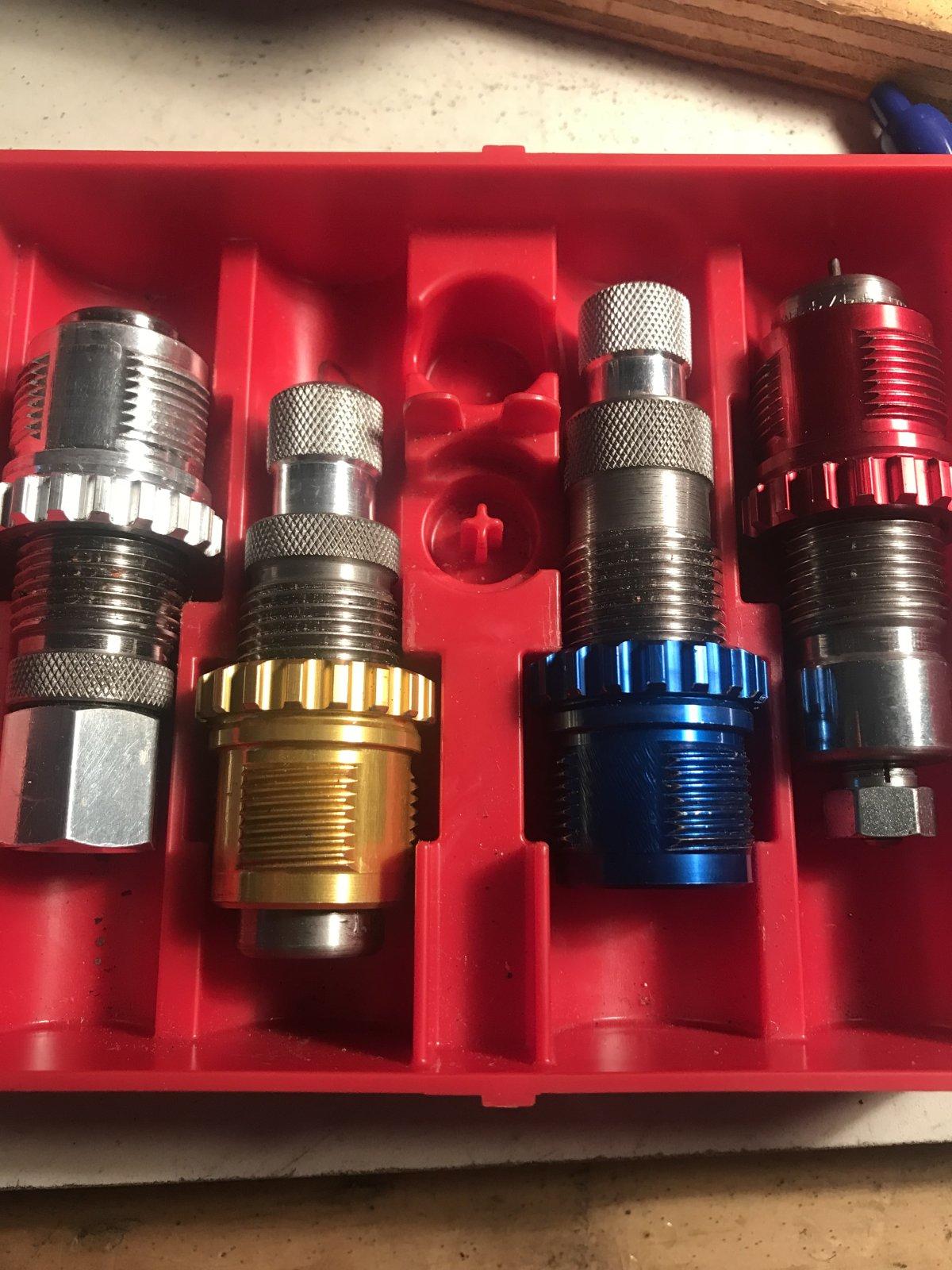
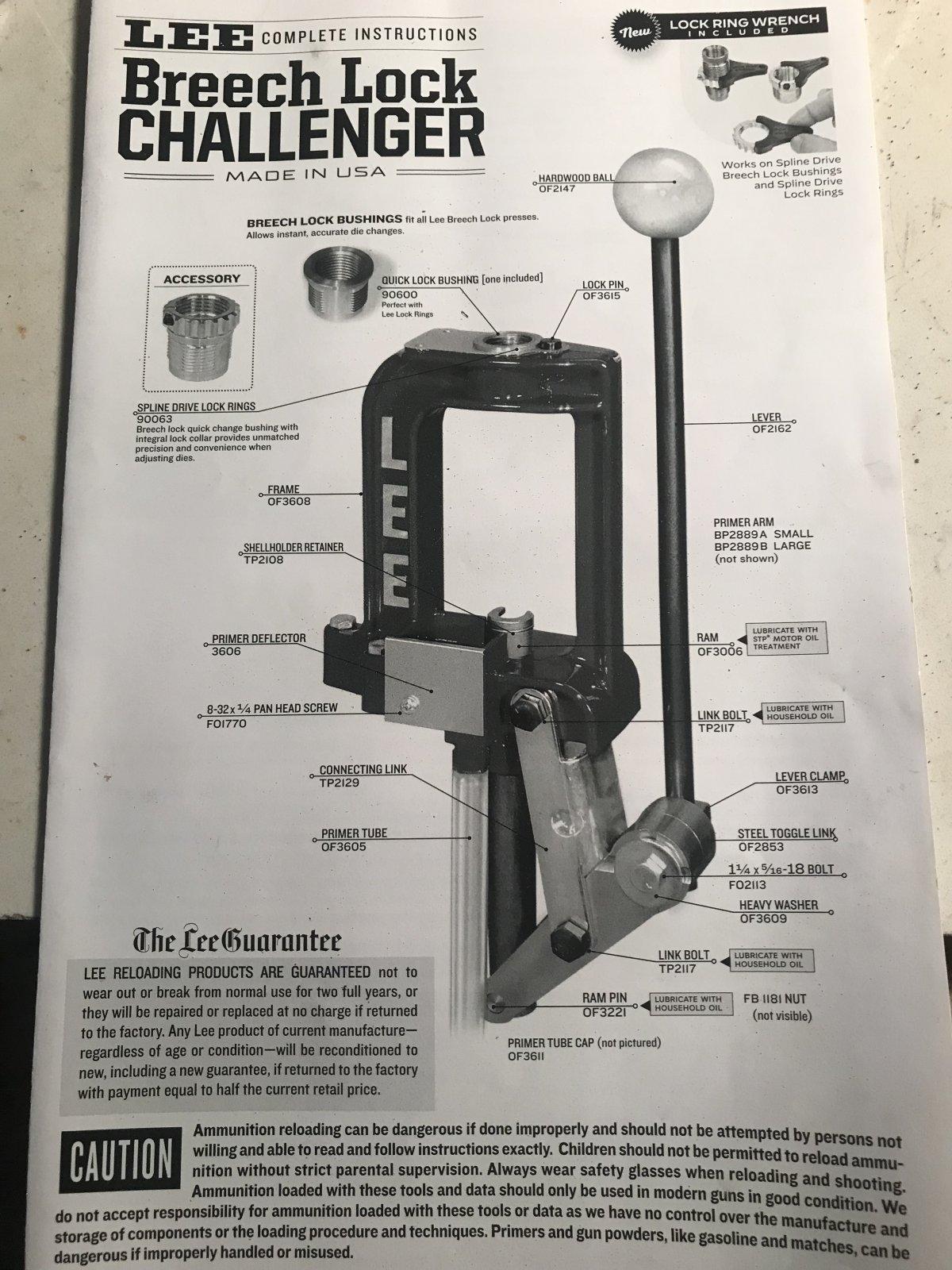
I bought the 4 die set with that fast release feature. I have a little plastic pin wrench, so swapping dies out is easy.
It has a sizing and decapping die, a powder loading and case bell mouth die, a bullet seating die, and a roll crimping die.
If I'm following you, you're saying that the seating die applies a roll crimp too?
I have a single stage press.
I also use a Franklin Arsenal primer, I find it's faster than the Lee thing that rides on the press ram.
I enjoy the process, and now that I limit myself to 48 rounds per session, it's easy to keep up with needs.
thanks!
 
I always scrape the Primer Pockets out, that way
I know the Primer edges are not crushing down
residue and even.

I crimp all my different cartridges I reload.
In a separate step always.
Learned my lesson with the 223Rem. Bolt
Action.
Not crimped = not as accurate. Crimped =
improved accuracy. I've seen this in other
cartridges in my years of reloading.

I use only Lee Factory Crimp dies (FCD).
The collet finger squeeze type for Rifle.
The Roll Crimp radiused interior type for
Revolver/Pistol.

My experience. The Best to you and your
Endeavors.
I like to clean the primer pockets too, I too, reasoned that the primers would seat better.
Too many years messing with bearings to press something into a blind hole with residue 😵‍💫
 
As you can see,, there are varying opinions about primer pocket cleaning,, or the lack thereof.

When you need a LOT of ammo especially where long range match precision (such as rifle shooting,) it can be a tedious process.
But the question centered around .44 mag ammo. So,, that's different than long range precision rifle shooting. And if you are a person who shoots a fair number of competition matches often,, you'll see that almost ALL of them when shooting pistol rounds do not bother cleaning primer pockets. They need thousands of rounds monthly and they don't have the time to hand clean that many each month. Dillon has progressive presses used by the hundreds of thousands of handgunners who never clean primer pockets.
Yet,, they also offer a special press just to process rifle cases. The CP2000. And even there,, most don't try & clean primer pockets.
With all that,, people WIN competitions w/o cleaning primer pockets.

I'm not saying never do it,, or if you desire to do it,, I'm saying it isn't as necessary as other aspects of handloading ammo.
 
this is all great information, the subject is fascinating.
but what's most fascinating is the logic, the use of reason, and deduction.
To me, firearms and reloading is still mysterious, more like alchemy than sound practice derived from years of experience.
but i'm having fun.
Went to the range today, shot my new regimen of 48 rounds of .44.
However, today I shot the last 6 standing up, with one hand, and instead of at 75 feet distance, I put the target at 10 meters, ala Olympic Air Pistol. LIKE THE TURK!


Attachments

  • 760632CF-CB18-4239-8C1A-747432B87C46.jpeg
    760632CF-CB18-4239-8C1A-747432B87C46.jpeg
    18.3 KB
I don't think I have ever cleaned a primer pocket. I have the tools to do it, but haven't seen the need to use them.
 
I bought the 4 die set with that fast release feature. I have a little plastic pin wrench, so swapping dies out is easy.
It has a sizing and decapping die, a powder loading and case bell mouth die, a bullet seating die, and a roll crimping die.
If I'm following you, you're saying that the seating die applies a roll crimp too?
I have a single stage press.
I also use a Franklin Arsenal primer, I find it's faster than the Lee thing that rides on the press ram.
I enjoy the process, and now that I limit myself to 48 rounds per session, it's easy to keep up with needs.
thanks!
I don't know your particular set. However, the seating dies I've seen are also crimping dies so you can both seat the bullet and apply the crimp in one action (let's not get start the discussion as to which way is better [one operation vs separate]...that tends to start internet fights like .45 vs 9mm and the like ;)...but I'm an admitted "one-stroker" for all my revolver ammo with no resulting bad results).

Not to sound snarky but check the instructions that came with the dies (if you bought them new and they're included). They will tell you.

I just looked at my Lee set (I have the 3-die set) and my seating/crimping die is stamped "LEE-44MAG-C4".

Looks like your ammo is working for you...that's great!

Aqualung
 
Since we are discussing the crimping & especially recommending a roll crimp for a boomer, I'll add a little more.

Quite often,, many loaders who have a normal 3-die set,, where the bullet seating die is also the roll crimp die,, separate the process. The back out the die body away from the crimp ring,, then seat the bullets. After seating is done,, then they back out the seater plug,, and then set the die to just crimp the cases.
Others often buy spare dies to just set & lock the seater and have the spare for just crimping. Making it an actual 4 die set.
 
Accuracy is hard to achieve if your cylinder is tied up or the cartridge does not detonate properly. If the primer pocket is not clean and cut uniform to the same depth, you have a chance of a primer not fully seating. If that were to occur sometimes the hammer strike will seat the primer while trying to detonate it. It can end up being like a light hammer strike to the cartridge. Most people see what they think is a "flyer" so do not understand its cause. OR, it can cause the cylinder to drag or stop turning depending on how much of it is not fully seated. This is more rare then the first description but does happen. Case prep devices are made by several suppliers. Mine is by RCBS and has tool spots for a primer pocket uniforming tool, flash hole uniforming and deburring tool, case mouth chamfering tool, case mouth deburring tool, and a couple other spots for tools you might need like a case mouth lube brush.
My case prep machine was an expensive addition at the time but has been worth it to me over the years I have had its use.
If you just want something to go bang, none of these steps are needed.
In my quest for accuracy, there were three elements that had to be addressed for me. The firearm had to have good enough specs. to give good accuracy. The ammunition had to be good enough to take advantage of those good specs. And, I had to shoot well enough to take advantage of the other two. I addressed the first by having guns rebuilt by good custom gunsmiths. The second by using all the loading techniques I could learn about. So, if my accuracy was lousy, I could pretty much count on it being my faulty shooting.
When we talk about crimp, especially in a big bore straight wall case, the subject must include case length. When roll crimping cases you have to have uniform length cases to get a uniform amount of crimp. The crimp effects the internal combustion process that happens when the cartridge is detonated. The idea for accuracy is to have each process in the loading of the cartridge be as uniform as possible. If you are shooting at a steel plate to make it ring, it may not make a difference. If you are trying to place a bullet in a precise spot on an animal, it may make all the difference in the world. Including, whether you survive the experience. The good news is, you get to choose what you want to do when you load your ammunition. Good luck.
 
looks like the seating die also crimps (if you trim the cases a uniform length?)
the "factory crimping die" came with my die set.
Imma gonna keep usin it!!!
anyways, always learning 🤔
 

Attachments

  • F5B8D67E-E8E5-48C6-95F8-572A1DC3AC06.jpeg
    F5B8D67E-E8E5-48C6-95F8-572A1DC3AC06.jpeg
    236.3 KB
  • F716EF5E-8A5F-49C6-8921-116A181AA23B.jpeg
    F716EF5E-8A5F-49C6-8921-116A181AA23B.jpeg
    280.9 KB
  • B27331D2-0004-4F9E-906F-ECAEC95B7F62.jpeg
    B27331D2-0004-4F9E-906F-ECAEC95B7F62.jpeg
    282.7 KB
  • AB85B02B-7A94-4297-B501-1EEC98BD8868.jpeg
    AB85B02B-7A94-4297-B501-1EEC98BD8868.jpeg
    294.8 KB
Accuracy is hard to achieve if your cylinder is tied up or the cartridge does not detonate properly. If the primer pocket is not clean and cut uniform to the same depth, you have a chance of a primer not fully seating. If that were to occur sometimes the hammer strike will seat the primer while trying to detonate it. It can end up being like a light hammer strike to the cartridge. Most people see what they think is a "flyer" so do not understand its cause. OR, it can cause the cylinder to drag or stop turning depending on how much of it is not fully seated. This is more rare then the first description but does happen. Case prep devices are made by several suppliers. Mine is by RCBS and has tool spots for a primer pocket uniforming tool, flash hole uniforming and deburring tool, case mouth chamfering tool, case mouth deburring tool, and a couple other spots for tools you might need like a case mouth lube brush.
My case prep machine was an expensive addition at the time but has been worth it to me over the years I have had its use.
If you just want something to go bang, none of these steps are needed.
In my quest for accuracy, there were three elements that had to be addressed for me. The firearm had to have good enough specs. to give good accuracy. The ammunition had to be good enough to take advantage of those good specs. And, I had to shoot well enough to take advantage of the other two. I addressed the first by having guns rebuilt by good custom gunsmiths. The second by using all the loading techniques I could learn about. So, if my accuracy was lousy, I could pretty much count on it being my faulty shooting.
When we talk about crimp, especially in a big bore straight wall case, the subject must include case length. When roll crimping cases you have to have uniform length cases to get a uniform amount of crimp. The crimp effects the internal combustion process that happens when the cartridge is detonated. The idea for accuracy is to have each process in the loading of the cartridge be as uniform as possible. If you are shooting at a steel plate to make it ring, it may not make a difference. If you are trying to place a bullet in a precise spot on an animal, it may make all the difference in the world. Including, whether you survive the experience. The good news is, you get to choose what you want to do when you load your ammunition. Good luck.
my instincts are "form follows function."
never cared how good it looked or how easy it was, but it's gotta work.
 

Attachments

  • 6B6CB72C-FBC4-4E9B-896C-C02EAD4DCC92.jpeg
    6B6CB72C-FBC4-4E9B-896C-C02EAD4DCC92.jpeg
    234.5 KB
  • 05700489-15F2-4404-8AA4-74D4F3A74936.jpeg
    05700489-15F2-4404-8AA4-74D4F3A74936.jpeg
    92.9 KB
  • 1E9B2C55-5415-4F7A-BCA2-85122672128F.jpeg
    1E9B2C55-5415-4F7A-BCA2-85122672128F.jpeg
    278.1 KB
  • 3EDBF09B-42E6-42C5-8BB7-03D32B27E21B.jpeg
    3EDBF09B-42E6-42C5-8BB7-03D32B27E21B.jpeg
    237.9 KB
I do clean primers pockets just because I'm a bit OCD about my ammo. The most effective primer pocket cleaning tool I've used is homemade - take an empty case of your choice - a rifle case gives you a little more area to grip but most any case will work. Squeeze just the neck of the case together in a vise, or even with pliers. Grind or file the neck from both sides until it will just fit in your primer pocket (you'll need to make one tool for small primers another for large). You can lightly file an edge on the "cutter" portion if you wish but not essential. Then spread the two ears of the cutter slightly and, viola, you have a cheap and very effective primer pocket cleaner that won't damage or enlarge your primer pockets. I'd post a pic if I was at home, but it's a pretty simple idea, and works better than the commercially produced tools, IMO.
 
Quite often,, many loaders who have a normal 3-die set,, where the bullet seating die is also the roll crimp die,, separate the process. The back out the die body away from the crimp ring,, then seat the bullets. After seating is done,, then they back out the seater plug,, and then set the die to just crimp the cases.
Been doing it that way for years, Ty, and it works just fine for me. I also occasionally clean my primer pockets with a little tool made just for that purpose.

Just FWIW, I rarely reload more than fifty rounds at a time, and I'm not in a hurry. ;)
 

Latest posts

Back
Top