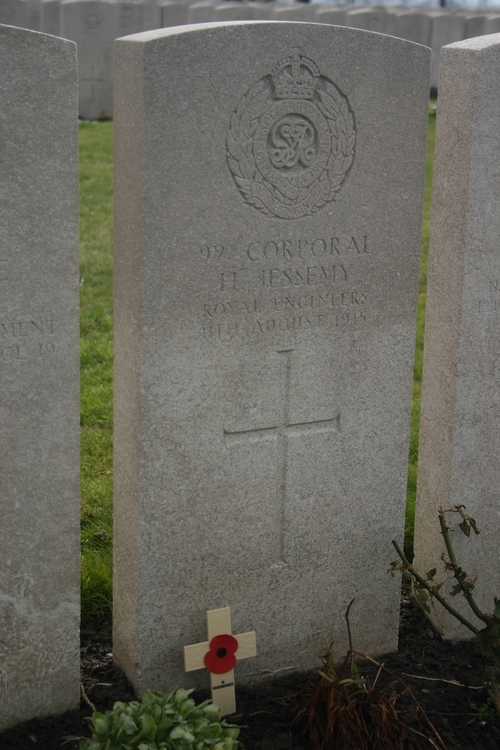
My great, great Uncle Harry Jessemey died there in the battle of Hooge , August 11th 1915.
His grave stone in Lijssenthoek Military Cemetery.
The gentleman who took the picture for me was kind enough to include the cross with the poppy.
JESSEMY, HARRY
Nationality: United Kingdom
Rank: Corporal
Regiment: Royal Engineers
Unit Text: 1st/1st (London) Field Coy.(later 509th field company, 6th division)
Date of Death: 11/08/1915
Service No: 92
Casualty Type: Commonwealth War Dead
August 9, 1915: The Assault and Peak Casualties
Two days before Harry’s death, the 6th Division launched its counter-attack to recapture Hooge. The 1st/1st London Field Company did not sit back; their
Number 4 Section was ordered directly into the assault alongside the 2nd Battalion, Durham Light Infantry.
The attack was a bloody success, recapturing the chateau ruins and the massive Hooge crater. However, the cost was immense. According to unit history records, August 9 saw the company suffer its
highest casualties in a single day of the entire war. Harry survived the initial wave of the assault, but the victory brought a grueling new task.
August 10–11, 1915: Consolidating the Line under Fire
Once the ground was taken, the Royal Engineers faced their most lethal job: "consolidation." The newly captured positions were completely exposed to German artillery observers on the surrounding high ground.
Harry's final 48 hours would have been spent in a sleepless, adrenaline-fueled haze. Working under the cover of darkness and thick smoke, the sappers had to sprint into the open mud of no-man's-land to string up heavy coils of barbed wire and dig shallow trenches into defensible fortresses before daylight returned. GHQ reports later specifically praised the company for its heroic wiring work under fire during these exact hours.
August 11, 1915: The Fatal Blow
On Wednesday, August 11, the German artillery retaliation reached a fever pitch as they attempted to shell the British out of their new positions. While performing these vital fortifications or hunkered down in a shallow trench, Corporal Jessemy was mortally wounded—most likely by flying shrapnel from a high-explosive artillery shell or a sniper's bullet.
Because of his rank as a Corporal and his status as a veteran pre-war volunteer, he would have been leading his men from the front line during these highly dangerous consolidation efforts.
The Final Journey to Lijssenthoek
Stretcher bearers evacuated the wounded Corporal from the Hooge sector, carrying him down the communication trenches to an Advanced Dressing Station, and then by horse-drawn or motor ambulance down the bumpy roads to the rear. He was taken to the
10th Casualty Clearing Station at
Lijssenthoek, a massive field hospital hub located safely out of normal artillery range near Poperinge.