Could I be the only one here ...

Some are saying we should raise the temperature of our water heaters past 140 and install mixing valves to temper it to below 120 for use.

Think about it, storing it at 120 is in the danger zone for food, but ok for potable water?
 
Not really. A pot on a stove is very similar to a water tank. Potable water needs to be treated as food.

I’ve seen signs in kitchens stating “ice is food”.

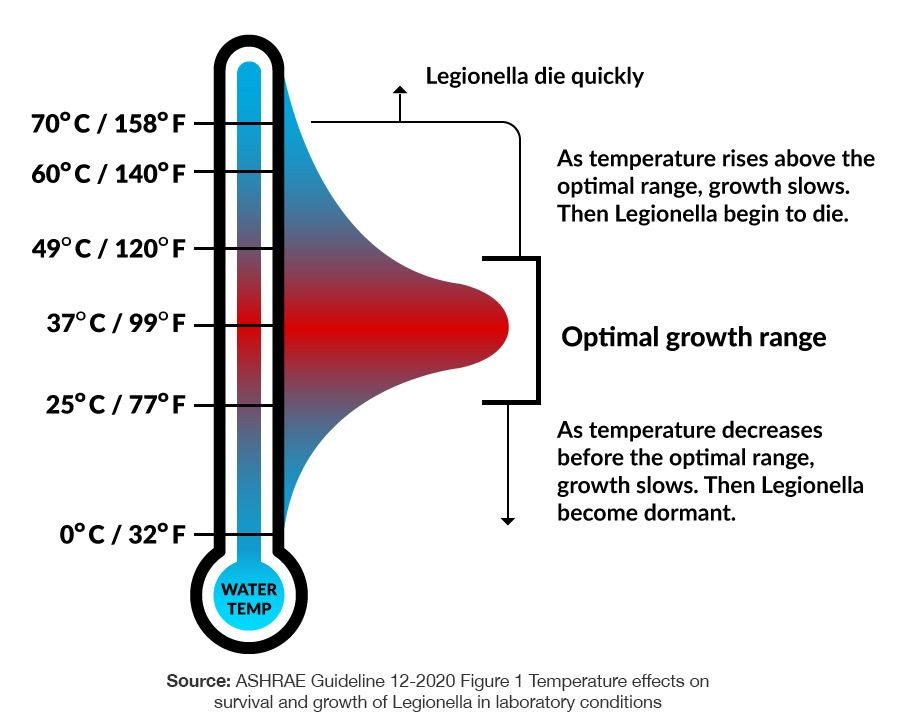
Check out this chart for legionella. Even 130 is still in the danger zone
IMG_9178.jpeg
 
Not really. A pot on a stove is very similar to a water tank. Potable water needs to be treated as food.
Okay, joke mode disabled momentarily; the water at 140 is heat-treated, but scalding territory, and reduxing the treated water to less-dangerous 120 does nothing to its treatment until it comes out the tap into the germy real world. The same 140 treats your food, until it comes out of the oven. Eat it quick, cool it quick, stow it in the cooler before it gets anything on it. Once out in the real world, you are going on cleanliness practices and luck, eh?
 
Okay, joke mode disabled momentarily; the water at 140 is heat-treated, but scalding territory, and reduxing the treated water to less-dangerous 120 does nothing to its treatment until it comes out the tap into the germy real world. The same 140 treats your food, until it comes out of the oven. Eat it quick, cool it quick, stow it in the cooler before it gets anything on it. Once out in the real world, you are going on cleanliness practices and luck, eh?
Yes.

The key is how long it is at the temperature that encourages bacteria to grow. (danger zone)

The water is stored at a high temperature to inhibit growth, then mixed with cold just before use.

It isn’t my theory. I have been told they have considered making it code.

If you google “emergency water storage temperature ”. The CDC says between 50 and 70 degrees F keep it in a cool place. For the same reason. Bacteria doesn’t grow below the temperature danger zone.
 
Last edited:
Would a "swamp cooler" be a breeding place for this type of bacteria?
Oh my yes. A hospital put a swamp cooler in a maintenance building to save construction costs. They had me take a look because they had "staining" on the walls. I walked in and immediately walked out the walls were covered with black mold. The building was red tagged. I did further tests on the cooler and found an extremely high bio count. Specific testing indicated the presence of legionella.

The cost to clean and install a proper HVAC system was considerably higher than had it been done right to begin with.
 
As an Amazon Associate we earn from qualifying purchases. Product prices and availability are accurate as of the date/time indicated and are subject to change.
Yes.

The key is how long it is at the temperature that encourages bacteria to grow. (danger zone)

The water is stored at a high temperature to inhibit growth, then mixed with cold just before use.

It isn’t my theory. I have been told they have considered making it code.

If you google “emergency water storage temperature ”. The CDC says between 50 and 70 degrees F keep it in a cool place. For the same reason. Bacteria doesn’t grow below the temperature danger zone.
Chilled water for cooling of larger buildings is usually about 40 degrees. This is often in a closed loop, meaning it isn't exposed to the air. I have seen and treated systems that had huge amounts of both macro and micro biomass. This included legionella (by the way untreated systems can have biologicals that are much worse than legionella).

Large commercial, industrial and residential buildings regularly test and treat these systems. Many include legionella specific testing.

By the way, did you know there are critters that live well in hot water. I found heating hot water systems were contaminated from time to time. Treating these is a bit harder as the heated water doesn't play well with most biocides.
 
This is interesting to me. Glad the OP survived and recovered. I live on the family farm. So do my parents and grandmother, since 1952. Grandmas still on her original stone lined well.

Dad and mom are still on their own well, where every spring and big rain a river runs past it coming off any acres of cropland since 1974.

And I am on my own, third well. Ran it to the new house in 2008 but weve all been drinking from it in farmyard since it was drilled in early 70s.

We must have tolerance.
Y’all’s immune system is working as designed!
gramps
 
Please remember the contraction of Legionnaires is through airborne water vapor. Can't get it from a well or a creek or a water heater. You have to breath in the contaminated vapor. That's why the swamp cooler is so suspect.

I peeked at my bill. I will have a holster to sell and I have home grown pickled peppers too but those would only profit me on a local sale ...
 
Please remember the contraction of Legionnaires is through airborne water vapor. Can't get it from a well or a creek or a water heater. You have to breath in the contaminated vapor. That's why the swamp cooler is so suspect.

I peeked at my bill. I will have a holster to sell and I have home grown pickled peppers too but those would only profit me on a local sale ...
I was wondering if showering created enough of a vapor mist to get legionella into your lungs?
 
I was wondering if showering created enough of a vapor mist to get legionella into your lungs?
Yes it can. Let's say you have a shower you haven't used in a while. The virus eventually uses up all the chlorine and begins to multiply. Then you come along and open the tap hot or cold doesn't matter what either or both could be contaminated. The water that initially comes out could have a very high virus count.
And remember, many whole house systems do a great job removing chlorine but not bacteria and viruses. So if you have a whole house system the situation could be worse.
 
Not a linked system; house water does not go into in the cooling system and back into house supply. Yecch!
Further up we were talking about how it can grow in your water heater. I knew the swamp cooler water didn’t end up in your shower. Yecch! Indeed.
Yes it can. Let's say you have a shower you haven't used in a while. The virus eventually uses up all the chlorine and begins to multiply. Then you come along and open the tap hot or cold doesn't matter what either or both could be contaminated. The water that initially comes out could have a very high virus count.
And remember, many whole house systems do a great job removing chlorine but not bacteria and viruses. So if you have a whole house system the situation could be worse.
Legionella has to be in a mist to make it into your lungs. I’m pretty sure showering will be enough of a vapor mist. Good point about filtering out the chlorine. The plumbing code here says how to sanitize a water heater, but nobody ever does it. The pipes are another issue.

The more you know the more you wonder how any of us are still alive. 😂

I’ve seen a condo that was heated off of a water heater. The same water in the baseboard radiators came out of the tap or shower.

There were provisions to make sure the water never sat too long in the baseboard. A check valve as I recall. So incoming water had to go through the baseboard to fill the tank. Also a timer to run the heat circulation every so often all year round.

I’ve been told it’s common in trailers too.
 
Last edited:
When large buildings are built and started up all of the water systems are flushed, circulated with a cleaner and then flushed again If the tests look good the systems for heating, cooling and such are treated with both a biocide and a corrosion inhibitor. The potable water is not treated obviously, but it is then sanitized with a chlorinated product. When the biotests are good, the product is flushed out and the potable water system put in service. Once this is done contractors are supposed to flush all of the taps regularly.

More often that I liked the contractors would skip this part (manhours are expensive). In one large Los Angeles hospital the system got so septic that it required another extensive chlorination. And by the way, that ain't cheap either.

New build or extensively remodeled homes or are rarely cleaned, much less chlorinated. If you buy one or do a remodel, flush the living heck out of your water system making sure you get every nook and cranny.
 
Local rumors lean toward careless maintenance in the Iowa legionella issues. Higher temps lasting longer than 'normal' caused cooling towers to run warmer allowing the problem to grow.
'GG', I'm happy you recovered and quitting smoking may be an actual benefit that helps in the long term.
 
Back
Top