Can’t make myself trust a Progressive

Ok, I said I was done,, but the above post makes it appear that I put speed over safety.

Obviously the many times I've mentioned using various safety features such as a powder check die, or paying attention, no distractions etc is being overlooked.

And the quotes from the folks above,, please post the dates they wrote those books or manuals. Plus, you mentioned the millions of rounds they loaded. I can guarantee that much of their volume ammo was loaded on machines,, & not individually loaded by them. Even you have mentioned that fact. But I can say that I have personally loaded a lot of ammo & shot a lot of ammo, using both single-stage presses AND progressives.
Besides, much of the stuff used decades ago could have more issues than the more modern & better stuff available now.
How do I know? I've read those fellows works & I also know they passed away long ago. Plus I read old loading info in many places & realized that times, equipment & such has changed & gotten better.
And those guys mentioned did NOT have access to nor used a Dillon progressive.

I've NEVER said to NOT check your ammo. I've just tried to quiet the fears of using a progressive press because I too had them before I tried one.

I can say that there are a lot of people using a Dillon progressive at every range in every place, (except totally private, no access ranges.)

So if you feel it's unsafe to stand beside me on a range,, because I do not follow YOUR type of reloading program,, is insulting. But I can ignore that. Because I'm sure if you actually go to ranges & shoot a lot,, you will be standing beside people who do use a progressive & do not follow the loading methods you seem to demand. Either that,,or you will be using a range by yourself.

I base my posts on actual, hands on decades of experience. Both in using various types of equipment, AND actually shooting the tens of thousands of rounds that I have shot. With 48 years of loading experience,, AND shooting these loads,, safely, I can speak with a bit of real world use.

Can you say the same thing?
 
Ok, I said I was done,, but the above post makes it appear that I put speed over safety.

Obviously the many times I've mentioned using various safety features such as a powder check die, or paying attention, no distractions etc is being overlooked.

And the quotes from the folks above,, please post the dates they wrote those books or manuals. Plus, you mentioned the millions of rounds they loaded. I can guarantee that much of their volume ammo was loaded on machines,, & not individually loaded by them. Even you have mentioned that fact. But I can say that I have personally loaded a lot of ammo & shot a lot of ammo, using both single-stage presses AND progressives.
Besides, much of the stuff used decades ago could have more issues than the more modern & better stuff available now.
How do I know? I've read those fellows works & I also know they passed away long ago. Plus I read old loading info in many places & realized that times, equipment & such has changed & gotten better.
And those guys mentioned did NOT have access to nor used a Dillon progressive.

I've NEVER said to NOT check your ammo. I've just tried to quiet the fears of using a progressive press because I too had them before I tried one.

I can say that there are a lot of people using a Dillon progressive at every range in every place, (except totally private, no access ranges.)

So if you feel it's unsafe to stand beside me on a range,, because I do not follow YOUR type of reloading program,, is insulting. But I can ignore that. Because I'm sure if you actually go to ranges & shoot a lot,, you will be standing beside people who do use a progressive & do not follow the loading methods you seem to demand. Either that,,or you will be using a range by yourself.

I base my posts on actual, hands on decades of experience. Both in using various types of equipment, AND actually shooting the tens of thousands of rounds that I have shot. With 48 years of loading experience,, AND shooting these loads,, safely, I can speak with a bit of real world use.

Can you say the same thing?
I can say that you tend to make the machines out to be impervious in which they aren't. You claimed the issues are all user error and never the machines fault. You seem to imply that so long as one pulls the handle when they are supposed to there will never be any issues with powder drops. (Yet if that were so, there would never been a need to invent a powder cops or lock out dies to help bring ones attention to this real life issues). And a powder cop does no good if one is not carefully watching it faithfully. And you unfairly compare a home progressive press with the factory ones as if they are equal in safety features. Yet as noted by Earl Naramore the factory version have electronic eyes, laser beams, as well as many other mechanical safety devises and they also have someone paying very close attention to the machinery and a supervisor keeping an eye on them too. So trying to make out like a Dillon is anywhere in the same ball park as these factory machines or that any machine is infallible is nonsensical. One would at least have to step up to a Mark 10 and add more safety features than could ever fit on a Dillon to claim that their progressive comes any where near the safety of the factory machines and they still like the factory machines will have to keep a very close eye on it.

On the other hand, I'm telling people that yes, the powder, at times, can drop wrong from even a modern powder measure and they need to keep a very keen eye on the powder process every time. And redundant checks are what will save one's kester, not just a modern piece of machinery. And yes, those folks I quoted above have moved on to the hereafter, yet these are not the only manuals I've read. A lot are current modern manuals and still claim one needs to be visually aware of the powder charges, I just did not feel like posting them all as what I did should suffice.

But other than these issues I agree with you on the rest of what you said back in post #57.

And that is my last word on this! [Oh hell, who am I fooling?] Not.

Basically you seem to be over selling these machines as infallible and tend to leave out the much needed safety warnings which the reloader should heed. And I also add when a machine messes up then the operator is only (100%) at fault if they doesn't catch it and correct it then and there. If they do catch and fix things on the spot then the blame lies 100% on the machine.

P.S. - You say that I insulted you for not wanting to stand next to you when you shoot ammo that was done without safety checks, but know you said that I was teaching from ignorance long before you got your feelings hurt. You say that you could over look such and I say sticks and stone may break my bones but your words will never hurt me🤪. I learned at a young age that some people when in their own mind think they are loosing a debate turn to attacking the messenger as you had when first by twisting my message claiming I was teaching fear when I am teaching caution, and then further you try and belittle me with a personal attack by saying I am showing ignorance. Which is saying from all the books I've read you known more than any of them, because I'm just sharing what they teach. So by implication you are claiming they are ignorant fearmongers 😲. 🙄Oye Vey!
 
Last edited:
Ok, you are mis-reading my posts. I never claimed the machines were perfect. Even your post says that I was "implying" things and that it was "all user error."
If you recall, I always mention the used of a powder check die as a safety feature. And it's obvious you have not used one ("a powder cop does no good if one is not carefully watching it faithfully") because the Dillon ones have a buzzer that makes noise & you do not have to look at it for it to function as intended.
Yes,, modern machinery does have various pieces of equipment in the factories, to check the ammo as it's being loaded. But if we follow your older & out of date info you put forth,, you are being contradictory. Either trust modern machinery or trust only human visual inspection.

I've never said that a Dillon is the same as a modern factory loading machine. I merely pointed out that a progressive Dillon is a good progressive machine that turns out millions of rounds annually, SAFELY for tens of thousands of home reloaders. If they needed to have a way to visually inspect each & every case for the proper powder level it would have been invented. But yes,, the Dillon powder check die DOES it's job,, for those who fear an under or over powder charge.
You keep preaching about modern powder measures dropping errant charges. Yet,, it does not happen as much as you make it appear to be.
Plus,, if you re-read my post (and a few others) about using a powder that mostly fills the case to where the internal volume is 95% or better once a bullet is seated,, you would have an immediate VISUAL reference to an over-charge, AND the potential of a low charge by the previous loaded round. Easy to remove both of these rounds from the machine.
It's when the humans fail to follow these signs of a problem, OR choose to not use a load with a full volume (approximately) set-up. or when they fail to manually index a shell plate like on the Dillon 550. That's human error.

I'm not trying to "oversell" these machines. I am trying to convey to the OP that a progressive has a proven track record of safety. And if he has fears,, then get a machine that allows for a powder check die.
You have been very strongly against anything that doesn't allow you (or anyone else) the ability to "visually double check each case" for safety. Yet,, you fail to accept the fact that millions of rounds of ammo are loaded by people annually without them having to do so.
Besides if it were so bad or dangerous,, Dillon, (and others,) would have been sued out of business long ago.

I never called you out by quoting you like you have done to me & my posts. I said
"But to spread fear WITHOUT actually having a lot of experience using one is showing ignorance." I meant that for anyone who tried to put in something without actual experience. YOU took it as personal.

You are attacking me directly by quoting my posts.

I don't feel like I'm losing a debate. All my posts were directed at my experiences, to help the OP in his decisions of his equipment purchases.

MY posts are rooted in decades of experience.

And since you seem bent on attacking me directly by quoting me,, I'll challenge you with this;

Put forth YOUR decades of actual loading experiences. Tell us how many hundreds of thousands of rounds you've loaded on both a single-stage AND a progressive. Tell us how you have spent decades actually using these hundreds of thousands of rounds in competition, in teaching, and actual use. Tell us how you've taken game with your ammo. Tell us how you are a certified handloading instructor.

In short,, back up your attacks upon me with your credentials or PROOF that you must do as you claim people should do. PROVE that a progressive machine is unsafe & incapable of operating without "visually double checking each case" for powder.

By your own admission, you do not own a Dillon progressive. Yet you are saying you will buy one,, and THEN ALTER it to your way of loading. Basically not letting the Dillon do the work it was designed for.

You are speaking without experience.

I can agree that sharing words of caution is perfectly fine. But you attacked me, and insulted me by saying you wouldn't stand next to me on a range.
Now back up your experience with proof.
 
Ok, you are mis-reading my posts. I never claimed the machines were perfect. Even your post says that I was "implying" things and that it was "all user error."
If you recall, I always mention the used of a powder check die as a safety feature. And it's obvious you have not used one ("a powder cop does no good if one is not carefully watching it faithfully") because the Dillon ones have a buzzer that makes noise & you do not have to look at it for it to function as intended.
Yes,, modern machinery does have various pieces of equipment in the factories, to check the ammo as it's being loaded. But if we follow your older & out of date info you put forth,, you are being contradictory. Either trust modern machinery or trust only human visual inspection.

I've never said that a Dillon is the same as a modern factory loading machine. I merely pointed out that a progressive Dillon is a good progressive machine that turns out millions of rounds annually, SAFELY for tens of thousands of home reloaders. If they needed to have a way to visually inspect each & every case for the proper powder level it would have been invented. But yes,, the Dillon powder check die DOES it's job,, for those who fear an under or over powder charge.
You keep preaching about modern powder measures dropping errant charges. Yet,, it does not happen as much as you make it appear to be.
Plus,, if you re-read my post (and a few others) about using a powder that mostly fills the case to where the internal volume is 95% or better once a bullet is seated,, you would have an immediate VISUAL reference to an over-charge, AND the potential of a low charge by the previous loaded round. Easy to remove both of these rounds from the machine.
It's when the humans fail to follow these signs of a problem, OR choose to not use a load with a full volume (approximately) set-up. or when they fail to manually index a shell plate like on the Dillon 550. That's human error.

I'm not trying to "oversell" these machines. I am trying to convey to the OP that a progressive has a proven track record of safety. And if he has fears,, then get a machine that allows for a powder check die.
You have been very strongly against anything that doesn't allow you (or anyone else) the ability to "visually double check each case" for safety. Yet,, you fail to accept the fact that millions of rounds of ammo are loaded by people annually without them having to do so.
Besides if it were so bad or dangerous,, Dillon, (and others,) would have been sued out of business long ago.

I never called you out by quoting you like you have done to me & my posts. I said
"But to spread fear WITHOUT actually having a lot of experience using one is showing ignorance." I meant that for anyone who tried to put in something without actual experience. YOU took it as personal.

You are attacking me directly by quoting my posts.

I don't feel like I'm losing a debate. All my posts were directed at my experiences, to help the OP in his decisions of his equipment purchases.

MY posts are rooted in decades of experience.

And since you seem bent on attacking me directly by quoting me,, I'll challenge you with this;

Put forth YOUR decades of actual loading experiences. Tell us how many hundreds of thousands of rounds you've loaded on both a single-stage AND a progressive. Tell us how you have spent decades actually using these hundreds of thousands of rounds in competition, in teaching, and actual use. Tell us how you've taken game with your ammo. Tell us how you are a certified handloading instructor.

In short,, back up your attacks upon me with your credentials or PROOF that you must do as you claim people should do. PROVE that a progressive machine is unsafe & incapable of operating without "visually double checking each case" for powder.

By your own admission, you do not own a Dillon progressive. Yet you are saying you will buy one,, and THEN ALTER it to your way of loading. Basically not letting the Dillon do the work it was designed for.

You are speaking without experience.

I can agree that sharing words of caution is perfectly fine. But you attacked me, and insulted me by saying you wouldn't stand next to me on a range.
Now back up your experience with proof.
Replying to your posts is not a personal attack (unless I where to claim you where ignorant). When one clicks on "Reply" it automatically quotes them. I figure so others will know the context that sparked the comment. Saying I do not agree with your slant on progressive machine presses is not an attack on you either, it is simply and opposing opinion. Just how fragile is your ego?

As far as my opposing opinion goes it is contrived from people with plenty of experience. And not just that of 90+ manuals but video testimony as well (and a few personal experience shared face to face by others). They show/expressed [especially on the cheaper ones] how rods come lose, primer systems fail, powder droppers having issues, etc... I'll let their words speak for themselves {see quotes from above}.

Even the mighty Dillon 650 has had issues with the primer stack mass detonating due to a poor design, hence the need to invent the Dillon XL750 with an improved primer feeder system. And to think that the buzzer could not fail on a Dillon powder cop could easily lead one to become complacent and feel no need to visually inspect each case. And not every cartridge can be charged safely up to 50% or more of its case volume, such as the older black powder ones when using smokeless powders [e.g. either the long or short 45 COLTs].

And as to handloading I started five years ago with a Lee Loader and a rubber/plastic mallet. Quickly moved on to a Buchanan Precision Machine hand press. During this time I continue to study the writings of others that have gone before, and or watch their videos. So far everything has been done in single stages. I have taught three people to reload very safely during this time, and let them shoot the rounds out of my gun. And as I have stated before I use a powder measure to drop a light charge and trickle up on a beam scale, then move the pan to a digital scale as a double check. And once a loading block of 50 cartridges is made up I visually check all of them together to see if there are any over or under charges.

As far as not wanting to stand next to a gun being fired with handloads from someone playing the odds of simply trusting a machine to load ammunition safely- no I would not want to be close to a gun that fires such rounds. Then again I do not trust most people to keep the gun pointed in a safe direction either so I don't go to public ranges unless it is void of others, unless in a small group and I have gone over the safety rules before hand and they strictly adhere to them. Last competition I did was a few months ago with one friend of mine on his private property. We shot 22LR from bolt action rifles at a cardboard target. I been shooting since I was 5 years old and am 62 now.

All that said I may not have loaded as many rounds as you have but I can 100% guarantee [without any assumption] that every round I made so far is 100% safe, because I take the time to instill triple checks of every powder charge in my loading routine. And no I do not blindly trust machines. I've been a mechanic and yes things fail. Brakes go out and that is why there is such a thing as backup emergency brakes. One should always use redundant safety checks when dealing with thing that could become dangerous.
 
I have been an employee of Dillon Precision for over 40 years, am a competitive shooter (SASS, USPSA and 3 Gun) as well as a Class 3 owner. I can tell you I've personally loaded well over 1 million rounds of 9mm, and at least 200,000+ rounds of .223, as well as for thirty-some other different cartridges.( Don't decide to collect military bolt actions?) Anyway, I have seen parts wear and break in our automatic powder measure. Like any other machine, a quick pre-flight inspection is always a good idea. I have confidence in our powder measures. I check the powder charge extensively at the beginning of every loading session. For competition use, I gage every round by hand. I use a lot of range brass (cheapskate), and often it was left on the ground for a reason. I personally have never encountered an overload. I have had a couple of squibs long ago, which led to me inspecting the measure before using. Bellcrank cubes can crack and fall off, and roller screws can back out with use. Parts need to be greased occasionally.
When I'm shooting competition, approximately 78% of my fellow competitors are using reloads in rather expensive firearms. If progressive machines had a significant failure rate, they wouldn't be so prevalent among those who consume more ammunition than any other category of civilian shooter.
The advantage of most progressive loaders is that to begin, you do start by loading one round at a time. As you learn to understand the process, and how the individual functions interact together, then you can increase your volume by loading progressively. I much prefer to shoot than reload.
I started loading as a 5 year old, helping my Dad load 16 ga shells on a Pacific loader. At ten, after passing Hunter Safety I received a Herters single stage press for loading my 300 Savage and my Dads 270 Winchester. At 18 I was loading 45ACP on a Lyman turret loader for IPSC shooting. At 20, three friends and I co-owned a Dillon RL300. Then one of us bought a 1919A4 from Mike Dillon, and switched it to load 30-06. At 25 I bought an M16., and my own Dillon RL450. Soon after that I started to work at Dillon. Now I have two RL550s and an RL1050. All operated by hand.
Sorry for being so long winded, but wanted to establish my authenticity. I have done seminars for SASS, and the NRA. I've also done most of our tech support videos. I'm happy to answer any questions about Dillon equipment.
 
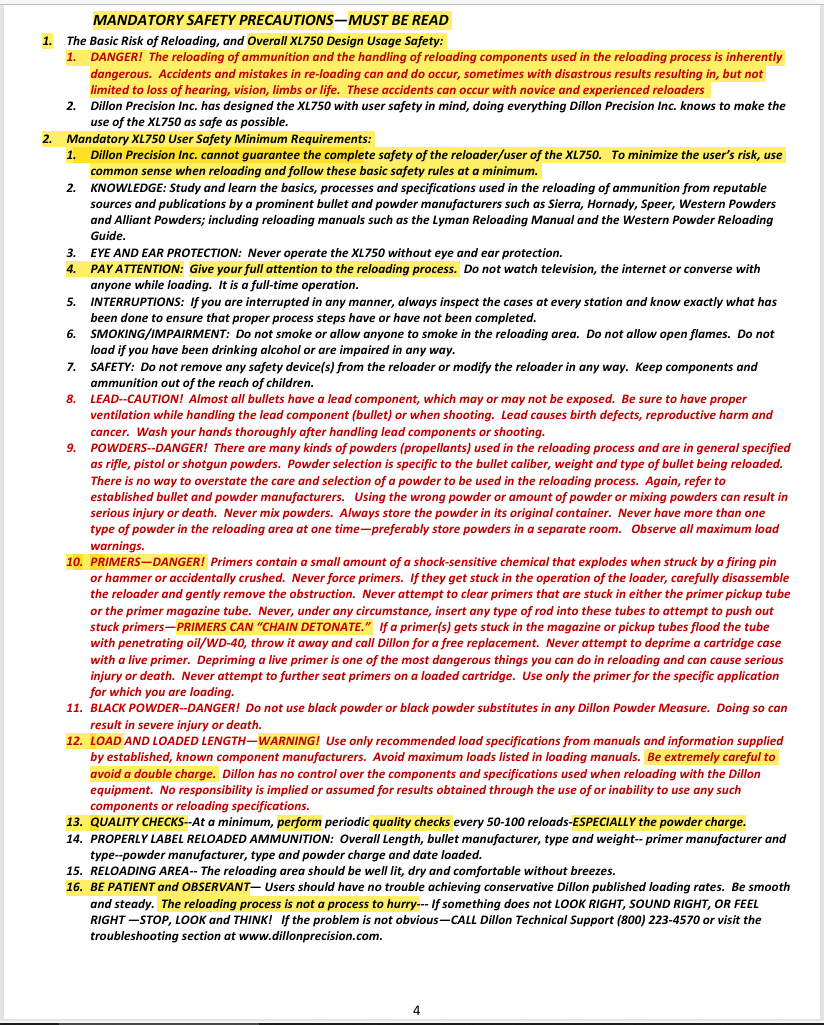
Straight from the horse's mouth to be observant, pay attention, be careful, perform quality checks - and not just rely on the machine.
Dillon XL 750 Safety Warnings:
Dillon Safety Warnings for XL750.PNG
 
As an Amazon Associate we earn from qualifying purchases. Product prices and availability are accurate as of the date/time indicated and are subject to change.
Apparently Dillonfriend is an employee & lifetime reloader.

And even he follows safety procedures we all should follow. And as noted in your copied Dillon info,, they stress safety,, especially how the human error issues can cause problems.
Plus,, notice item # 2,, which you did not highlight;
"The 750 was designed with safety in mind, making it as safe as they possibly can."

Yes,, Dillonfriend has mentioned stuff that has failed. But he also states that things should be inspected for wear or breakage often. And he also advocates the checking of the powder measure & weights etc ever so often.
See his quote; "Like any other machine, a quick pre-flight inspection is always a good idea. I have confidence in our powder measures. I check the powder charge extensively at the beginning of every loading session."

Just like I do.
But just like him & tens of thousands of others,, we use a Dillon progressive with confidence. But of course we all, as humans,, need to make sure we maintain the machines, check it's operation, and adjustments. When we as humans fail to do so,, things can happen.

Thank you Dillonfriend for your post. I hope to see you at SHOT this year. (If you attend & I can discover who you are.)
 
Hi Folks, I’ve been loading on a single stage for 15 years. I have my own system & never had a problem. I’ve been burning through 9mm pretty steadily, which has me thinking about a progressive. I’m so paranoid about safety & like monitoring things closely + I like the simplicity of the single stage. Did any of you Folks struggle with this? Thanks for your input-Dave
After 3 pages of replies, I don't know how many direct responses you got to your original question so here goes. Best I can remember, I had a hand tool, a hand die press (Wilson), 4 single stage presses, and 4 progressives. Currently we have a RCBS Rock Chucker and a Hornady Lock-n-Load progressive. I am a fussy handloader where safety, accuracy, and reliability are absolute musts. After 50+ years of loading and shooting in competition I am 100% satisfied with the current machines and I can't think of any reason to replace them. That is the background.

I loaded everything on a single stage for maybe the first 20 years(?). About then I got a Lee 1000 to load 45 ACP, 9mm, 38 Special, and later 32 S&W Long for precision pistol. The ammo was fine but, on point of your question, you had to watch it closely particularly the primer feed. I then seen a Hornady Lock-n-Load and what impressed me was its 2" diameter ram which really holds everything straight through its operation. Keeping everything straight and aligned is needed for quality ammo. A habit I started with the Lee and continued with the LnL was to eyeball the powder level in each case as I set each bullet by hand. Yeah that may slow you down but I have no doubt the correct amount of powder is in the case and the bullet is started straight. Add to that the powder measure on the LnL is dead nuts accurate even with the tiny 32 charges so now you are doubly sure. You still want to spot check powder weight but I have yet to ever need to correct the LnL.

While the LnL can load a lot of stuff, I use it 99% of the time for straight wall pistol rounds. I did run off a bunch of 223 Rem through it but that is the only rifle rounds I can remember on the progressive. It was fine but I just don't load enough rifle ammo to use the progressive. I will never be without both a single stage and a progressive. They each have their role in our setup. Hope this helps. YMMV
 
And even he follows safety procedures we all should follow. And as noted in your copied Dillon info,, they stress safety,, especially how the human error issues can cause problems.
And that is one reason I stress redundant safety checks to be sure and catch all human errors.

Plus,, notice item # 2,, which you did not highlight;
"The 750 was designed with safety in mind, making it as safe as they possibly can."
Which is why I stress safety checks to catch any issues the machine may cause, as they noted they made it as safe as they possibly could, not fail proof.


But I especially highlighted the parts they stressed about powder charge issues to show that such didn't become out dated and obsolete just because the patriarchs of reloading who first stressed this issue have passed on. As their warnings are still being reiterated by the modern industry because they are still just as relevant as ever before. The main one being double check to be sure there is no double charge - due to human or machine errors. And yes if a machine's error is not caught by an operator then it becomes both mechanical and human errors.

So I'll say again for all who have ears to hear:
Hand/Re-Loading should be undertaken as a serious endeavor, as dangerous consequences could occur if certain details are left to chance. So make it a habit to never fully trust a powder measurer and always eyeball the powder in every case before seating the bullets, as innocent bystanders lives depend upon it.
 
Last edited:
Hi Folks, I’ve been loading on a single stage for 15 years. I have my own system & never had a problem. I’ve been burning through 9mm pretty steadily, which has me thinking about a progressive. I’m so paranoid about safety & like monitoring things closely + I like the simplicity of the single stage. Did any of you Folks struggle with this? Thanks for your input-Dave
I loaded (pistol rounds) on a single stage for a few years and then went to an auto-advancing turret (Lee- 4-die). The simplicity of operation of a single-stage (and ability to visually check each primer seating and powder charging since I do not use an automatic powder charge device, but mete out each charge by hand), but cranking out a completed round, start to finish before starting the next cartridge. Almost like a progressive except it takes 4 strokes of the handle instead of one. I charge the powder with a scoop instead of a powder drop device and place bullets on the case mouth by hand. I can do 50 rounds in an hour and quality control is excellent. (Confession: to my chagrin) I quit using a powder measure when I loaded 17 rounds from an empty powder measure but had to pull 50 bullets to make sure I found all the faulty rounds.

Using the auto-advancing feature reduces the number of times each case is inserted and extracted from the press. Otherwise it is the same as using a single stage with quick-change dies. Difference is you do the operations 1 - 2 - 3 - 4 instead of 1 1 1 1 1 1 1 1 (50 times) and then 2 2 2 2 2 2 50 times, 3 3 3 3 3 3 3 50 times and so on.
 
It's not just 'reloaded' ammo that can have issues. Just last year, I bought a case of 6.8 SPC ammo and the third round chambered had no powder. Fortunately, the primer didn't push the bullet into the bore.
For a while, I was buying and 'recycling' lots of factory reject/defect ammo (AKA-pulldowns). During the dismantling process, I found all sorts of 'powder issues' from little to no powder to so much overcharge that the force of machine seating the bullets had bulged the case body and the powder had to be dug out with a pick. :oops:
Lately, I don't load nearly as much as in the past but I visually check every charge on my old Dillon SDB (scale check at the beginning of every loading session) and scale check every third or fifth round charged with a manual hand measure. I used to scale every rifle cartridge charge but I don't load quite as close to MAX anymore nor am I shooting for money so a kernel of powder either way isn't going to be disastrous.
 
It's not just 'reloaded' ammo that can have issues. Just last year, I bought a case of 6.8 SPC ammo and the third round chambered had no powder. Fortunately, the primer didn't push the bullet into the bore.
For a while, I was buying and 'recycling' lots of factory reject/defect ammo (AKA-pulldowns). During the dismantling process, I found all sorts of 'powder issues' from little to no powder to so much overcharge that the force of machine seating the bullets had bulged the case body and the powder had to be dug out with a pick. :oops:
Lately, I don't load nearly as much as in the past but I visually check every charge on my old Dillon SDB (scale check at the beginning of every loading session) and scale check every third or fifth round charged with a manual hand measure. I used to scale every rifle cartridge charge but I don't load quite as close to MAX anymore nor am I shooting for money so a kernel of powder either way isn't going to be disastrous.
Despite the level of reliability of those factory machines many rejects are caught by mechanical or electronical safety devices and even by physical inspections by people. Well most are, got to wonder how that 6.8 SPC got past all the factory inspections. Main take away is one can never be too safe and should implement a plethora of safety inspection when loading at home, irregardless the level of quality the equipment they may possess.
 
Last edited:
I know this has gone on for a long time but I'll chime in; my rule #1 is "pay attention." If you pay attention you won't get hurt.

Using a progressive press is like going from an 1964 Chevy pickup with the old straight six and three on the tree to a 2025 pickup, lot more complicated.

I've used Dillon equipment for 25 years with no complaints, I learned the hard way to pay attention. It's not as automatic as my old single stage where I can run basically by physical rhythm (for lack of a better definition). I use my Dillon for volume loading which is only a few calibers and I only run that after I have experimented and found exactly what I want.
 
As noted,, a powder check die of some type,, (Dillon, RCBS or Hornady) can allow you to catch a powder discrepancy.
I like the Dillon because it has a buzzer alarm.

One thing NOT covered,, and is something all reloaders need to adhere to,, is to never leave powder in a powder measure of any type for any extended length of time. Powder can & will possibly attract moisture,, or even have a reaction to the powder hopper causing it to change properties. Skeeter Skelton wrote on this decades ago,, when he found that his charges of Unique powder were not performing correctly. He'd been leaving the powder in the powder measure, (single stage type BTW) w/o removal.

It's just a good safety practice that upon the loading of ammo, that all components be stored properly. Primers in their boxes. Powder back in it's original container, and clean the machine or press of any residues.

And as gnappi mentions,, if using cast & lubes,, regular internal cleaning of dies of "build-up" inside them. You should also do this occasionally with jacketed bullets as well. This is where Dillon dies shine. They can be taken apart & cleaned WITHOUT having to re-adjust the settings.


In addition to power being hygroscopic, it's also reactive with many plastics. I know Hodgdon's Lil'gun and Longshot will fuse itself to the plastic of the Dillon powder hopper and the plastic of my PACT powder dispenser if left in overnight.
 
In addition to power being hygroscopic, it's also reactive with many plastics. I know Hodgdon's Lil'gun and Longshot will fuse itself to the plastic of the Dillon powder hopper and the plastic of my PACT powder dispenser if left in overnight.

I had heard this about certain dispensers. I have left lil gun, as well as TG, H110, H335, et al, in my Lyman 55's for extended periods and have never had that issue. I expect certain plastics are more vulnerable than others.
 
Current Dillon powder hopper tubes are a new flavor of polycarbonate plastic, and the residual solvents in powder won't affect it for a long time. They don't discolor where powder has been left in it. Been this way since before the great plague.
 
In addition to power being hygroscopic, it's also reactive with many plastics. I know Hodgdon's Lil'gun and Longshot will fuse itself to the plastic of the Dillon powder hopper and the plastic of my PACT powder dispenser if left in overnight.
There is a company that makes replacement hoppers, made of Pyrex, for all major brands.

And to my understanding once a powder jug is opened the powder will acclamate to the humidity level in the environment it is being stored in even with the lid screwed back on tightly.
 
There is a company that makes replacement hoppers, made of Pyrex, for all major brands.

And to my understanding once a powder jug is opened the powder will acclamate to the humidity level in the environment it is being stored in even with the lid screwed back on tightly.

Thankfully that doesn't happen with the plastic jugs, at least from Hodgdon if you keep the seal in the cap, in my experience. I have some powders that nearing 10 years old, and they burn the same as when they were new. It was a real issue with old metal and cardboard canisters back in the day.
 
Me neither.

Glad I read this as I thought the topic was political the whole time by the title. There's a local Lee .45 AUTO progressive for sale "cheap" so I might have one soon even though I don't shoot much (at all) and stopped reloading for inventory four years ago.
 
The title got me on this one...I thought this was a political post so I ignored it. The last press I bought was a Rockchucker maybe in '78 or so...I check every round at every step with my fingers and eyes and measuring tools if needed as if I had to depend on it....hasn't always been that way but it seems I have developed some habits. I would trust my ammo for self defense purposes way more than some store bought factory ammo. I did get a few hundred 9mm rounds from an old guy mebe 10 years ago that had been made on his progressive...it all functioned but I wasn't comfy with it around so I just shot it up...I don't need a lot of ammo but I am loading for an AR at the moment...this AR feels like a SNAP recipient when it come to feeding time....
 
I went to a friends to load some .45 Colt on his Dillion progressive. We spent almost as much time clearing primer problems as we did loading.
I loaded for 30 years on a single stage press and finally gave in to the progressive when I began shooting lots of 9mm, 45 ACP, 30 carbine and 223. I bought a Dillon 650 and it has worked flawlessly. I bought a Lee Pro 1000 and had nothing but trouble with the primer feed system with a number of them popping when I tried to seat them. I put it back in the box and it's been there for almost 30 years.
 
There's a local Lee .45 AUTO progressive for sale "cheap" so I might have one soon even though I don't shoot much (at all) and stopped reloading for inventory four years ago.
Well I pulled the trigger and bought the progressive press. When it arrived I unboxed it, looked it over, and put it all back in the box. Off to eBay and sold it in a week. It's already arrived with someone new. But have no fear ... I shot some 9mm, .357, and .45 AUTO on Thanksgiving and have already got the turret out and reloaded 100 .45's and 50 9mm's as well as other prep...which lead to me going through almost all of my stash including the safe and all the storage cabinets. Snowballed into a re-organization project. Had to relearn some of the set ups. Haven't loaded much of anything in 3-4 years but I still got it.
 
I've a Dillon square deal B. It's an excellent reloading press with great customer service and loaded tens of thousands of rounds on it. The only real 'glitches' I get are primer issues (where the sliding block hangs up sometimes or I get the occasional primer flipped in the cartridge--usually at the beginning of a run). I've found my work around is simply put in the habit pattern that my thumb rides the block back in and I have no problems. On startup if I have a glitch I deliberately back everything up and start over. It auto indexes which also helps. While it's rated at 500 rounds or so per hour I've never gotten that out of it (perhaps because I'm pretty cautious) and it's more like 2 or 300 once I get into it. It's therapeutic in a way.

The Dillon throws its powder well; usually within .1 to .2 grains at the outset. Once set it's pretty much good to go but I always check powder charge on startup (maybe putting 5 or 10 cases through and seeing that it's throwing powder well and occasionally sampling powder at station 3). I load primarily universal for everything (.38 special, .44 special, and .45 colt). It meters reasonably well.

The only thing I'd change is on station 3 make it a bit easier to visually see powder. You can, but it's a bit of a slant. If I were more dedicated a mirror segment would probably work well. But I've had no problems and the powder measure device is straightforward and has a fail-safe type of setup. The only way I think one could get a double charge is get a stoppage and not start everything back up from the get go.

I've been very happy with it and it works well. My thoughts are the progressives (especially auto indexing ones) are plenty safe and not very complicated. Just be attentive and if you get a stoppage (primer, bullet seating station going awry, fed cartridge wasn't all the way in on the shell plate) back things up and start over (crimp the one completed cartridge but take everything else out). And don't be afraid to toss rounds if there's a question as to what was where.

I don't personally reload 9s for a few reasons (many do). My autoloaders throw brass everywhere (making pickup a bit of a PITA), the 9 is very sensitive to COAL as far as pressures go--and bullets usually don't have a crimp groove on 9s, and they use a taper crimp (the latter being weaker and a bit harder to set than a roll crimp which is pretty obvious). 9s are also pretty cheap compared to the 38s or 45s so for me it wasn't worth it. Lots of folks do though so it shouldn't be a barrier--just be attentive to COAL.
 
I went to a friends to load some .45 Colt on his Dillion progressive. We spent almost as much time clearing primer problems as we did loading. We would have to pull a couple shells off the press to do this. I am in the habit of weighing all my reloads when I get finished, to catch under and over loads. While going thru this batch at home I caught one that weighed a double charge. I do my pistol reloads on a turret press, weighing every charge, my rifle I do my sizing on a single stage and then the rest on the turret. I could have gotten a great deal on a Dillon, but declined it after this experience.
This is a sort of weak link on the Dillons (or at least mine); what I found worked well is you can ride the translating primer shuttle with the thumb and start it back in on the handle upstroke which seems to alleviate the problem. It usually works its way out after the first 100 rounds or so; it's mostly on startup that I've found the problem. Once it gets into your habit pattern it's seamless.

I also QC the rounds from the finished round bin before I put them in the ammo can. Quick Look at overall length, primer, condition, etc.
 
If you were to get a 750 and do the modifications TexasRat has mentions,, will negate the usefullness of the 750.

Joey,, the 550 is a good press for folks who want to go slower, do more checking, and yet allow a bit of a faster method of reloading. it's the lack of auto-indexing that can get people in trouble. People become complacent, and fail to truly pay attention to their loading by allowing themselves to be distracted.

OCD types of personality should not get a progressive because they are incapable of actually allowing the machine to work without micro-managing each step.

Millions & millions of rounds of ammo have been loaded on progressive presses by handloaders for decades with very few issues.
And hundreds of millions of rounds of ammo have been loaded on progressive automated machines for over a century by commercial ammo makers with very few issues.

We trust ammo companies to make good ammo, so why not have a progressive set-up at home. yes,, a smaller set-up, but still doing the very same thing.

Yes,, we as handloaders can inspect & sample our ammo. The same as any ammo maker.

Brass should be inspected for splits or flaws prior to actually starting the handloading process.

Going the single-stage route,, or even doing all the steps TR mentioned above takes TIME. And if you are needing several hundreds of rounds of ammo weekly,, you will be spending a whole week just making the ammo. People have jobs, families & such to where that amount of time is just not available if you need 300-500 (or more,) rounds a week.

Once a machine is set up,, I can uncover it, add powder, fill primer tubes,, (I do use a Dillon auto primer filler machine,) put cases in the case feed, and load several hundred rounds in under an hour.

Of course,, my brass has already been cleaned, & inspected. In fact,, my brass gets handled & inspected often prior to making it to the press.
When I pick it up, I'm looking at it casually,, PLUS,,, I have learned that I can LISTEN & HEAR a split case in a handful of brass. Then as I'm putting the brass in containers &such,, I'm listening to it as well.
Into the wet tumbler it goes. When it comes out & is having the media separated,, (I use a wet rotating separator) I LISTEN to it. Then I put my brass in a dehydrator,, and as I'm pouring the brass around the trays,, I'm looking & listening. When I remove it,, I'm looking & listening. And since my competition ammo is to be for serious use, I separate the brass by brand. So, my brass gets individually hand sorted. Again, I'm physically looking at & listening to each piece.
Just this past week, I was able to do this to over 1200 pieces of brass. And it was done in stages, with the individual sorting taking most of the time.
I have a few 3 gallon buckets that I put different brands in that are already sorted. When I'm ready to load,, I pull out cleaned & inspected brass to be put into my case feed.

And my ammo,, I also use a case gauge ammo checker on each round after loading.
Once my ammo is loaded,,, it goes into plastic trays,, nose down, primer up for another visual inspection. (Just in case I get a flipped over primer.) From the trays to the case gauge.
Once gauged,, they go into my match ammo bag. And when I'm going to get ready for a match,, I load the ammo onto the moon clips for my revolver. I then chamber check each full moon for operation in the revolver. That way,,,, my ammo is ALL good to go when the buzzer goes off & I'm under the clock.

Volume shooting requires quicker methods. A progressive press is the only way to go.

I recall hearing stories of serious competition shooters having their families help them all week long to get enough ammo for practice & competition before good progressive presses became available.

Yes,, the "fears" of having a bad round or such is a very real thing to many. But once you actually step back, look at the fact that factories use automated machines to make millions of rounds, AND that a hobbyist can do the same thing, you can relax a bit. Plus,, if they didn't work,, why would world champion shooters trust them??????

All a person has to decide is this;
"Do I shoot enough to justify the need for a lot of ammo in a much shorter timeframe?"

BTW; I just loaded 700 rounds last weekend, from start to finish (including all the checks,) in under 3 hours.
FWIW, I'm pretty OCD and haven't had any problems with the SDB. When I get a stoppage I DO take everything back and start from the beginning.
 
I have been reloading on a single stage as well for about 30 years (RCBS Rock Chucker, two of them). Back about 15 years ago when I was shooting a lot more than I do now I considered going to a progressive (Dillon). I studied this a bit but did not go that route.

Then, about 13 years ago (2012) I was shooting my Glock G36 at an indoor range with a buddy of mine who was considering getting one for himself. We were shooting his reloads that were loaded on his Dillon. He was shooting (I was standing behind him) when suddenly the magazine bottom plate blew off and scattered the contents all over the floor.

The gun had exploded with a case blowing out the bottom and destroying the magazine. It took us a while to figure out what happened and we determined (after some investigation) that this was most likely an accidental double charge from his Dillon. He did not have a "powder cop" or any other device to confirm proper and correct powder charging for each round. He immediately claimed responsibility as we headed to my car to put a few Band-Aids on the palm of his hand due to surface injuries. He was sore for a few days and wrote me a check to replace my G36.

Here is what it looked like:

View attachment 83007

Needless to say, I stayed with my Rock Chuckers (and still use them to this day).

Dan
I had a very similar experience with a Glock 23 and commercially reloaded remans. Not as bad in that it blew the mag clear and the only other damage was it blew the extractor of the gun off. Felt like I'd gotten slapped by an angry woman and hit a baseball with a bat wrong. A new extractor and back in business. The case looked VERY similar. My take was it wasn't a problem with powder, OAL, etc. but a simple fatigue failure of the brass along the unsupported section of the Glock. Bottom line is I don't shoot remans in .40 cal in Glocks anymore.
 
What were the particulars that taught you this lesson?
"Boy oh boy that was a lot of recoil!" Hmm... this case is sticky coming out...

I only keep one power, one primer at a time on the bench, no chance to screw up.

I've also seated bullets too deep because the die "wiggled" a bit.

All captured under the general heading of "pay attention."
 
Back
Top