These topics are generally comedic and full of internet untruths. I guess I should read all the replies before commenting but I will address post one first.
Texas finally outlawed inspections for 2025. I have (had?) an inspection license. Not sure about your State but in Texas the brake portion is inspected by operation, not measurement. The vehicle must stop from the standard test speed in the required distance that is marked on the ground at the inspection station. The pedal must not travel beyond a certain minimum distance from the floor as measured by a standard tool supplied. There can be no pull, wander, or excess or abnormal noise (their definition is more objective). Parking brake must hold vehicle still in drive at 1200 RPM. Texas never cared (and shouldn't) how much lining material is left on your brakes. A State inspection here was in no way related to a vehicle inspection by trained personnel actually looking for potential issues.
Minimum tire tread is 3/32" OR two adjacent wear bars contacting the road in the center of the tire tread. Most brake pads are in contact with some amount of resistance 100% of the time the wheel is turning.
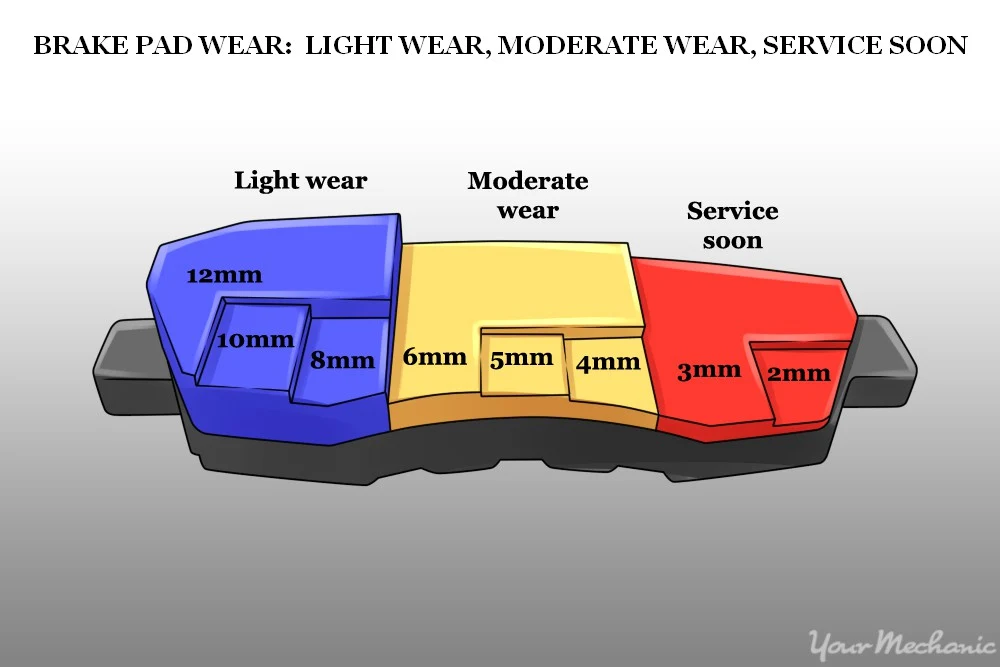
Most new brake pads have linings that are 10-12/32" thick. All of my cars have the factory pads except my 2005 Bonneville. It has the old iron single piston calipers. The others all have over 180K miles on the original pads with modern cast aluminum calipers.
Hard to believe how politicians made bumper supports part of a State inspection. We don't have rust here and our inspections were $7 max State regulated before nixed.
Who does the maintenance on the car? It should have the brake lining inspected at every service. They should last dozens of oil change intervals so it's odd it snuck up on you. Relying on the State doesn't work.
Brake pads have not contained asbestos in over 40 years and saying that makes them not last is so incorrect I can't tell if the statement was supposed to be a joke. Front pads on GM half tons routinely go a quarter million miles. On a 1993 truck they last about 30K. Guess what? Gas no longer has lead either.
I haven't had many cars I didn't put at least 100K on and I haven't bought a new car since 1998 ... when I bought two ... the last two new ones. Wife has had the same vehicle (bought used) for almost 19 years so she might get a new one this year ... an actual new one.
Absolutely ZERO reason to replace rotors 95% of the time pads are worn out. That's over the top comment number two or seven. Lost count.
Some brake pad designs require the person putting them on to install the wear indicators onto the pads before the pads are installed. Seeing how sorry the world is I can also see how someone would buy pads for the indicators, take them, then return the pads leaving the next guy with no small parts. I have never seen pads without squeakers but I am sure someone makes them.
I certified in PA, in 1977, as a state qualified inspector. It was an 8 wk course, two nights a week. Inspections are dine by any certified repair shop, dealership, etc...
Body perforation, protrusions (like a bent bumper), glass cracks, and many other criteria BESIDES brakes, suspension, tires and those usual suspects are included. It is a very comprehensive inspection.
Iirc, it was biannual. I left PA in Nov, 1980. Don't know if it's still the same. At the time, PA's process was touted as a model every state should use.
When I came to AZ, I was amazed at the garbage that was allowed on the road.
In 2002, a friend who does tile, was driving his F250 4x4 when the front pads fell out. He continued to drive it, using the the E brake, for months, hauling boxes of tile and tools...


![Pampers Sensitive Baby Wipes, Clinically Proven, Fragrance Free, Unscented, Water Based, Hypoallergenic, Multi-Use, Hand Wipes 336 Wipes Total (6X Flip-Top Packs) [Packaging May Vary]](https://m.media-amazon.com/images/I/41KLBHu9CAL._SL500_.jpg)









 ))).
))).