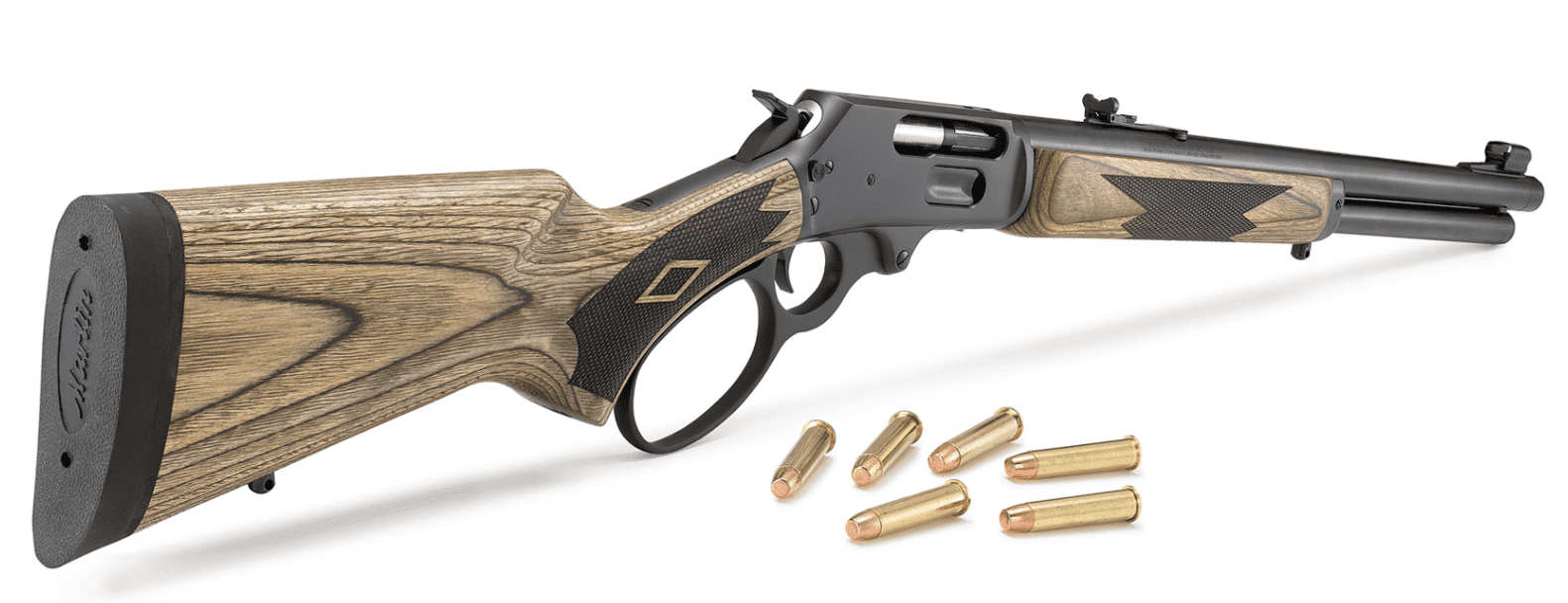
Hyphenated rounds?

Bob Wright

Hawkeye
Joined
Jun 24, 2004
Messages
8,597
City & State/Province
Memphis, TN USA
A gent on another forum stated his choice for "hyphenated rounds." Took me a second or two to get that. What he was referring to, or coourse, was primarily the old black powder rounds introduced by Winchester in the 'Seventies. (Eighteen Seventies!) So far as I know, he coined this expression.

But there is a revival among handgunners to build custom sixshooters, appropriate t these rounds, in .38-40 and as convetibles wkith extr 10 mm or .40 cal cylinders. At my time of life, I'm not about to embark on any such venture.


But sure is interestin'.................


Bob Wright
 
I think, for a lot of younger shooters (and I am counting myself in this group), the hyphenated rounds cause some confusion. Much akin to the .357/.38spc/9mm. I myself have looked into a couple of them, mostly the 45-70. I would love to see this in .45 LC, but they only offer it in 45-70.
1731344381051.png


Yeah, the "hyphenated rounds" are making a comeback, but I do not own any.
 
I ran into a gent whose passion was collecting rifles in obscure chamberings. He had stuff I’d never heard of. Mostly rolling block and levers. Made brass on a lathe, made bullet molds, worked up loads etc.

Fascinating but more work than I’m willing to put out. There are so many facets to our hobby.
 
During the 1800s nearly all cartridges were "hyphenated calibers." The practice at the time was to designate a cartridge by (nominal) caliber, powder charge, and bullet weight. An example was the .45-70-405 Government rifle round. As I recall thee was a Sharps' .50-120-500. This practice soon became obsolete and only the (nominal) caliber and maker/desgner was the designation. This gave us the .44 Remington, .44 Colt, .44 Merwin Hubert. Also the .44 Rimfires as the .44 Henry Flat and .44 Colt and Henry pointed.

I have heard this, but never seen it documented: The original round from Winchester was ".44 Winchester Center Fire" or .44 W.C.F. When Marlin introduced their Model 1894 lever action chambered for that round, they were loathe to put "Winchester" on the barrels oof their rifles, so coined the term ".44-40." Similiar story with Colt which gave us the same cartridge known variously as the ".38 Smith & Wesson Special" and the ".38 Colt Special." Same as .38 S&W and .38 Colt New Police.

All fascinating study!


Bob Wright
 
I think, for a lot of younger shooters (and I am counting myself in this group), the hyphenated rounds cause some confusion. Much akin to the .357/.38spc/9mm. I myself have looked into a couple of them, mostly the 45-70. I would love to see this in .45 LC, but they only offer it in 45-70.
View attachment 58343

Yeah, the "hyphenated rounds" are making a comeback, but I do not own any.
Don't know of its availability, but one version of the Model 1894 Classic was offered in .45 Colt. And several Italian made carbnes are in .45 Colt. Bring money!

Bob Wright
 
Reminds me of the .25-45 Sharps that hit the market a few years ago. IIRC, it's just the .223/5.56 case necked up to 25 caliber, with no other changes. Looked like it might be a fun cartridge to reload & shoot, but I never saw a barrel for sale that would fit my budget (if anyone has one sitting in a closet gathering dust, please let me know ;^). It never got very popular, probably because of the "hyphenated" name (and folks associate "Sharps" with big-bore cartridges); guessing if they had called it the 6.35mm Creedmoor or 6.35mm Fury instead, they might have sold millions!
:)

1731358884269.jpeg
 
Last edited:
Imagine being 40 or 50 years old or older when the fully contained cartridges started coming on the scene.

Likely a lot like today, some scoffing, saying they'll never stand the test of time, some embracing the new stuff & others not really caring, likely because they didn't understand it. Having all the ingredients named for the cartridge had to help some with the transition.

On the other side of the coin, cartridge designations can be confusing to many. I was looking at an earlier 1894 Winchester in a gun shop one day. I pointed to the chamber designation on the barrel which said 30 WCF & asked the young clerk if he could get ammo for it. Well, not known to me the hangers on at the shop had had him spending hours looking for ammo for it when he finally realized it was 30-30. Seems he'd been the but of a joke for 2 days & I nearly got an ear full. Maybe ya had to be there, but I've chuckled a bit writing it.

Now,,, a new era is coming, Hardened case heads mated with brass bodies, & pressures/velocities unlike ever before. Wonder how the will designate those.
 
... I pointed to the chamber designation on the barrel which said 30 WCF & asked the young clerk if he could get ammo for it... he finally realized it was 30-30...

Now,,, a new era is coming, Hardened case heads mated with brass bodies, & pressures/velocities unlike ever before. Wonder how the will designate those.

Formal or official cartridge names seem to get ignored from time to time. @JohnL mentioned .30-40 a few posts back; if I remember things right, the official name was something like ".30 US Army", which was abbreviated on some barrels as ".30 USA" (but obviously, just about everyone calls it .30-40, which works fine for communication purposes). Another one IIRC is the world-famous ".375 Belted Rimless Magnum Nitro Express" - I've been tempted to ask for a box of that ammo somewhere, just to see what happens (but I guess I shouldn't go out of my way to irritate other folks ;^).

As for the new high-tech cartridges with the multi-piece cases and ultra-high operating pressures, I mostly designate them as "unaffordium", but that's just me. As always IMHO, FWIW, YMMV, etc...
 
I have a .375-338Win. Mag also known as the .375 Taylor and .375 Chattfield-Taylor after its designer Robert Chatfield-Taylor. He wanted .375 H&H power in a lighter weight rifle. Mine is on a Ruger M77 tang safety model and sits in a Ramline stock. The rifle is amazingly accurate and the ES for 270 and 300 gr. bullets is 5 and 6 FPS. I forget which was which The only drawback is that 7.5 pound monster kicks like a very angry mule. I had the rifle built for an elk hunt in very steep dark wooded territory.
Paul B.
 
The only gun I've owned that used a "hyphenated round" was an old S&W DA Revolver in 32-20 (marked 32 WCF). It was also one of the most useless guns I've ever had...Too powerful for hunting rabbits, too weak for anything much bigger, way too much noise and blast for the power it actually had, and the ammo itself was expensive...other than that, I liked it fine. LOL.

DGW
 
Last edited:
I think, for a lot of younger shooters (and I am counting myself in this group), the hyphenated rounds cause some confusion. Much akin to the .357/.38spc/9mm. I myself have looked into a couple of them, mostly the 45-70. I would love to see this in .45 LC, but they only offer it in 45-70.
View attachment 58343

Yeah, the "hyphenated rounds" are making a comeback, but I do not own any.
If you are looking for a .45 LC carbine, I can recommend the Henry. I have one and it’s a sweet, lightweight carbine.

1731437153727.jpeg
 
.32-20 is my favorite.......................

32-20 got me into reloading. When I inherited my Great Grandpa's Colt Army Special (mfg. 1921) & 8 vintage rounds, I realized that if I wanted to shoot it, I'd best be rolling my own. That led me down an enjoyable rabbit hole. :D

i;ve often thought a Three Screw Flat Top medium frame Blackhawk, or Colt new Frontier, in .32-20 ahnd having a 7 1/2" barrel would be a dandy varmint revolver.
Colt from 1904 originally issued to my Great Great Grandfather as a Texas Ranger ... .32WCF (.32-20WIN).

Colt-32-WCF.jpg
 
"I have heard this, but never seen it documented: The original round from Winchester was ".44 Winchester Center Fire" or .44 W.C.F."


Bob,
At first W.C.F. stood for Winchester CENTRAL Fire. My 1897 Sears and Robuck list them that way.

"Don't know of its availability, but one version of the Model 1894 Classic was offered in .45 Colt. And several Italian made carbines are in .45 Colt. Bring money!"

I have a Marlin 1894 Cowboy 45 and a Uberti 1866 in 45 both are fine rifles. There are many of both on the used market. Many have been slicked up along with short stroke kits and springs added which makes them better than new ones.

Also, the 45 Colts was not ever meant to be a rifle round until Cowboy Action came along. That is when Marlin and the Italians started producing rifles in 45 Colts.
The rims on the early 45 was too small for extraction in rifles. The rim was made small to fit 6 rounds in the small diameter cylinder of the 45 SAA. I have also read that the 45 Colt cartridge had a patent on it same as the SAA. Also, the straight wall case was not all that great with black powder in a rifle due to the blow by. I will not shoot BP in my 45 rifles that is what the 44-40 is for

And just for fun explain the reason the 38-40 doesn't go by the nomenclature of the others.
Since it is 40Cal. rather than 38
 
"I have heard this, but never seen it documented: The original round from Winchester was ".44 Winchester Center Fire" or .44 W.C.F."


Bob,
At first W.C.F. stood for Winchester CENTRAL Fire. My 1897 Sears and Robuck list them that way.

"Don't know of its availability, but one version of the Model 1894 Classic was offered in .45 Colt. And several Italian made carbines are in .45 Colt. Bring money!"

I have a Marlin 1894 Cowboy 45 and a Uberti 1866 in 45 both are fine rifles. There are many of both on the used market. Many have been slicked up along with short stroke kits and springs added which makes them better than new ones.

Also, the 45 Colts was not ever meant to be a rifle round until Cowboy Action came along. That is when Marlin and the Italians started producing rifles in 45 Colts.
The rims on the early 45 was too small for extraction in rifles. The rim was made small to fit 6 rounds in the small diameter cylinder of the 45 SAA. I have also read that the 45 Colt cartridge had a patent on it same as the SAA. Also, the straight wall case was not all that great with black powder in a rifle due to the blow by. I will not shoot BP in my 45 rifles that is what the 44-40 is for

And just for fun explain the reason the 38-40 doesn't go by the nomenclature of the others.
Since it is 40Cal. rather than 38
The .44-40 was hailed as for deeer sized game. the .38-40 was pushed, by Winchester advwertising, as a small game rifle. Winchester ad men felt .40 was too similar to the .44, so called it .38 to emphasize it use on smaller game. All in PR men's realm.

And, yes, you are correct. The term of the day was Central Fire.

Bob Wright
 
Not really a need for the 38-40 (38WCF). None of the BP pistol calibers were that great of a large game hunting rifle. That is why Winchester made the 1876 45-75 Centennial and then the 1886 45-70s, and others
I would think that at the time period you were not hunting game as a sport but for survival.
I'm sure you hunted with what you had and didn't much care how the game was killed.
That way of thinking also carried over to the market hunters.
Think about the Indians and their crap bows and spears were not made to kill Buffalows, but they did

The .38-40 Winchester (10.17x33mmR) is actually a .40 caliber (10 mm) intermediate cartridge shooting .401 in (10.2 mm) caliber bullets. The cartridge was introduced by Winchester in 1874 and is derived from their .44-40 Winchester. This cartridge was introduced for rifles, but in its reintroduction for cowboy action shooting it has seen some popularity as a revolver cartridge. It is not particularly well suited to hunting larger game, but it was popular when it was introduced, along with the previous .44-40 Winchester, for deer hunting. It can be used successfully on smaller game animals, and for self-defense.
 

Latest posts

Back
Top