A picture is worth a thousand words

Let me answer a couple of the unnecessary comments here:

The "little extra twist" I gave it was just to hold it tight. Of course it was unnecessary, but there is no way it was enough to break the clamp. It should be impossible for someone to be able to break a C-Clamp twisting it with the supplied lever.

As far as the right tool, I'm not a mechanic by trade, just a DIYer on vehicles when I can. I've done disk and drum brakes on every vehicle I or my family has owned, and compressed the piston on a disk brake caliper probably 60-80 times, always done with a C-Clamp unless it was one of those odd balls that had to be twisted back into place. While I know that there are special tools designed for this, it has never been, and still isn't necessary, as I just grabbed another clamp to finish the job.

Don't recall where I got this particular C-Clamp, but it probably came with some junk tools I've bought at auction a couple of times, or else it was one I picked up from my departed FIL, as he had a penchant for Harbor Freight tools. I only shop Harbor Freight for things like grinding disks, cut-off wheels, or impact sockets. This was the only one like this in my collection of probably 25-30 C-Clamps, and the one I grabbed to replace it finished the other four wheels with no problem.

I was really more interested in hearing if others have had some of the same experiences that I've had regarding my perceived lowering of the quality of hardware in general.
 
Let me answer a couple of the unnecessary comments here:

The "little extra twist" I gave it was just to hold it tight. Of course it was unnecessary, but there is no way it was enough to break the clamp. It should be impossible for someone to be able to break a C-Clamp twisting it with the supplied lever.

As far as the right tool, I'm not a mechanic by trade, just a DIYer on vehicles when I can. I've done disk and drum brakes on every vehicle I or my family has owned, and compressed the piston on a disk brake caliper probably 60-80 times, always done with a C-Clamp unless it was one of those odd balls that had to be twisted back into place. While I know that there are special tools designed for this, it has never been, and still isn't necessary, as I just grabbed another clamp to finish the job.

Don't recall where I got this particular C-Clamp, but it probably came with some junk tools I've bought at auction a couple of times, or else it was one I picked up from my departed FIL, as he had a penchant for Harbor Freight tools. I only shop Harbor Freight for things like grinding disks, cut-off wheels, or impact sockets. This was the only one like this in my collection of probably 25-30 C-Clamps, and the one I grabbed to replace it finished the other four wheels with no problem.

I was really more interested in hearing if others have had some of the same experiences that I've had regarding my perceived lowering of the quality of hardware in general.
I've got one that I clamped a pair of vise grips onto the handle and turned so much that I deformed the clamp, but it didn't snap . . . . . 👍
 
No problems so far, am hoping the snowblower carb that I bought and installed 2 or 3 years ago continues to perform well...... guess we'll see next winter.
I DID buy TWO just in case
:)

J.
The fountain of knowledge from Honda ATV forums has found that high quality rebuild kits on the OEM Japanese carburetors are a better value than the "Chineseium" cheap knockoffs. Hard starting, poor idling, cutout at some rpm range, stuck floats are all commonplace.
You've got all summer to get it right.
Just sayin'
 
View attachment 108261


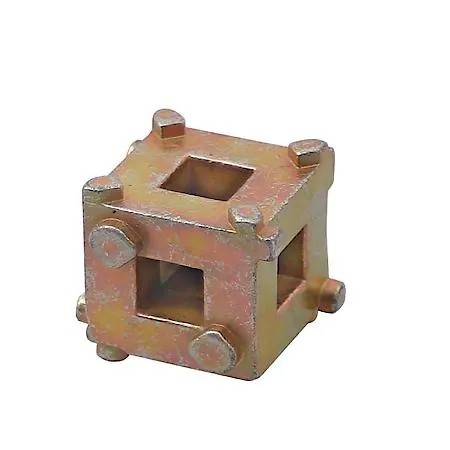
Just trying to compress the caliper piston on my wife's car this weekend. Got it all the way in and put a little bit more pressure on it and the clamp just popped apart.

Been moaning about Chinese hardware for a while now, finding a lot more screws and nuts not going together or twisting off with very little torque. Anyone else been seeing this?
The modern vehicles' with electronic parking brake releases MUST be disabled with a specific scan tool.
Ask me how I know.. big sorry honey, instead of doing your brakes in the driveway, I'm loading your partially dismantled car on the flatbed tow truck. Badwordbadwordbadword
 
As an Amazon Associate we earn from qualifying purchases. Product prices and availability are accurate as of the date/time indicated and are subject to change.
Buying expensive tools works better if you have a one person, in shop type operation.
Around my place, there are 3-4 people digging, pawing, and scattering over several hundred acres. I do try to keep a 'good' set of wrenches in the new shop building.
 
The modern vehicles' with electronic parking brake releases MUST be disabled with a specific scan tool.
Ask me how I know.. big sorry honey, instead of doing your brakes in the driveway, I'm loading your partially dismantled car on the flatbed tow truck. Badwordbadwordbadword
This was a 2020 Escape, so I did have the electronic parking brake disengaged. If you don't you can't depress the caliper at all. This one was all the way depressed when the clamp snapped.
Why does anyone want "electronic parking brakes"?
Most of us don't "want" electronic parking brakes, but in newer vehicles, which I like to get for my wife, you don't really have an option on what type of parking brake you get. Like just about everyone with an automatic transmission, we never use the parking brake. Although I'll admit that a brake run by an actuator right on the caliper is much less likely to become solidly corroded like a cable-run system and become completely unusable.
 
Like just about everyone with an automatic transmission, we never use the parking brake.

If you ask a transmission guy, that's about as silly as you can get.

Although I'll admit that a brake run by an actuator right on the caliper is much less likely to become solidly corroded like a cable-run system and become completely unusable.

I've never had a brake cable corrode to that point but I'd worry about electrical failures disabling your brakes.
 
Last edited:
The pistons in a brake caliper are supposed to knock back a little with the rotation of the rotor, every time you let off the pedal and release the pressure. There's not supposed to be enough resistance that you need a clamp at all. Most of the resistance is supposed to be from pushing the fluid down the little tube and back into the reservoir. The worst Chinese clamp should be more than enough. If that wasn't a bad casting that failed on about the first use, it's probably a good indication that you have enough rust on the piston or in the bore to prevent the caliper from working correctly. Maybe bleed that one and see how much milky brown fluid comes out before it runs clean.
 
Buying expensive tools works better if you have a one person, in shop type operation.
Around my place, there are 3-4 people digging, pawing, and scattering over several hundred acres. I do try to keep a 'good' set of wrenches in the new shop building.
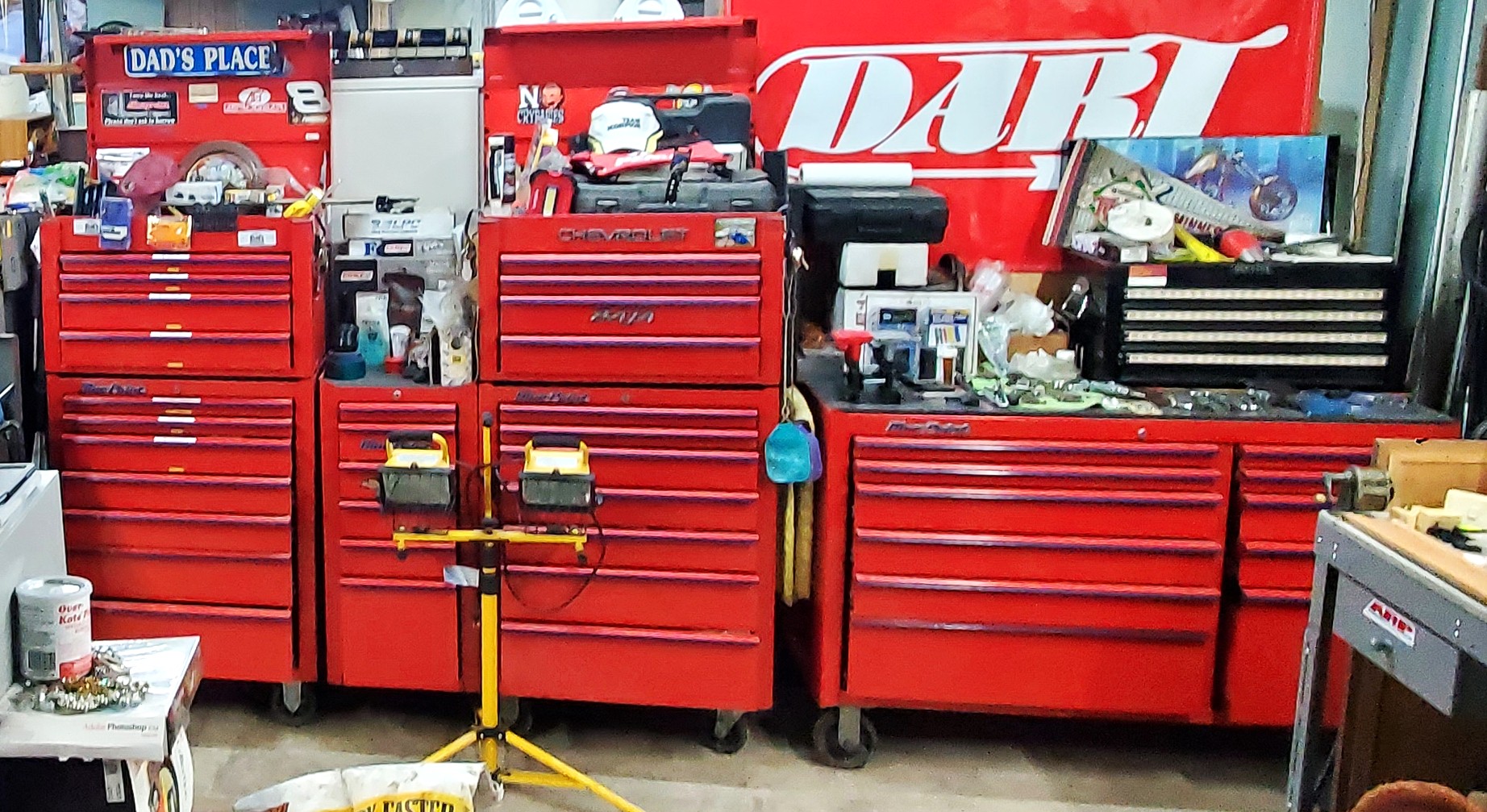
Quality before quantity, some of the Snap-on tools in these boxes are from c.1940's, which my son inherited from my father who was a diesel mechanic. They still look almost like brand new and work like just fine . . . . . oh ya, don't even think of borrowing anything from these boxes. There are others in the shop you can borrow, but none of these ☠️

Now that I think of it, it's time to open each drawer and take photos for insurance purposes, just in case.... lots of $$$$$ there 😱

1783453235956.jpeg
 
Last edited:
If you ask a transmission guy, that's about as silly as you can get.
Well, I've been driving for more than 45 years, most of that time with an automatic transmission, and I've also known a few other people who were also drivers through the years, and I'll stand by my statement that by far most drivers of automatic transmissions never use their parking brake. Maybe transmission guys do, but that is a pretty small percentage of drivers. And if that is the silliest thing you've heard, you have led a very sheltered life.
I've never had a brake cable corrode to that point but I'd worry about electrical failures disabling your brakes.
Most of the vehicles I purchase for my own use are 10-15 years old when I get them, and 20-25 years old when I get rid of them. If they are a stick shift I always ensure that the parking brake is working when I get them, and since I use them regularly they continue to work fine. But I don't even check the parking brake on used trucks with a auto transmission, as I have done on the past and they stick, making the truck undrivable until someone takes it apart to release the brake. And if the actuator for the parking brake stopped working, it would either be stuck like a normal parking brake might, or you wouldn't have a parking brake. It wouldn't just render your brakes inoperable.
 
The pistons in a brake caliper are supposed to knock back a little with the rotation of the rotor, every time you let off the pedal and release the pressure. There's not supposed to be enough resistance that you need a clamp at all. Most of the resistance is supposed to be from pushing the fluid down the little tube and back into the reservoir. The worst Chinese clamp should be more than enough. If that wasn't a bad casting that failed on about the first use, it's probably a good indication that you have enough rust on the piston or in the bore to prevent the caliper from working correctly. Maybe bleed that one and see how much milky brown fluid comes out before it runs
This was in a 6-year-old car with barely 60K miles on it. The calipers and brake fluid still look close to new. The piston was easy to compress back into the caliper, just at the end I tightened the clamp a little and that's when the clamp came apart. I just thought it made a good picture with "China" prominently displayed on a broken C-Clamp.
 
That's just about as silly as not using your parking brake. Brake fluid is hygroscopic and should be replaced every year.
While I've replaced brake fluid before, it was always based on condition, not age.

Quick poll- Everyone else reading this, reply with a yes or no, do you actually replace your brake fluid every year? Or even every two years as the standard seems to be?
 
Quick poll- Everyone else reading this, reply with a yes or no, do you actually replace your brake fluid every year?

Many people think that Mohammed is a prophet, that doesn't make them right.

When I did sporty car things, I flushed my brakes every time that I changed pads which was four or five times a year. Now, I'm old so I pay my mechanic to do it during my annual inspection.
 
While I've replaced brake fluid before, it was always based on condition, not age.

Quick poll- Everyone else reading this, reply with a yes or no, do you actually replace your brake fluid every year? Or even every two years as the standard seems to be?
OF COURSE NOT....
I bought a 1962 Corvette (fuelie) NEW; and the first time I changed the brake fluid was
1989 when it had about 90,000 miles on it (and I was 'repairing' one stuck wheel cylinder). Our 2009 Subaru and 2016 Camry get the brake fluid changed every 10 - 12 years.
I'm no expert, but I've always believed that the b.s. about changing brake fluid is one
of the most brilliant strategies to get the masses into their service centers (where they then get their pants pulled down in short order).
IMHO of course.... there is NO knowledge here
J.
 
Quality tools???
Lately, I'm a fan of 'usually good enough'. Grandson is a 'use 'em and lose 'em' sort of operator so quality has given way to quantity. o_O
I used to work with a guy in the GE Lighting System Lab. Over a five year period, he lost every tool in a three tier Craftsman Tool Set twice. Wherever he used a tool, that is where he left the tools. He talked a B.S. story of how "skilled" he was in his work but after he moved from NC to Seattle we had to retest some of the lighting fixtrues he tested and found that most of his data was bogus. Those failures were across the spectrum of his testing expertise, thermal tests, photometric tests.
 
Unfortunately that's easier said than done. Some of the best name brands are now chinese made -- and not just tools. President Trump is trying to bring back American manufacturing; like him or not, that's a good thing.
I grew up near Utica, NY in the 50s. Everybody used decent tools from Utica Drop Forge, now long gone. I still use some of their stuff.
 
I grew up near Utica, NY in the 50s. Everybody used decent tools from Utica Drop Forge, now long gone. I still use some of their stuff.
I have a few Utica hand tools. They are very well made out of real tool steel. My side cutter has no chips after a lifetime of use. My needle nosed pliers are still straight and they still close flush at the tip. They may not look fancy but they are eminently serviceable given a minimum of care.
 
While I've replaced brake fluid before, it was always based on condition, not age.

Quick poll- Everyone else reading this, reply with a yes or no, do you actually replace your brake fluid every year? Or even every two years as the standard seems to be?
Been in the automotive industry my whole life. I only flush brake fluid when it fails the visual inspection.

My maintenance schedule:

Engine oil- by miles. 3k for non-synthetic, 5K for synthetic.

Differential and transfer case fluid- 60k unless towing, then rear diff 24k.

Transmission- 60k unless visual inspection/smell warrants earlier service. I always flush the transmission.

Coolant- when required by testing the protection temp, or 100k.

Brake fluid- when it fails visual inspection.

I never use the engine oil life reminder.
 
Back
Top