Ruger Harrier

The Harrier is just another example of Ruger correcting their list pricing structures, they knew they had priced themselves out of the AR market over the last few years by ever increasing their MSRP’s. This is another example of introducing a “new & improved” model at a much lower MSRP…

Ruger trying to stay relevant in a firearms market with ever increasing quality lower priced imports.
 
As an Amazon Associate we earn from qualifying purchases. Product prices and availability are accurate as of the date/time indicated and are subject to change.
The Harrier is just another example of Ruger correcting their list pricing structures, they knew they had priced themselves out of the AR market over the last few years by ever increasing their MSRP’s. This is another example of introducing a “new & improved” model at a much lower MSRP…

Ruger trying to stay relevant in a firearms market with ever increasing quality lower priced imports.
How many on the Forum own a Daniel Defense AR (one of the most "upscale pricey ARs). I just checked my distributor pricing on AR-style rifles 89 of 198 entries were priced below $700 wholesale. About half of the 89 were priced around $550. That said Ruger doesn't want to be at the 550 level but half of the market is at entry level of 700. Most folks I know want to build on a base rifle to their expectations.
 
A lot of those lowest priced ones are plastic lowers, with hypoint's unique zink alloy entry aimed for the bottom. "Bleah!" as snoopy says.

Everyone has their own preferences, but my favorite AR15 lowers are the (now out of production) Cav15 Mk2 polymer lowers made by Cavalry Arms, and later on by GWACS. Bought my first one back in 2003, when ArmaLite was selling them with the 'Eagle Arms / ArmaLite' name on them, and have also built rifles using identical polymer lowers labeled Sabre Defence, GWACS & Cav Arms. Hard to find anymore, because the "What Would Stoner Do" series made them very popular and extremely pricey (stripped lowers selling for $200-$300 each). KE Arms is currently selling their 'updated' KP-15 version (also available as the Wraithworks WARP-15) for under $100 ($25-$35 on GunBroker, for stripped Wraithworks lowers), but I personally prefer the originals. No better way to build a light weight AR15 at a reasonable price!

As always IMHO, FWIW, YMMV, one size never fits all, etc., etc.
:)
 
The Harrier is just another example of Ruger correcting their list pricing structures, they knew they had priced themselves out of the AR market over the last few years by ever increasing their MSRP’s. This is another example of introducing a “new & improved” model at a much lower MSRP…

Ruger trying to stay relevant in a firearms market with ever increasing quality lower priced imports.

That's one way to upstart sales again... Introduce a clone that is little changed from the previous series, put a different name on it, and put an entry level price on it.
I'm curious if there are really any "re-engineered" changes with its operation or even receiver/action components from the AR series. Or is it just a different free float handguard, longer rail, different buttstock and Mini-14 style muzzle brake?
Also curious as to how the Harrier may be different in the upper/lower barreled action/operation from Anderson offerings.
Chet15
 
...
I'm curious if there are really any "re-engineered" changes with its operation or even receiver/action components from the AR series. Or is it just a different free float handguard, longer rail, different buttstock and Mini-14 style muzzle brake?
Also curious as to how the Harrier may be different in the upper/lower barreled action/operation from Anderson offerings.
Chet15

I doubt that there were any major "re-engineered" changes. However, having your design crew make a lot of small changes that most customers wouldn't even notice, can add up to substantial cost savings. For example, a firearms company might swap from 4150 to 4140 steel barrels, from Carpenter 158 to 9310 steel bolts, and from 7075 to 6061 for aluminum components. Component testing and finish specs can also be changed. Since even the most well-known AR15 manufacturers (including ArmaLite, Colt and FN ;^) out-source many of their components, it might be as simple as updating a contract or changing suppliers.

In my experience, Anderson produced quality products at reasonable prices. Over the course of many years, I used more Anderson receivers (upper and lower) than most folks, and only encountered one minor issue: a single magwell that was just slightly too tight for one brand of 9mm mag adapter (and I've seen thar exact same issue with lowers from other companies as well). IIRC, Ruger planned to retain some of the Anderson employees, and may have taken advantage of their knowledge and experience (as well as the Anderson facilities) when developing the Harrier...
:)
 
Last edited:
While I am not looking for another AR, as I have a Colt, I saw this. Anyone buy one yet?

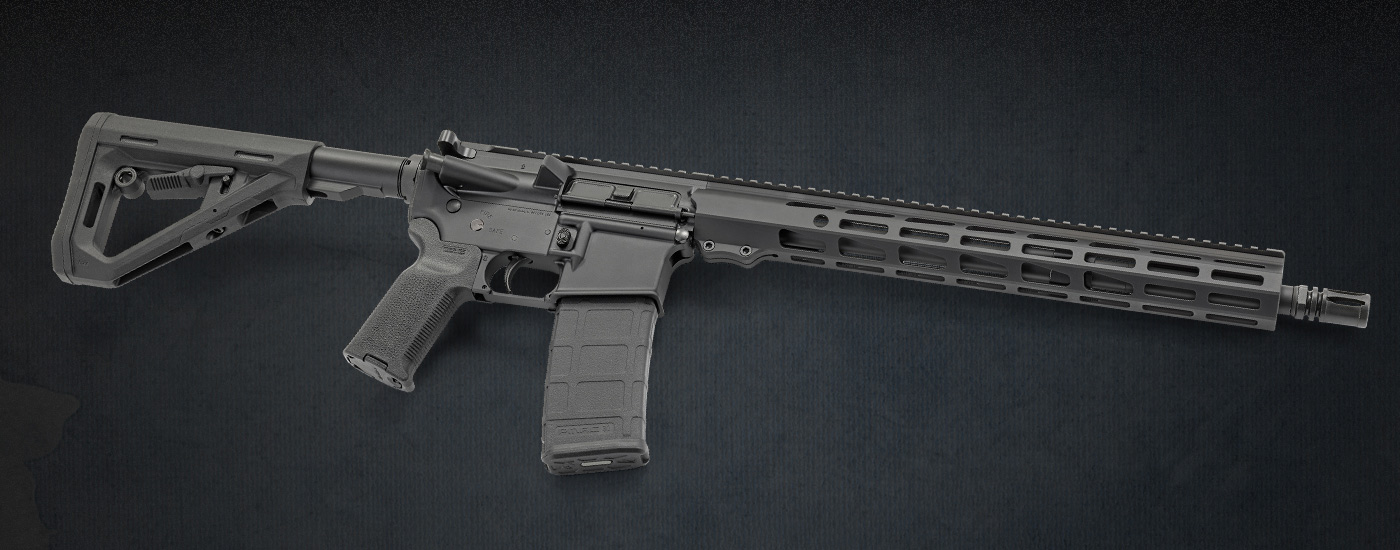
Ruger Harrier rifles are a completely re-engineered line of modern sporting rifles (MSRs) that represent the latest evolution in AR-pattern firearms. While the two initial Harrier rifle offerings differ in configuration to meet varying shooter preferences, both models are chambered in 5.56 NATO and feature a rigid, free-floated handguard with M-LOK® accessory slots, a threaded, 16.10" government profile barrel and upper and lower receivers machined to mil-spec dimensions from 7075 forgings. Manufactured at Ruger's Hebron, Kentucky factory, Harrier rifles are designed to deliver superior fit, function and aftermarket compatibility.

IMG_1925.jpeg
 
I see little obvious differences or improvements between the AR556 and this Harrier, other than a conventional forearm/shroud/handguard being replaced with a free-floated handguard with attachment points for an array of mall-Ninja accessories. Both types have been available from many manufacturers for quite some time. It would seem the free-floated design must have become the favorite of many folks, seein' Ruger has decided to divorce themselves from the conventional M4-style handguard. They did the same thing in designing their SFAR. I cannot tell anybody what their preferences should be, but I still prefer the old school handguard with the front sight permanently mounted to the barrel. I don't yet know how much I trust a front sight that is attached to a free-floated handguard.
 
It's very interesting. I'm looking into Appleseed Known Distance shooting possibly in the fall. This is one of the "suspects" for a KD rifle.
 
I'm not beating on the new product and I do see a couple of 'plus' features. Otherwise it's not significantly different than many other generic AR's.
I have numerous 'Anderson' AR bits/pieces/complete rifles and really don't see any problems with the 'brand name' other than they don't carry the status symbol 'see what I got' following.

regarding the comments about 'polymer AR lowers:
My experiences with 'polymer' AR lowers have been generally favorable although I wouldn't make a blanket statement that they're suitable for ALL applications--I would hesitate to use a polymer lower for the 'heavy caliber uppers, uppers with extremely heavy barrels, or actual combat use. The polymer can flex or break when subjected to high stresses--I wouldn't use one for a prybar or club and likely not a good choice for a pistol caliber upper. The polymer lowers have handled both high and low temperatures w/o failing-- I've been carrying one behind the seat of my farm pickup for over 2 years with 100% functionality.
 
I see little obvious differences or improvements between the AR556 and this Harrier, other than a conventional forearm/shroud/handguard being replaced with a free-floated handguard with attachment points for an array of mall-Ninja accessories. Both types have been available from many manufacturers for quite some time. It would seem the free-floated design must have become the favorite of many folks, seein' Ruger has decided to divorce themselves from the conventional M4-style handguard. They did the same thing in designing their SFAR. I cannot tell anybody what their preferences should be, but I still prefer the old school handguard with the front sight permanently mounted to the barrel. I don't yet know how much I trust a front sight that is attached to a free-floated handguard.
I have had no issues with this but I will say that most ARs that I have shot end up using red dots or optics of some sort. If you're in guard is installed correctly then you should have no issues with it.
I was an Anderson dealer for a number of years, I never had any problems with any of their products. I still have one in my inventory which is a 7.62x39.
 
Wondering here if the Ruger AR was, or mostly was Anderson all along, with Ruger actually messing that up by going with a non mil spec gas block & delta ring. That just didn't make sense, & now that seems to have changed.

Either or, if ya plan to burn one down, it's price point is good for that. Or most, if wise, will run a few mags through one to confirm short term reliability before setting it behind the bedroom door. Only, maybe, to be played with later, & they should be good for that. Otherwise, a pro will seek another brand altogether.
 
I had a couple of Andersons over the years and they were as good as any other AR from the same price point. Nary a problem with either.
 
^^this
At one time (before the AWB), I had an FFL and was buying AR lowers 10-12 at a time. Most of those were completed using whatever mil-spec LPK was cheapest and re-sold through my shop as complete rifles at very reasonable prices. I don't remember having any significant issues with fit or function of the Anderson/mil-spec combination other than the usual crunch and grind trigger pull.
 
I saw the two new Harrier models at a gunshop I frequent. The guns looked nice and retail was until $600.00 for either model. 599/579 if i recall correctly depending on model. Serial numbering based on looking on Ruger.com begin at 2860-02001 so there a couple of two digit guns 2860-020XX for sale.

Quality looked about the same as the AR556, unfortunately, I am not a serious AR guy so couldn’t tell you the differences between the old and new Ruger offerings or if they basically rebranded the Anderson units.
 
...regarding the comments about 'polymer AR lowers:
My experiences with 'polymer' AR lowers have been generally favorable although I wouldn't make a blanket statement that they're suitable for ALL applications-... The polymer can flex or break when subjected to high stresses--I wouldn't use one for a prybar or club and likely not a good choice for a pistol caliber upper...
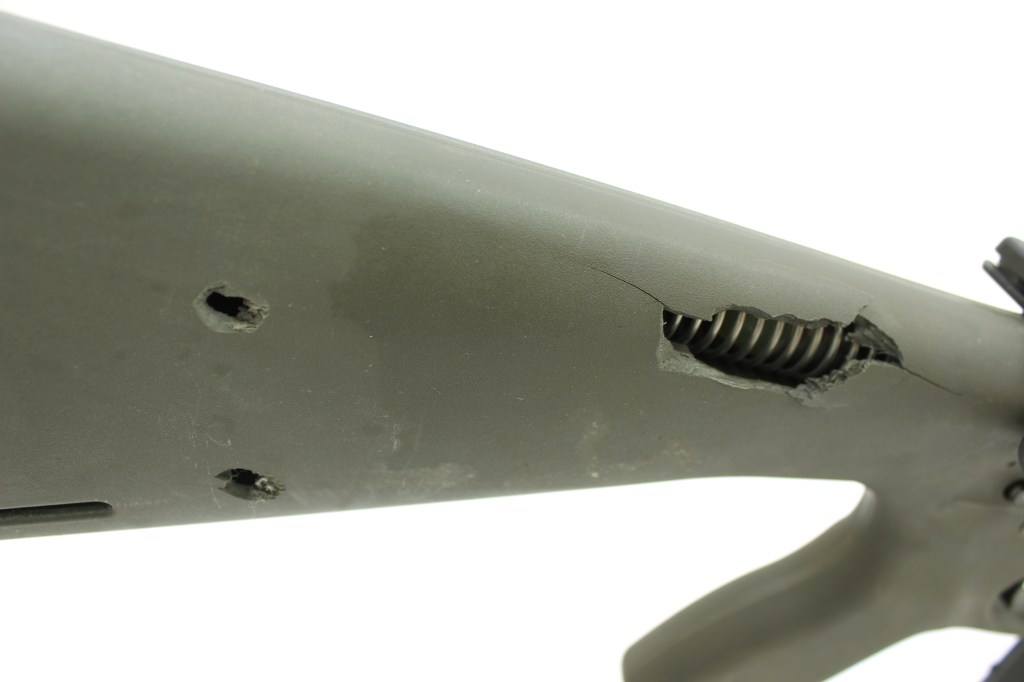
A little "flex" isn't always a bad thing; in some circumstances, monolithic polymer lowers may do better than mil-spec aluminum receivers. Here's a case where a couple of ARs (one monolithic polymer, one mil-spec aluminum) got run over by a truck - the rifle with the polymer lower continued to function, but the mil-spec rifle was DOA:

https://sinistralrifleman.com/2012/04/06/cav-15-polymer-lower-receivers/

And FWIW here's an "abuse test" where they shot a polymer lower full of holes (obviously, a mil-spec buffer tube wouldn't likely function with that kind of damage):

https://sinistralrifleman.com/2014/03/18/gwacs-armory-cav-15-mkii-abuse-test/

1000002316.jpg


A gunsmith I respect said he didn't like the CAV15 receivers for target rifles, because receiver flex could theoretically alter the relative positions of the hammer and trigger (but a 'cassette'-type trigger/FCG might address that concern). To each his own...

As always IMHO, FWIW, YMMV, one size never fits all, etc., etc.
:-)
 
Last edited:

Latest posts

Back
Top